
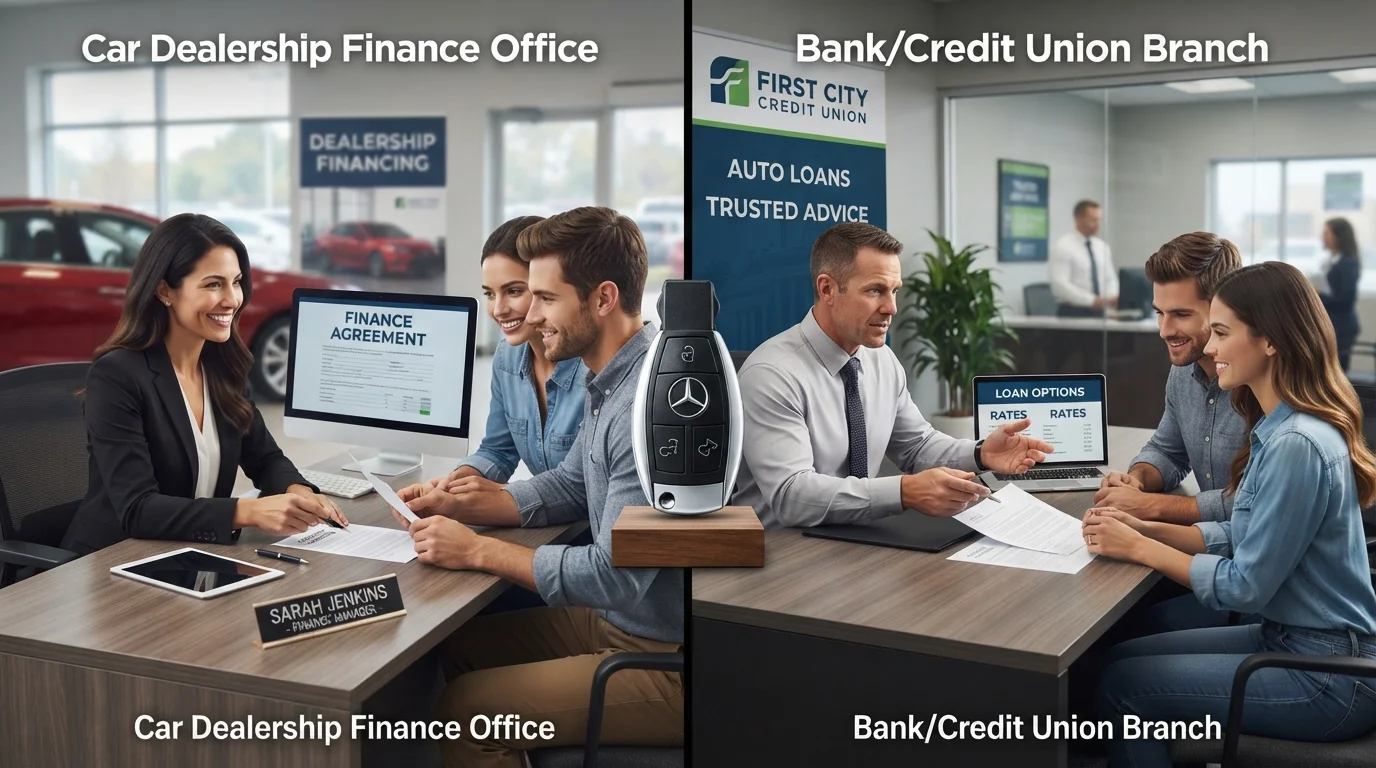
How Each Financing Route Actually Works
Understanding the mechanics of each path helps you see where your interests and the lender's interests may or may not align.
Dealer financing is technically indirect lending. The dealership's finance and insurance (F&I) office collects your application and submits it to one or more wholesale lenders — often banks or captive finance companies tied to the manufacturer. The lender sets a buy rate (the base rate they'll accept), and the dealer typically has latitude to mark that rate up before presenting it to you. The difference, called the dealer reserve, is additional compensation for the dealer. This arrangement is legal and common, but it means the rate you're quoted may not be the lowest rate you qualified for.
Bank and credit union loans work as direct lending. You apply to the institution, receive an approval at a fixed APR, and bring that commitment to the dealership. Credit unions — member-owned, nonprofit cooperatives — historically post lower average auto loan rates than commercial banks, according to data published by the National Credit Union Administration. Banks offer broad accessibility and often streamlined digital applications. Either way, the rate you receive is the rate you pay; there is no intermediary earning a markup.
For a broader look at how loan structures differ by vehicle type, see our comparison of new vs. used car loan terms.
| Criterion | Dealer Financing | Bank or Credit Union Loan |
|---|---|---|
| How the rate is set | Lender buy rate + possible dealer markup | Direct rate from institution, no markup layer |
| Typical APR competitiveness | Varies; promotional rates can be lowest available | Credit unions often below-market; banks competitive |
| Application process | Single application at point of sale | Apply before shopping; pre-approval letter in hand |
| Negotiating leverage on price | Limited — price and finance often bundled | Strong — separates vehicle price from loan terms |
| Promotional rate availability | Yes, via manufacturer captive lenders | No manufacturer subsidies available |
| Speed of approval | Fast; often same-day at the dealership | Varies; some credit unions take 1–2 business days |
| Credit flexibility | Depends on lender pool used by dealer | Credit unions often more flexible for imperfect credit |
Rate Structures, Incentives, and Where Costs Hide
APR is the most important single figure to compare, but it doesn't tell the whole story on its own. Lining up loan offers on equal terms requires looking at total interest paid over the loan's life, not just the monthly payment.
~1–2%
Typical APR advantage of credit unions over banks
National Credit Union Administration data has historically shown credit union auto loan rates averaging meaningfully below commercial bank rates, though individual results vary by credit profile.
~80%
New-vehicle loans arranged through dealerships
Federal Reserve research has indicated that a large majority of new-vehicle purchases are financed at the dealership, underscoring how dominant indirect lending is in the auto market.
0%–1.9%
Promotional APR range on qualifying new vehicles
Manufacturer captive lenders periodically offer deeply subsidized rates to qualified buyers, typically requiring prime or super-prime credit scores and limited to specific models.
Dealer financing becomes genuinely competitive in one scenario: manufacturer-subsidized promotional rates. When an automaker's captive lender offers, say, 0% or 1.9% APR on specific models to move inventory, those rates are often impossible to beat externally. However, they typically require top-tier credit scores (often 700+), apply only to certain trims or model years, and may be mutually exclusive with a cash rebate. Our article on choosing between a cash rebate and a low-APR offer walks through how to calculate which actually saves you more.
Outside of promotional deals, independent research consistently shows that pre-shopping rates gives buyers negotiating leverage. If a dealer knows you already hold a 6.5% pre-approval, they have a concrete number to beat — or match. That competitive pressure benefits you. Without a benchmark, you're evaluating the dealer's offer in isolation.
One nuance worth noting: some dealers offer rate-match or rate-beat programs, particularly at volume dealerships. These are worth exploring, but confirm the full loan terms — rate, length, and any add-on products — before signing. For context on rate structures more broadly, see the Rates & Payments hub.
This article is for general informational and educational purposes only. It does not constitute personalized financial or legal advice. Consult a qualified financial professional before making decisions specific to your circumstances.