
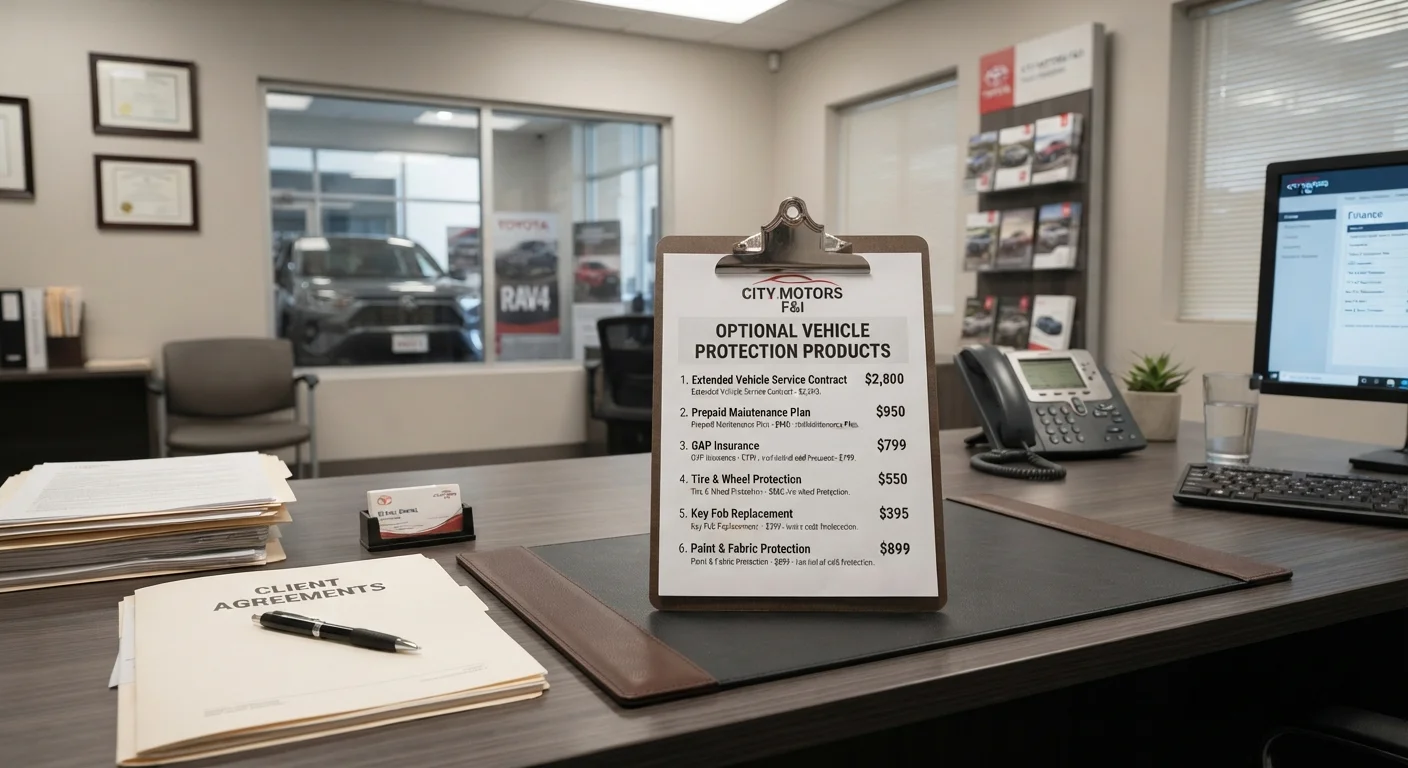
How the Finance Office Works
Once you've agreed on a vehicle price, you'll typically meet with a finance and insurance (F&I) manager. Their job is to finalize your financing — and to present a menu of optional products. This is where dealers generate substantial back-end profit, as explained in our piece on how dealers actually make money on a car sale.
Products are often presented quickly, folded into monthly payment figures rather than total costs, and bundled in ways that make individual pricing hard to assess. Understanding what each product actually covers — before you walk in — is the most effective defense against overpaying.
You Can Say No to Any Add-On
No federal or state law requires you to purchase F&I products as a condition of buying a vehicle. Some loan agreements may require gap coverage, but that requirement comes from the lender, not the dealer. If a finance manager implies otherwise, ask to see the specific requirement in writing. Reviewing which fees and charges are actually negotiable can help you separate mandatory costs from optional ones before you sit down.
Add-Ons That Can Carry Genuine Value
Not every dealer extra is a waste of money. A few products address real financial risks worth considering:
Gap insurance covers a real, quantifiable financial risk
If your car is totaled and you owe more than its market value, gap coverage prevents you from being left paying off a loan for a vehicle you no longer have. It's particularly relevant on long-term loans or low-down-payment deals.
Factory-backed extended warranties offer predictable repair costs
Manufacturer-issued service contracts tend to have clearer terms and fewer exclusions than third-party plans, making repair budgeting more reliable for buyers who keep vehicles long-term.
Some protection products have legitimate applications
Paint protection film applied professionally can prevent stone-chip damage on vehicles driven in harsh conditions — the issue is pricing, not the concept itself.
Gap insurance (Guaranteed Asset Protection) covers the difference between what you owe on a loan and what your insurer pays if the car is totaled. It's most relevant if you financed with a small down payment or on a long loan term. That said, it's often cheaper through your auto insurer than through the dealer — worth comparing before accepting dealer pricing.
Extended warranties (also called vehicle service contracts) vary widely in coverage and cost. Factory-backed plans from the manufacturer tend to be more straightforward than third-party contracts. If you're keeping a vehicle well past the factory warranty period, a plan with clear exclusions and a reputable administrator can offset repair costs — though you should read the contract carefully. See how dealership service pricing compares in our breakdown of servicing costs at dealers versus independent garages.
Add-Ons That Rarely Justify Their Price
A larger category of dealer extras offers minimal practical benefit relative to what dealers charge for them:
Heavy markups on cosmetic protection products
Dealer-applied paint sealants, fabric protection, and ceramic coatings are typically marked up several hundred percent above retail cost for equivalent products or services available from detailers.
Third-party extended warranties carry significant exclusion risk
Non-manufacturer service contracts often contain lengthy exclusion lists that can leave owners responsible for major repairs they assumed were covered. Contract language deserves careful review before purchase.
Nitrogen tire filling provides negligible real-world benefit
Nitrogen offers marginally more stable pressure in extreme temperature swings, but the practical difference for everyday road driving is minimal — and topping up with regular air negates the benefit entirely.
Add-ons rolled into monthly payments obscure true cost
Presenting a $1,500 product as '$22 a month over 72 months' makes it easier to accept without recognizing the full amount being paid — or the interest being charged on it.
Products often available cheaper outside the dealership
Gap insurance through your auto insurer and extended warranties through credit unions or manufacturers' websites frequently cost less than equivalent dealer-sold versions of the same coverage.
Paint protection film and ceramic coatings have legitimate applications, but dealer-applied versions are frequently marked up 200–400% over what a specialist detailer would charge for equivalent work. Fabric protection spray is another example — it's often a product available retail for a fraction of the dealer cost. Nitrogen tire inflation offers marginal pressure stability compared to regular air and carries no measurable safety benefit for typical road driving.
These products are worth scrutinizing carefully, particularly when presented as already installed or non-removable from the deal. As we note in our guide on dealership fees and what's negotiable, pre-installed extras are a common tactic to make removal feel impossible — it usually isn't.
How to Evaluate Each Product Clearly
A straightforward framework helps cut through the pressure of the F&I office:
- Ask for the price of each item individually, in writing. Never evaluate an add-on as a monthly payment increment.
- Ask what the product covers and what it excludes. Vague answers are a signal to decline.
- Check whether you can buy it elsewhere. Gap insurance, extended warranties, and some protection products can be purchased through insurers, credit unions, or third parties — often at lower cost.
- Ask whether it's already installed. If it is, ask for it to be removed or the price to be deducted. Pre-installation doesn't obligate you to pay.
Be aware that add-on upsells are one of the most consistent ways buyers give back savings they negotiated on the vehicle price — a pattern our article on where buyers give back savings without realising it covers in detail.
~$1,800
Average F&I profit per new vehicle sold
Industry tracking data from NADA (National Automobile Dealers Association) has historically shown F&I back-end profit in this range, reflecting how significant add-on revenue is to dealer margins.
200–400%
Typical markup on dealer paint protection
Independent detailing professionals and consumer advocates commonly cite markup ranges of this magnitude when comparing dealer-installed protection packages against specialist market rates.
Making the Call
You are never obligated to accept any add-on product to complete a vehicle purchase. F&I products are optional, and a dealer cannot legally require them as a condition of sale (though some lenders require gap coverage for certain loan structures — always worth confirming). For a broader look at how these products are structured and what they actually cover, see our in-depth guide on F&I products and how to evaluate them.
The goal isn't to reject everything — it's to make decisions on clear terms, not under time pressure. Research your specific situation beforehand, bring a list of what you're open to considering, and treat each product as a separate purchase decision from the vehicle itself.
This article is for general informational purposes only and does not constitute personalized financial, legal, or insurance advice. Coverage terms, product availability, and pricing vary by provider and region. Consult a licensed insurance agent or financial adviser for guidance specific to your circumstances.