
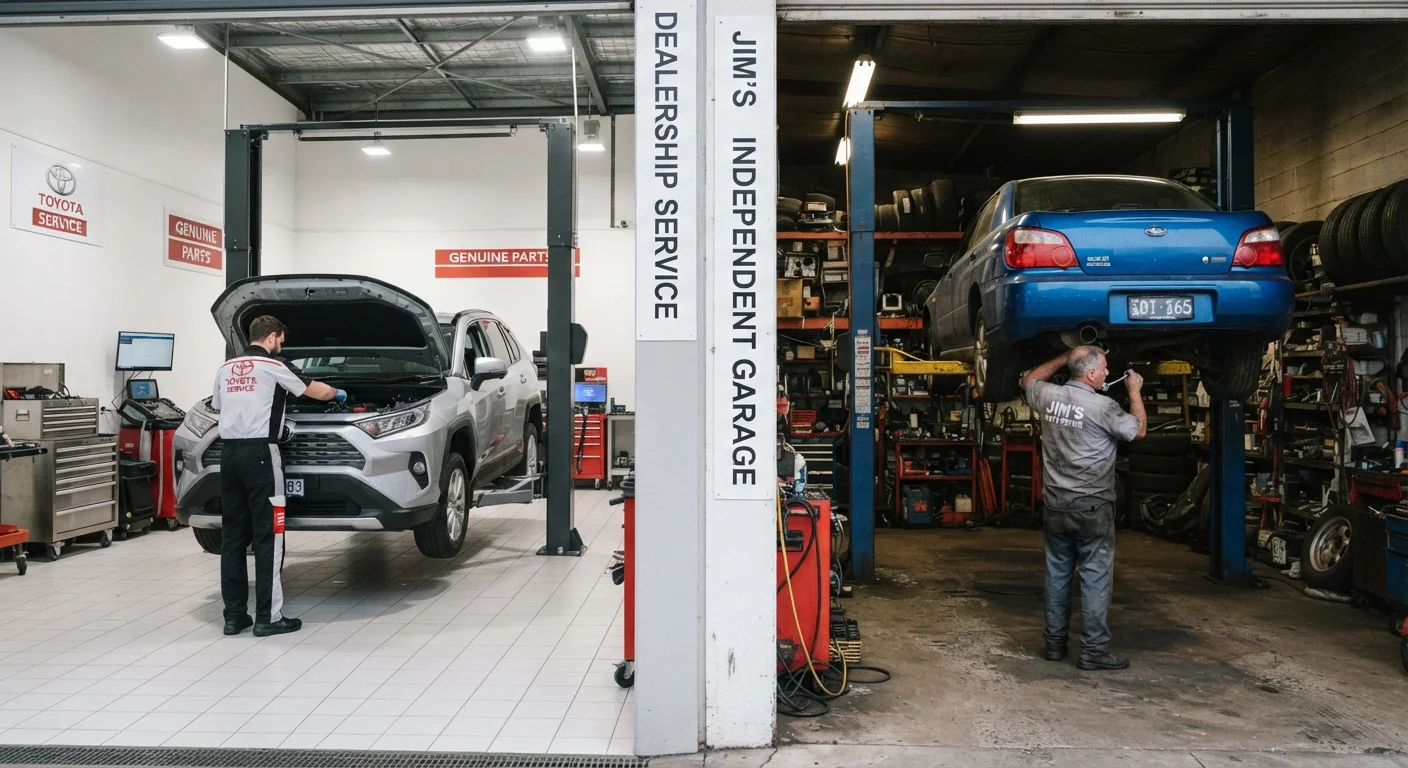
How Labour Rates Are Set — and Why They Differ
Labour is usually the biggest variable between dealership and independent invoices. Franchise dealerships set hourly labour rates based on manufacturer guidelines, regional market positioning, and the cost of maintaining certified technicians, specialised equipment, and purpose-built facilities. Published dealer labour rates in the US commonly range from $130 to $200+ per hour, depending on brand and location.
Independent garages carry lower overheads. Without franchise fees, manufacturer compliance costs, or the capital burden of large showroom facilities, most independents price labour between $80 and $130 per hour. That gap compounds quickly on multi-hour jobs like timing chain replacement or transmission service.
It's worth noting that labour time estimates also differ. Dealers often bill using manufacturer-published flat-rate times, which assign a fixed number of hours per job regardless of how long it actually takes. Some independents follow similar guides; others bill actual time. Ask upfront which method applies — it affects your final cost either way. For a broader look at what specific repair categories cost, see typical repair cost ranges.
| Criterion | Franchise Dealership | Independent Garage |
|---|---|---|
| Typical labour rate | $130–$200+ per hour | $80–$130 per hour |
| Parts sourcing | OEM (manufacturer parts) | Aftermarket / OE-equivalent |
| Parts markup | 20–40% over wholesale | Varies; typically lower |
| Diagnostic tools | Proprietary brand-specific tools | Universal scanners; may lack OEM access |
| Manufacturer warranty coverage | Required for recall and warranty repairs | Legal for routine maintenance |
| Service documentation | Logged in manufacturer systems | Paper/digital receipts (keep copies) |
| Technician certification | Brand-certified (e.g. ASE + OEM training) | ASE-certified varies by shop |
| Scheduling flexibility | Structured; can have longer lead times | Often more flexible and faster |
Parts Pricing: OEM, OE-Equivalent, and the Markup Question
Parts cost is the second major driver of invoice differences. Dealerships stock and install OEM parts — components produced by or for the manufacturer to exact factory specifications. OEM parts carry a price premium, partly because of quality assurance and partly because dealers mark them up, often by 20–40% over wholesale.
Independent garages typically source parts from aftermarket suppliers or OE-equivalent manufacturers — companies that produce parts meeting or exceeding OEM specifications, sold at lower retail prices. For routine maintenance items (brake pads, filters, spark plugs, belts), the functional difference is minimal in most cases. For certain electronic components, sensors, or model-specific assemblies, OEM sourcing may carry a genuine reliability advantage.
Always ask your garage whether parts carry a warranty, who supplies them, and whether you can specify OEM if that matters to you. A reputable independent will accommodate the request — usually at an additional parts cost that still undercuts dealer pricing. Understanding where servicing fits into your full cost picture is easier when you view it alongside total car ownership costs.
30–50%
Typical dealer labour rate premium over independents
Industry surveys from AAA and consumer automotive organisations consistently place dealer hourly rates significantly above independent shop averages across US markets.
~$500
Average US annual vehicle maintenance spend
AAA's annual 'Your Driving Costs' research places average scheduled maintenance costs for a typical new vehicle around this figure, not including unplanned repairs.
35%
Share of car owners using independent garages post-warranty
Consumer research consistently shows a significant shift toward independent service providers once a vehicle's manufacturer warranty expires, driven primarily by cost.
Warranty Implications and What the Law Actually Permits
A persistent misconception is that using an independent garage voids your manufacturer warranty. Under the Magnuson-Moss Warranty Act, manufacturers cannot legally require that you use their dealership network for routine maintenance as a condition of keeping your warranty — provided the work is performed correctly and documented.
What this means in practice: an independent garage can legally carry out your oil changes, brake services, and scheduled maintenance during the warranty period. The key requirements are that the shop uses parts meeting manufacturer specifications and provides a written service record. Keep those receipts and service records organised — they're your evidence if a warranty dispute arises.
Keep Your Service Records — Always
Whether you use a dealer or an independent, a complete paper trail of scheduled maintenance is essential. If a warranty dispute arises, the burden is on you to demonstrate that the work was done correctly and with appropriate parts. Digital records are fine, but back them up. Gaps in service history can also affect resale value.
Where dealer servicing becomes genuinely necessary is for warranty recall work and any repairs covered under powertrain or bumper-to-bumper warranty claims. Those must go through an authorised dealer. Some manufacturers also tie certain extended warranty products to dealer servicing requirements — check your specific warranty documentation carefully.
If you're evaluating whether a dealer service plan or pay-as-you-go approach makes more financial sense for your situation, fixed-price vs pay-as-you-go servicing breaks down that trade-off in detail.