
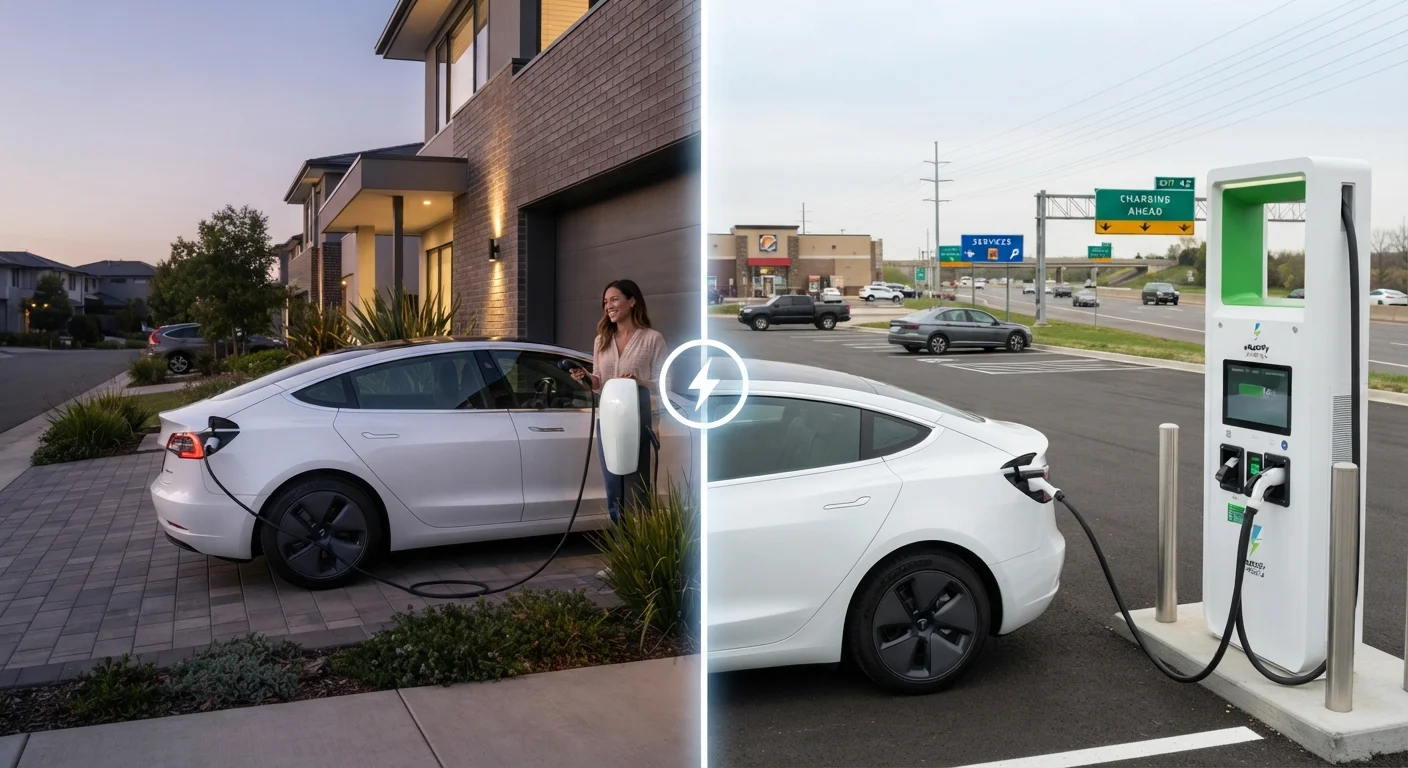
How Each Type of Charging Actually Works
The electrical grid delivers alternating current (AC) — power that reverses direction many times per second. EV batteries, however, store direct current (DC) — power that flows in one direction. That gap between what the grid provides and what the battery accepts is where charging speed is determined.
With AC charging, the conversion from AC to DC happens inside your vehicle using its built-in onboard charger (OBC). The OBC has a maximum power rating — often between 6.6 kW and 22 kW depending on the vehicle — and that ceiling is what truly limits how fast a Level 1 or Level 2 station can charge your car, regardless of the station's own output capacity.
With DC fast charging, the conversion happens inside the charging station itself. The station delivers already-converted DC power directly to the battery, bypassing the OBC entirely. This allows far higher power delivery — typically 50 kW to 350 kW — which is why charge times drop dramatically. For a deeper look at the underlying electrical principles, see AC vs DC charging explained.
| Criterion | AC Charging (L1 & L2) | DC Fast Charging |
|---|---|---|
| Conversion location | Inside vehicle (onboard charger) | Inside the charging station |
| Typical power range | 1.4 kW (L1) – 22 kW (L2) | 50 kW – 350 kW |
| Approx. miles added per hour | 3–5 mph (L1) / 15–30 mph (L2) | Up to 200+ miles per 30 min |
| Typical cost per kWh | Lower (especially at home) | Higher at public fast chargers |
| Battery stress | Lower — gentler on cells | Higher — more heat generated |
| Best use case | Overnight / workplace charging | Road trips and quick top-ups |
| Connector types (US) | J1772 (Level 2), standard outlet (L1) | CCS, CHAdeMO, NACS (varies by vehicle) |
| Universal EV compatibility | Yes — all plug-in EVs support AC | No — not all EVs accept DC fast charge |
Speed, Cost, and Battery Health Trade-Offs
Speed is DC fast charging's clear advantage, but it comes with trade-offs worth understanding before you rely on it daily.
Cost per kWh at DC fast chargers is typically higher than both home Level 2 rates and public Level 2 stations. Pricing structures vary widely by network and region, so check the specific network's rates before assuming a fast charge is economical.
Battery health is a longer-term consideration. High-power DC charging generates more heat inside the battery pack, and sustained heat accelerates electrochemical wear over time. Most automakers explicitly recommend using DC fast charging for road trips and occasional needs rather than as a daily routine. Many newer vehicles include active thermal management systems to mitigate this, but the guidance to limit frequent DC fast charging remains common across the industry.
Compatibility also matters. Not every EV can accept DC fast charging — some entry-level models and most plug-in hybrids (PHEVs) are limited to AC charging only. And among DC-capable vehicles, the maximum accepted power varies considerably. A vehicle rated for 50 kW DC will not charge faster simply because it's connected to a 150 kW station. For a full breakdown of how Level 1, 2, and DC fast charging compare in practice, see EV charging levels explained.
The 80% Rule at DC Fast Chargers
DC fast chargers deliver power most quickly up to around 80% state of charge. After that, the vehicle's battery management system (BMS) intentionally slows the charge rate to reduce heat and protect cell longevity. On a road trip, stopping to charge from 10% to 80% is typically more time-efficient than waiting for a full 100% charge. Many in-vehicle navigation systems now factor this into route planning automatically.
Choosing the Right Charging Approach for Your Situation
Most EV drivers end up using both AC and DC charging — the key is knowing when each makes sense. A practical framework:
- Daily driving: Use Level 2 AC charging at home or work whenever possible. It's slower, but lower cost and gentler on the battery when done consistently.
- Road trips: Plan DC fast charging stops using your vehicle's navigation or a third-party app. Aim to charge to around 80% rather than 100% at fast chargers, since the final portion of a charge slows significantly to protect the battery.
- No home charging access: A mix of workplace Level 2 and occasional DC fast charging is a viable strategy, though it raises per-mile energy costs compared to home charging.
Planning your overall charging lifestyle — not just individual sessions — is what makes EV ownership work smoothly. See home vs public charging compared for a deeper look at how to structure your approach. For broader context on EV and hybrid ownership costs, the Charging & Costs hub covers the full picture.
~20–45 min
Typical DC fast charge time to 80%
EPA and manufacturer data indicate most DC fast-capable EVs reach 80% state of charge in this window, though times vary by vehicle and charger power level.
~8 hrs
Typical overnight Level 2 AC charge time
A 60 kWh battery pack charged at 7.2 kW (a common Level 2 rate) takes roughly 8–9 hours from near-empty to full — well suited to overnight charging.
3–5 mph
Range added per hour via Level 1 (120V)
Level 1 charging from a standard 120V household outlet delivers approximately 1.4 kW, translating to 3–5 miles of range per hour under typical conditions.