
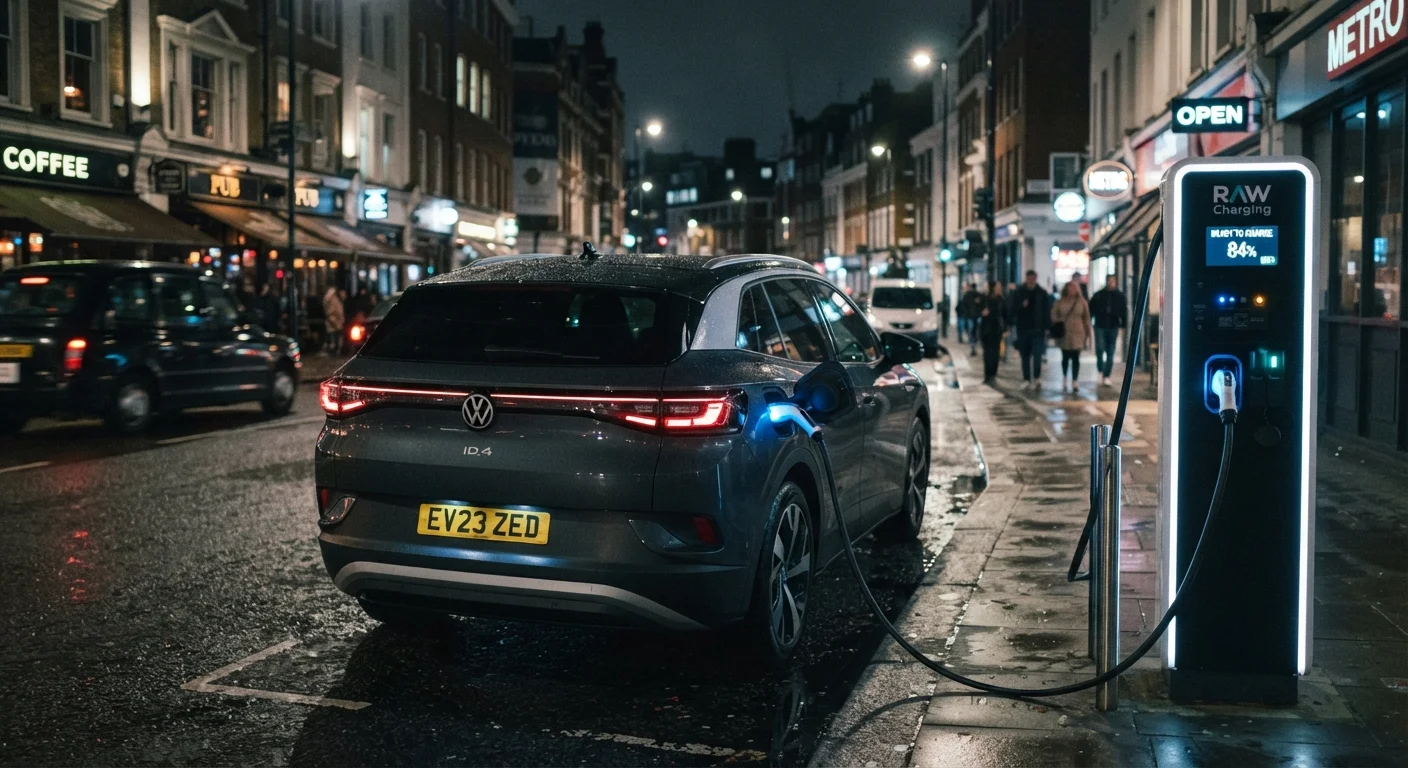
Level 1 Charging: The Slowest — and Most Accessible — Option
Level 1 charging plugs directly into a standard 120-volt household outlet using the cord that typically ships with the vehicle. No special installation is required — if you have a grounded three-prong outlet near where you park, you can charge tonight.
The tradeoff is speed. Level 1 delivers roughly 1.2–1.4 kW of power, translating to about 3–5 miles of range per hour of charging. For a driver commuting 30 miles daily, an overnight charge of 8–10 hours is usually sufficient. For anyone covering more ground regularly, Level 1 alone will likely fall short.
Level 1 is most practical as a backup or supplemental option — useful when traveling to locations without Level 2 infrastructure, or for plugin hybrid (PHEV) owners whose smaller battery packs top off quickly.
Make Level 1 Work While You Sleep
If Level 1 is your primary or backup option, time your charging to overnight hours. Many utilities offer lower off-peak electricity rates between roughly 9 p.m. and 6 a.m. Even at slow speeds, eight or more hours of Level 1 charging can meaningfully restore range for shorter daily drives.
Level 2 Charging: The Everyday Standard for Most EV Owners
Level 2 charging operates on a 240-volt circuit — the same voltage used by large household appliances — and is the format most EV drivers install at home. Power output ranges from about 3.3 kW to 19.2 kW, with most home units landing between 7.2 kW and 11.5 kW.
At 7.2 kW, a Level 2 charger adds approximately 20–25 miles of range per hour. A vehicle starting the night with 50 miles of remaining range could be fully charged in three to four hours. Public Level 2 chargers are widely available at workplaces, shopping centers, and parking garages.
One important nuance: the vehicle's onboard AC charger determines the maximum Level 2 rate your car can accept. A charger capable of 11.5 kW won't help if your vehicle only accepts 7.2 kW. For a deeper look at how AC power flows into your battery, see how AC and DC charging interact with your onboard charger.
~28 million
Public EV charging ports globally (2023)
According to the International Energy Agency's Global EV Outlook, the number of public charging points surpassed 28 million by end of 2023, with Level 2 AC chargers representing the majority.
80%
EV charging done at home (U.S. estimate)
The U.S. Department of Energy estimates that roughly 80% of EV charging in the United States occurs at home, underscoring the central role of Level 1 and Level 2 home setups.
20–45 min
Typical DC fast charge session duration
Most DC fast charging sessions at highway corridor stations add a substantial range buffer in under 45 minutes, according to charging network usage data.
For more on weighing home installation against public networks, home charging vs. public charging breaks down the practical tradeoffs.
DC Fast Charging: High-Speed Power for Long-Distance Travel
DC Fast Charging (DCFC) — sometimes called Level 3 — bypasses the vehicle's onboard AC charger entirely and delivers direct current straight to the battery. This is why speeds are dramatically higher: outputs commonly range from 50 kW to 350 kW, capable of adding 100–300+ miles of range in 20–45 minutes.
DCFC is the go-to solution at highway corridor charging stations and is what makes longer EV road trips feasible. However, not every EV supports fast charging, and those that do have varying acceptance rates. A vehicle with a 100 kW DC acceptance rate won't charge faster on a 250 kW charger — the car sets the limit.
“The charging infrastructure question is really about matching the tool to the trip. Fast chargers are optimized for corridor travel; home charging is optimized for daily life. Most EV drivers need both.”
— U.S. Department of Energy — Alternative Fuels Data Center, Federal resource on alternative fuel vehicle infrastructure and data
Connector compatibility also matters. The differences between AC and DC charging standards affect which stations your vehicle can use, so checking your vehicle's specifications before a trip is worthwhile.
To understand how all three charging levels fit into the broader reality of day-to-day EV ownership, what going electric actually looks like for an everyday driver offers a grounded perspective.
Choosing the Right Level for Your Driving Habits
Most EV owners settle into a pattern: Level 2 at home for daily top-ups, and DC fast charging on road trips when needed. Level 1 serves as a backup for those without home charging access or for PHEV owners with modest battery needs.
When evaluating which setup works for you, consider three factors:
- Daily mileage: Drivers covering under 40 miles daily can often get by with Level 1 overnight. Higher daily mileage almost always calls for Level 2.
- Vehicle specs: Check your EV's onboard charger rating (kW AC) and DC fast charge acceptance rate. These figures appear in the owner's manual or on the manufacturer's spec sheet. Our guide to making sense of EV specifications explains how to read these numbers.
- Home setup: Installing a Level 2 home charger requires a 240V circuit. Factor in electrician costs and any necessary panel upgrades when budgeting.
Understanding core EV concepts before purchasing helps ensure the charging infrastructure in your area aligns with your lifestyle — not the other way around.