
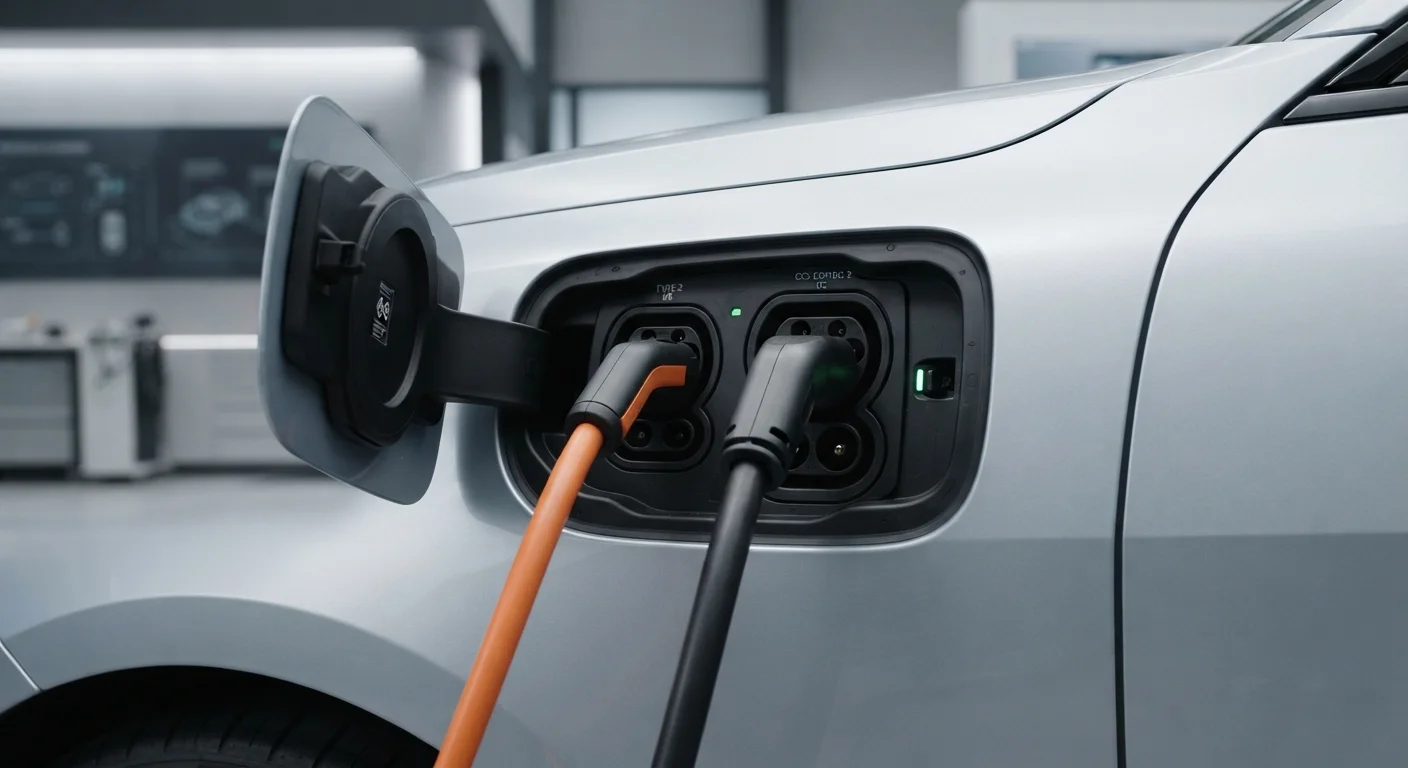
How Electricity Gets Into Your Battery
Every electrical grid — and every home outlet — delivers alternating current (AC), meaning the current reverses direction many times per second (60 Hz in the US). EV batteries, however, store direct current (DC), where electrons flow in one continuous direction. Bridging that gap is the central technical challenge of EV charging.
With AC charging, the conversion happens inside the vehicle using a component called the onboard charger (OBC). The OBC rectifies incoming AC power into DC power that the battery pack can accept. The key constraint: whatever the station delivers, your battery only receives what the OBC can process. If your OBC is rated at 11 kW, a 22 kW Level 2 station offers no speed advantage for that vehicle.
With DC fast charging, the conversion happens outside the vehicle inside the charging station itself. The station delivers DC power directly to the battery, bypassing the OBC entirely. This is why DC fast charging can deliver 50–350 kW at compatible stations — the bottleneck shifts from the OBC to the battery's own acceptance rate and thermal limits. See our full guide to charging levels for a breakdown of Level 1, Level 2, and DC fast charging infrastructure.
Head-to-Head: Key Differences at a Glance
The table below captures the most practical distinctions between AC and DC charging so you can evaluate which scenario applies to your driving life.
| Criterion | AC Charging | DC Fast Charging |
|---|---|---|
| Conversion location | Inside the vehicle (onboard charger) | Inside the charging station |
| Typical power range | 1.4 kW – 22 kW | 50 kW – 350 kW |
| Charge time (80% in a mid-size EV) | 4–12 hours (Level 2) | 20–45 minutes |
| Common locations | Home, workplace, public Level 2 stations | Highway corridors, retail fast-charge hubs |
| Vehicle onboard charger involved? | Yes — OBC rate is the ceiling | No — bypasses OBC entirely |
| Battery thermal stress | Lower | Higher at peak power |
| Typical cost structure | Residential electricity rate (home) | Per kWh or per minute (network pricing) |
One nuance worth noting: EV manufacturers publish both an AC charging acceptance rate and a DC fast-charging acceptance rate. These are separate specifications. A vehicle might accept 11 kW AC but handle 150 kW DC — always check both figures in the manufacturer's specification sheet before assuming a station's rated output translates to faster charging for your specific model.
Battery Health and Charging Frequency
A common concern among new EV owners is whether frequent DC fast charging degrades battery capacity faster than AC charging. The short answer is: high-power DC charging does place more thermal stress on battery cells, and some long-term studies suggest elevated degradation with very frequent fast-charge cycles. However, occasional use on road trips is widely considered a low-risk practice by most EV engineers and is within the design parameters of contemporary lithium-ion battery packs.
Check Your Vehicle's Charging Acceptance Rate
Not all EVs can accept the same maximum DC fast-charging rate. A station rated at 150 kW will only deliver what your battery management system allows — which could be 50 kW, 100 kW, or more depending on your model and current state of charge. Battery acceptance rates also taper as the battery approaches full, which is why charging from 20% to 80% is typically much faster than charging the final 20%. Always consult your vehicle's owner documentation for its specific AC and DC charging specifications.
Most automakers recommend relying on AC charging — particularly Level 2 — for regular daily top-ups, and treating DC fast charging as a situational tool rather than a routine habit. This mirrors how most EV owners naturally use their vehicles: charge at home overnight, fast-charge on longer journeys when needed. For a broader look at how daily EV ownership actually plays out, see what going electric looks like for an everyday driver.
Matching Charging Type to Your Lifestyle
Understanding the technical difference between AC and DC charging is most useful when you map it to your own driving patterns. Ask yourself two questions: How far do I drive on a typical day? and Do I have access to home or workplace charging?
- Short daily commuters with home charging: A Level 2 AC charger (typically 7.2–11 kW) installed at home will replenish most commute distances overnight without any involvement from a public network.
- Apartment dwellers or those without dedicated parking: Reliance on public Level 2 AC stations is common; DC fast charging may fill gaps when AC access is inconvenient.
- Frequent long-distance drivers: DC fast charging at highway corridors is essential for managing range on multi-hundred-mile trips. Planning stops around fast-charger locations becomes part of the trip routine.
The financial side of these choices also plays out differently — AC charging at home is typically priced at residential electricity rates, while DC fast charging on public networks carries a premium, often billed per kWh or per minute. Comparing home and public charging costs in detail can help you model your actual monthly charging spend. If you are also evaluating hybrid options as a transition step, self-charging vs plug-in daily fuel costs offers useful context on how charging frequency shapes overall running costs.