
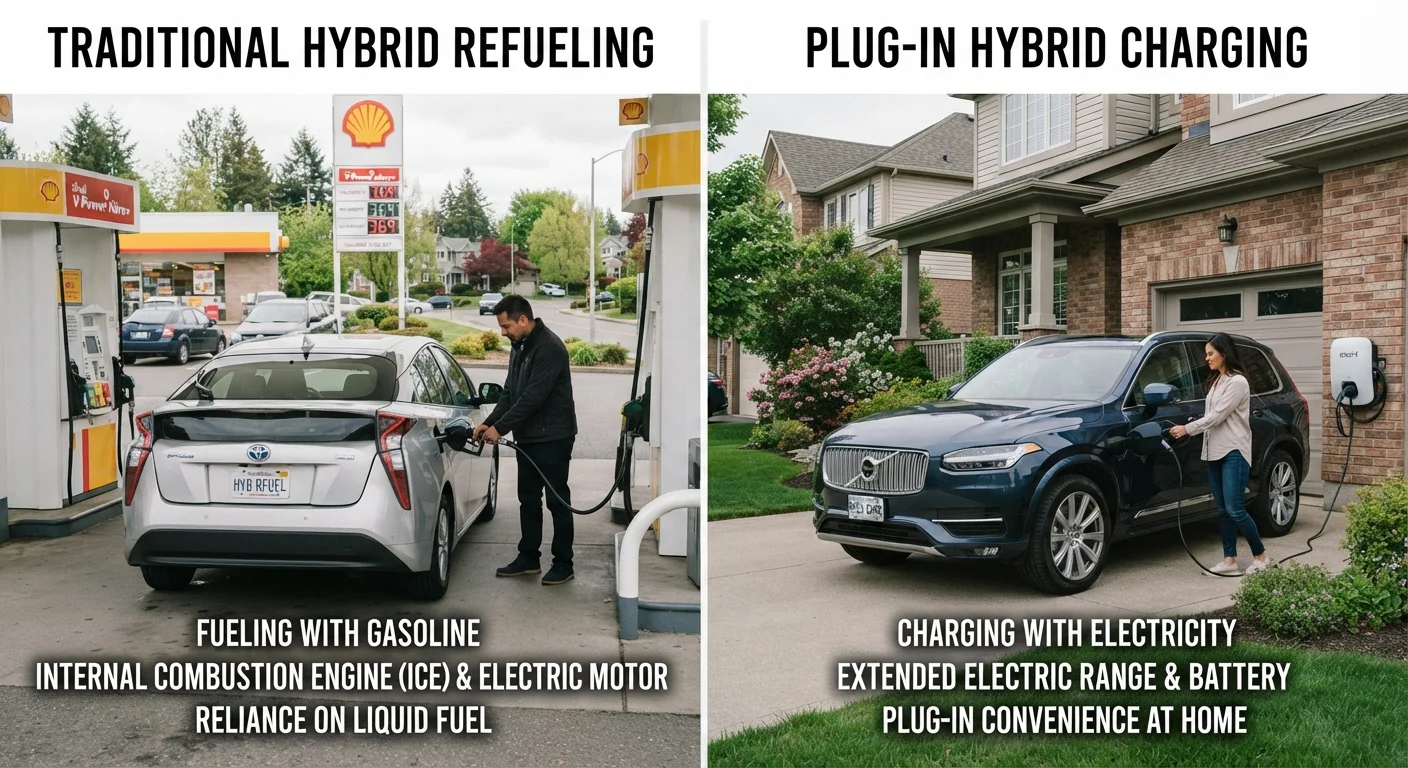
How Each System Actually Recharges
The term "self-charging hybrid" — used to describe a conventional hybrid, or HEV — refers to a vehicle whose battery pack replenishes itself entirely through two internal processes: regenerative braking (capturing kinetic energy when you slow down) and the combustion engine running a generator when conditions allow. You never plug it in. The battery stays small — typically 1–2 kWh — because it only needs to assist the engine briefly, not power the car independently for meaningful distances.
A plug-in hybrid (PHEV) adds a significantly larger battery — commonly 10–25 kWh — that can be charged from an external source, such as a Level 1 household outlet or a Level 2 home charger. It also charges via regenerative braking, but external charging is what unlocks its primary advantage: genuine electric-only driving for a defined range, typically 20–50 miles depending on the vehicle.
Understanding this distinction is foundational. For a deeper breakdown of powertrain architecture, see how HEV and PHEV systems differ mechanically.
What the Fuel Cost Difference Looks Like in Practice
A self-charging hybrid improves fuel economy by reducing how hard the engine works — particularly in stop-and-go traffic, where regenerative braking shines. A driver averaging 35 MPG in a conventional car might see 50–55 MPG in a comparable HEV under mixed urban driving conditions, based on EPA combined ratings for current models. Fuel savings are real, but they are always proportional to the gasoline price and the miles driven.
A PHEV, used correctly, can achieve dramatically lower per-mile costs on electric miles — potentially equivalent to 100+ MPGe — because electricity is generally cheaper per mile than gasoline. The EPA's MPGe metric allows comparison: one gallon of gasoline contains roughly the energy equivalent of 33.7 kWh of electricity. At average U.S. electricity rates, running on battery power costs significantly less per mile than burning gasoline at current pump prices.
| Self-Charging Hybrid (HEV) | Plug-In Hybrid (PHEV) | |
|---|---|---|
| Battery size (typical) | 1–2 kWh | 10–25 kWh |
| Electric-only range | None (brief assist only) | 20–50 miles typical |
| Charging required | No — fully self-managed | Yes — external charging recommended |
| Fuel economy consistency | High — predictable across drivers | Variable — depends on charging habits |
| Best efficiency scenario | Urban stop-and-go driving | Short electric-range commutes, charged nightly |
| Worst efficiency scenario | Sustained high-speed highway driving | Never charging — carries extra battery weight |
| Upfront cost vs. equivalent gas car | Moderate premium | Higher premium |
| Infrastructure needed | None | Home charger recommended |
The catch: those savings evaporate if a PHEV is rarely charged. Carrying the extra battery weight on gasoline alone often makes PHEVs less efficient than equivalent HEVs. Official PHEV fuel economy figures can be misleading precisely because they assume regular charging that many owners don't practice.
~100+ MPGe
Typical PHEV efficiency in electric mode
EPA MPGe ratings for PHEVs operating on battery power reflect the significant per-mile cost advantage of electricity over gasoline at average U.S. rates.
20–50 miles
Typical PHEV all-electric range
EPA all-electric range figures for current U.S.-market PHEVs vary by model; many cover average American daily commutes entirely on battery power when charged overnight.
~29 miles
Average U.S. daily driving distance
According to the U.S. Department of Transportation's Federal Highway Administration, the average American drives approximately 29 miles per day — within most PHEVs' electric range.
Commute Length and Charging Habits Are the Real Variables
The financial case for a PHEV hinges almost entirely on two factors: how far you drive daily and how reliably you recharge. A driver with a 15-mile round-trip commute who plugs in each night could complete nearly all weekday driving on electricity alone, cutting gasoline consumption dramatically. That same PHEV in the hands of a driver who commutes 80 miles daily — beyond most battery ranges — spends most of its time running as a heavier conventional hybrid.
Self-charging hybrids sidestep this variable entirely. Their fuel economy is consistent across drivers because the system manages itself. If you frequently drive long highway stretches where the electric motor contributes little, an HEV's advantage narrows, but it remains predictable. Highway driving at sustained speeds is where HEVs show their smallest efficiency gains over conventional vehicles.
Track Your Own Daily Mileage First
Before comparing fuel costs on paper, spend one to two weeks logging your actual daily mileage. If most days fall within a PHEV's electric range and you have a place to charge at home, the economics shift decisively in a PHEV's favor. If your trips are long, irregular, or charging access is limited, an HEV's steady efficiency may serve you better without the added complexity.
For a structured comparison of how these two architectures serve different lifestyles, a side-by-side look at HEV vs. PHEV usability covers range, cost, and convenience in detail.
Infrastructure, Upfront Cost, and the Full Picture
PHEVs typically carry a higher purchase price than equivalent HEVs, reflecting the larger battery and dual powertrain engineering. Federal tax incentives may partially offset this for qualifying buyers — but eligibility rules are specific and subject to change, so always verify current IRS guidance for your situation. The full cost of EV and hybrid ownership extends beyond the sticker price to include charging equipment, electricity rates, and long-term maintenance patterns.
HEV owners avoid charging infrastructure costs entirely. PHEV owners who want to maximize electric miles should budget for at least a Level 2 home charger installation, which typically runs between $500 and $2,000 depending on electrical panel capacity and labor. Relying solely on a standard 120V outlet (Level 1) is possible but slow — adding roughly 3–5 miles of electric range per hour of charging.
Neither option is universally superior. The smarter question is which one aligns with your actual driving patterns. Weighing hybrids against fully electric vehicles can help if you're also considering a BEV as part of your evaluation. And if you're still sorting out hybrid myths from facts, common hybrid misconceptions that trip up buyers is worth reviewing before you decide.