
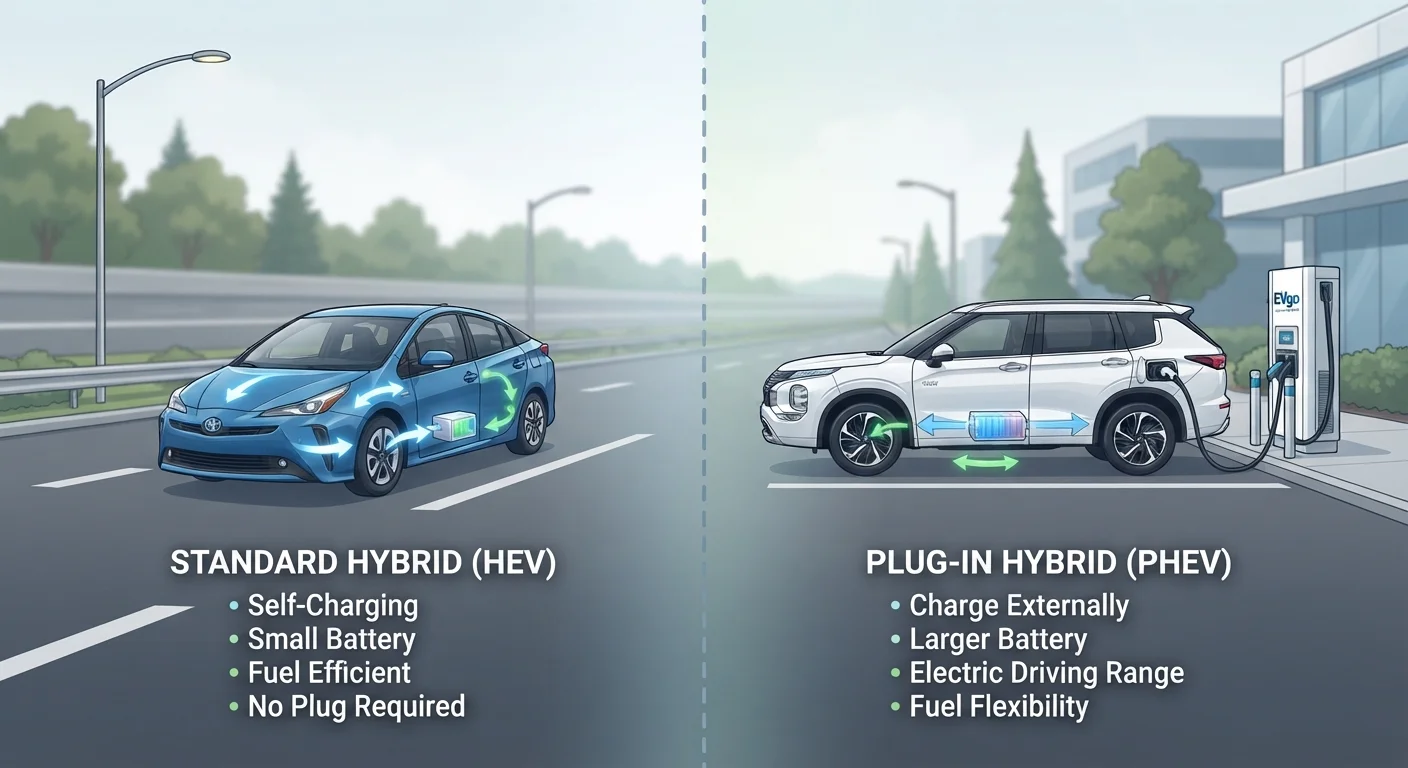
How Each System Actually Works
Despite sharing the word "hybrid," a full hybrid (HEV) and a plug-in hybrid (PHEV) manage energy in fundamentally different ways. Understanding the distinction starts under the hood.
A full hybrid pairs a gasoline engine with an electric motor and a relatively small battery pack — typically 1–2 kilowatt-hours (kWh). That battery charges itself through regenerative braking (capturing energy normally lost as heat when slowing down) and through the engine when it has surplus power. The system switches between gas and electric seamlessly, but it never needs to be plugged in. The electric motor primarily assists the engine at low speeds and in stop-and-go traffic, which is where efficiency gains are most pronounced.
A plug-in hybrid uses the same basic concept but adds a much larger battery — commonly 8–20 kWh — that can be recharged from an external power source such as a home outlet or public charging station. That larger battery enables a true all-electric driving mode for a defined range (often 20–50 miles depending on the model). Once that charge is depleted, the PHEV falls back to operating exactly like a conventional full hybrid.
For a broader view of where these two fit among all hybrid types, see The Hybrid Landscape: Full Hybrids, Mild Hybrids, and Plug-Ins Explained.
| Criterion | Full Hybrid (HEV) | Plug-In Hybrid (PHEV) |
|---|---|---|
| Battery size | ~1–2 kWh (small) | ~8–20 kWh (large) |
| Charging required | No — self-charging only | Yes — external plug recommended |
| Electric-only range | Minimal (low-speed assist) | Typically 20–50 miles |
| Fuel savings consistency | Predictable across all trips | Variable — depends on charge habits |
| Typical price premium vs. gas equivalent | Moderate | Higher (offset by potential incentives) |
| Federal tax credit eligibility | Generally not eligible | Often eligible (conditions apply) |
| Best driving environment | City stop-and-go, mixed driving | Short daily commutes with home charging |
| Long-trip efficiency | Consistent | Drops once battery depleted |
Fuel Economy: Consistent Gains vs. Variable Savings
This is where the two technologies diverge most sharply in real-world outcomes. A full hybrid delivers reliable, predictable efficiency improvements regardless of how you drive. City driving — with its frequent stops — is where HEVs shine most, with some models achieving EPA ratings above 50 mpg in mixed driving.
A PHEV's efficiency story is more complicated. If you charge frequently and your daily mileage stays within the electric range, you may cover most trips using very little gasoline. But if the battery runs flat and stays flat — because charging opportunities are scarce or the vehicle is used mostly for long highway trips — a PHEV can return fuel economy similar to or sometimes slightly worse than an HEV of comparable size, partly because it carries the extra weight of a larger battery.
This variability is a known issue with how PHEV efficiency is measured and marketed. Official PHEV fuel economy figures can be misleading depending on actual charging behavior — worth reading before drawing conclusions from a window sticker.
20–50 mi
Typical PHEV electric-only range
Most current PHEV models on the US market offer between 20 and 50 miles of all-electric driving before the gasoline engine engages.
~50+ mpg
Top HEV city fuel economy ratings
Several full hybrid models achieve EPA city ratings above 50 mpg, particularly in compact and midsize sedan segments.
8–20 kWh
Common PHEV battery capacity range
PHEV batteries are substantially larger than HEV packs, enabling external charging and extended electric-only driving modes.
Cost, Incentives, and Infrastructure
PHEVs typically carry a higher base price than equivalent HEVs, reflecting the larger battery and more complex charging hardware. However, PHEVs with batteries above a certain capacity threshold may qualify for federal tax credits under the Inflation Reduction Act, as well as various state-level incentives — potentially closing a meaningful portion of that price gap. Eligibility depends on income, vehicle price caps, and assembly location requirements, so confirm current rules with a tax professional before factoring credits into your budget.
On the infrastructure side, HEV ownership requires nothing new — you fill up at any gas station as always. PHEV ownership ideally pairs with a Level 2 home charger (240V), which can fully replenish most PHEV batteries in 2–4 hours. Without home charging, the practical benefits of a PHEV shrink considerably. Understanding EV charging logistics and real ownership costs is a useful reference if you're still mapping out your charging setup.
Tax Credits Vary — Always Verify
Federal EV and PHEV tax credit rules under the Inflation Reduction Act include income limits, vehicle MSRP caps, and battery sourcing requirements that change periodically. State incentives vary further by location. Because eligibility can significantly affect the real cost of a PHEV, consult a qualified tax professional or the IRS's official guidance before assuming a credit applies to a specific purchase. General educational content about incentives is not a substitute for personalized tax advice.
Choosing What Fits Your Life
The right choice between an HEV and a PHEV depends less on which technology is objectively superior and more on your specific driving patterns and circumstances.
Ask yourself three questions: How far do you drive on a typical day? Do you have a reliable place to charge at home or at work? How often do you take longer trips where charging en route is uncertain?
If your answers are "under 40 miles," "yes," and "occasionally," a PHEV is likely to deliver genuine electric-mile savings. If your answers trend toward longer unpredictable mileage and limited charging access, an HEV's simplicity and consistent efficiency may serve you better over time.
For a deeper look at the ownership experience of living with a PHEV day to day — including its genuine trade-offs — The Plug-In Hybrid Ownership Experience: Advantages and Limitations offers a balanced, practical overview. And if you're still sorting out how mild hybrids fit into this picture, What a Mild Hybrid Actually Does — and What It Doesn't clarifies that often-misunderstood category.