
The Core Distinction: Assist, Not Replace
The term "hybrid" suggests an electric dimension to driving, and mild hybrids do have one — but it is much more limited than most buyers assume. In a mild hybrid, the electric motor never drives the wheels independently. Instead, it works alongside the gasoline engine to reduce the amount of effort the engine must exert, particularly during acceleration.
Think of it like a power-steering assist: it makes the primary system work less hard, but it does not take over. The engine remains on and active whenever the vehicle is moving. This is the defining line between a mild hybrid and a full hybrid powertrain, which can genuinely move the car on electricity alone at low speeds.
Mild Hybrid Labeling Varies by Brand
Different manufacturers use different names for their mild hybrid systems — "eTorque," "MHEV," "48V Boost" and others all refer to mild hybrid architectures. The marketing terminology does not change the fundamental limitation: none of these systems enable electric-only driving. When evaluating a vehicle, look past the badge and ask specifically whether the car can move under electric power alone.
For a broader look at how mild, full, and plug-in hybrid systems compare side by side, see The Hybrid Landscape.
How the System Actually Works
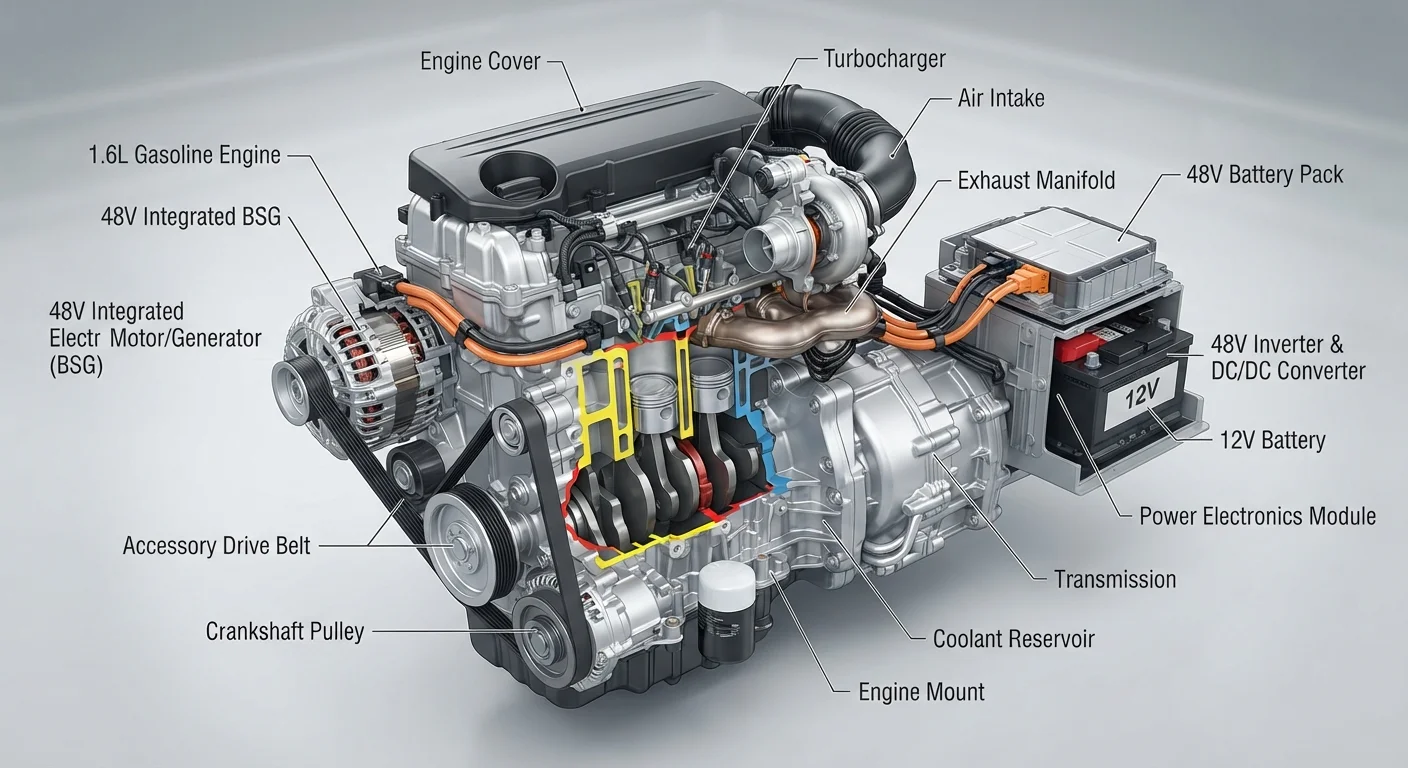
Most modern mild hybrids use a 48-volt belt-integrated starter-generator (BSG) mounted between the engine and transmission. During braking or coasting, this unit captures kinetic energy that would otherwise be lost as heat and stores it in a compact lithium-ion battery pack. When the driver accelerates, that stored energy is released to assist the engine — reducing the load the combustion system must carry and, by extension, how much fuel it burns.
The system also handles start-stop functionality more smoothly than traditional 12-volt systems, restarting the engine almost imperceptibly when the driver lifts off the brake. Some setups can briefly cut the engine during light-load highway coasting, though the driver typically does not notice.
10–15%
Typical mild hybrid fuel economy improvement
Industry estimates generally place mild hybrid fuel savings at 10–15% over an equivalent non-hybrid engine, with greater gains in city driving.
48V
Standard mild hybrid system voltage
The 48-volt architecture is now the dominant mild hybrid standard among major automakers, replacing earlier lower-voltage approaches for better energy recovery.
0 miles
Electric-only driving range
Unlike full or plug-in hybrids, mild hybrid vehicles cannot travel any distance on electric power alone — the combustion engine is always active while the vehicle moves.
What mild hybrids do not have: a large battery pack, a dedicated high-power electric motor, or any ability to plug in. The battery in a mild hybrid is small by design — it is a buffer, not a primary energy source.
What Efficiency Gains Are Realistic
Automakers often market mild hybrids with impressive-sounding fuel economy figures, but the real-world improvement over a comparable non-hybrid engine is typically 10–15%. That is meaningful, but it falls well short of what a full hybrid can achieve, particularly in urban stop-and-go traffic where electric assist has the most impact.
As explained in our article on why hybrids perform better in city driving, any hybrid system — mild or full — relies on frequent deceleration events to replenish its battery. At steady highway speeds, there is little braking energy to recover, and the benefit narrows considerably. Mild hybrid drivers who primarily commute on interstates may see smaller gains than the EPA estimates suggest.
Check the Voltage Before You Buy
Not all mild hybrids are equal. A 48-volt system recovers significantly more energy than an older 12-volt mild hybrid setup. When comparing models, ask the dealer or check the manufacturer's spec sheet for the system voltage — it gives you a clearer picture of the actual efficiency benefit you can expect.
Buyers should also be aware that not all vehicles marketed as "hybrids" use the same system. Some use 12-volt mild hybrid setups that offer even more modest gains than 48-volt systems. Always verify the voltage and architecture in the vehicle's spec sheet.
Where Mild Hybrids Fit in the Buying Decision
A mild hybrid makes the most sense for a buyer who wants a modest efficiency improvement without paying the premium of a full hybrid, and with zero charging infrastructure concerns. There is no plug, no range anxiety, and no new habits required. The experience at the wheel is essentially identical to driving a conventional gas vehicle.
However, buyers who are genuinely focused on reducing fuel costs or lowering emissions should approach mild hybrid claims with clear expectations. The savings are real but incremental. Understanding hybrid trade-offs honestly helps set realistic expectations before committing to any electrified powertrain. And if your goal is meaningful electric-powered driving, a full hybrid or plug-in hybrid is a more appropriate choice — something covered in depth in our full hybrid vs plug-in hybrid comparison.
Understanding what mild hybrids cannot do is just as important as what they can. Separating accurate information from marketing language is covered directly in our guide to common hybrid misconceptions.