
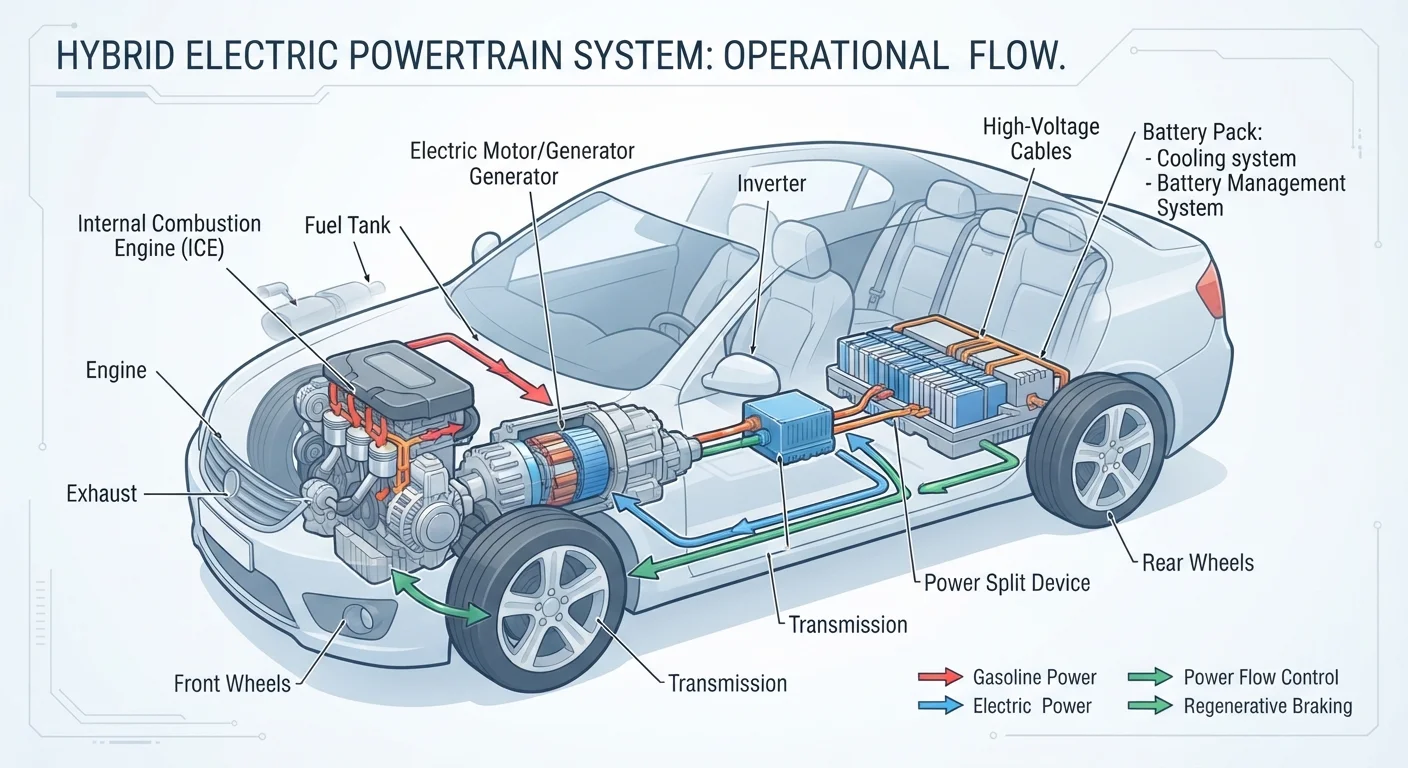
The Two Power Sources Working as One
A full hybrid powertrain has three core components: a gasoline engine, one or more electric motors, and a high-voltage battery pack (typically ranging from roughly 1–2 kWh in a standard hybrid). The key insight is that these components are not competing — they are coordinated by the vehicle's control software to optimize efficiency across all driving conditions.
At low speeds and light loads — pulling out of a driveway, crawling through a parking lot — the system often runs on the electric motor alone. The gasoline engine is off, producing no emissions and burning no fuel. Once speed or load increases beyond what the battery can sustain, the engine starts seamlessly and takes over or assists.
Under hard acceleration, both the engine and motor can work simultaneously, combining their outputs for stronger response than the engine could deliver alone. This "power assist" is why many hybrids feel surprisingly responsive despite having modest engine displacements. For a broader look at how this fits among all powertrain types, see what each powertrain type actually means.
Let the System Work Automatically
Most full hybrids manage engine and motor switching without any driver input — the control software is calibrated for efficiency across a wide range of conditions. Trying to 'game' the system by hovering at low speeds to stay in EV mode can occasionally backfire if it causes the engine to work harder to compensate later. Smooth, consistent driving tends to yield better real-world economy than aggressive technique changes.
Regenerative Braking: Recapturing Lost Energy
One of the most important — and frequently misunderstood — features of a hybrid is regenerative braking. In a conventional vehicle, kinetic energy is converted to heat through the brake pads and discs every time you slow down. That energy is simply lost. A hybrid intercepts it.
When you decelerate, the electric motor switches roles and becomes a generator. It resists the vehicle's motion (providing braking force) while converting that motion into electricity, which flows back into the battery. The physical friction brakes still engage when needed, particularly during hard stops, but regeneration handles a meaningful share of everyday slowing.
The practical effect is that city driving — with its frequent stops — actually recharges the battery more effectively than highway cruising. This is why hybrids tend to show stronger fuel economy improvements in urban cycles than on the open road, often inverting the pattern seen with conventional engines. If you want to use this feature more deliberately, adapting your driving technique can extend your electric range noticeably.
Why Highway MPG Gains Are Smaller
At sustained highway speeds, a hybrid's gasoline engine carries most of the load, and there are fewer deceleration events to trigger regeneration. The electric motor contributes less at high speeds than in city driving. This is why EPA highway ratings for hybrids often show a smaller percentage improvement over non-hybrid equivalents compared to city ratings — the physics of steady-speed driving favor the combustion engine.
How It Differs from Mild Hybrids and PHEVs
The term "hybrid" covers a spectrum. Understanding where a full hybrid sits on that spectrum matters when evaluating vehicles.
- Mild hybrid: Uses a small motor-generator to assist the engine and recover some braking energy, but cannot propel the car on electricity alone. The efficiency gains are real but modest. For a closer look, see what a mild hybrid actually does.
- Full hybrid (HEV): Can drive short distances on electric power independently. Battery is recharged through driving only — no plug required.
- Plug-in hybrid (PHEV): Carries a much larger battery that can be recharged from an external outlet, offering extended electric-only range (typically 20–50 miles EPA-estimated) before the engine takes over.
- Battery electric vehicle (BEV): No combustion engine at all. See how EVs actually work under the hood for a full comparison.
For unfamiliar terms you encounter on spec sheets — kWh, eCVT, EV mode — the hybrid glossary provides quick-reference definitions. The complete powertrain guide covers all four types in depth if you want to compare across categories.
~20–35%
Typical city fuel economy improvement over comparable non-hybrid
EPA testing consistently shows full hybrids achieve their largest efficiency gains in urban drive cycles where regenerative braking opportunities are frequent.
8–10 years
Common hybrid battery warranty period from manufacturers
Federal regulations require hybrid and EV battery warranties of at least 8 years / 100,000 miles in all US states, with California and adopting states requiring longer coverage.