
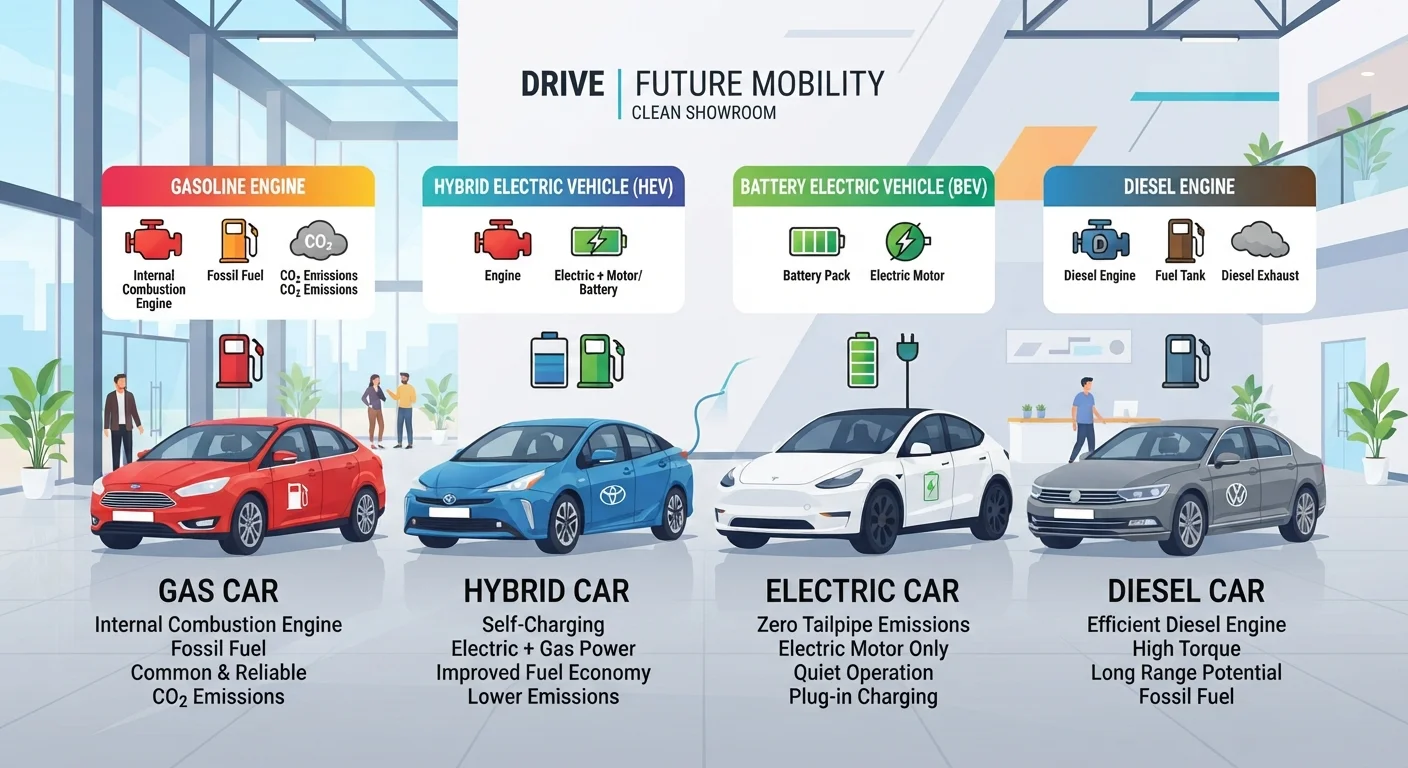
What Is a Powertrain?
The powertrain is the system that generates power and sends it to the wheels. It includes the engine or motor, the transmission, and the drivetrain components that make the vehicle move. When people talk about a car being "gas," "hybrid," "electric," or "diesel," they're describing what type of powertrain it uses — and that choice has a direct impact on how you fuel up, what your running costs look like, and how the vehicle feels to drive.
For a full glossary of powertrain terminology, see The Vocabulary of Powertrains.
Internal Combustion Engine (ICE)
An engine that burns fuel — gasoline or diesel — inside cylinders to create mechanical energy that moves the vehicle.
Regenerative Braking
A process in hybrid and electric vehicles where the motor acts as a generator during braking, converting kinetic energy back into electricity stored in the battery.
Plug-In Hybrid (PHEV)
A hybrid vehicle with a battery large enough to be charged from an external power outlet, giving it a short range on electricity alone before the gas engine takes over.
Battery Electric Vehicle (BEV)
A vehicle powered entirely by electricity stored in an onboard battery — no gasoline engine of any kind.
Torque
A measure of rotational force — in practical terms, it describes how much pulling or pushing power an engine or motor delivers, especially from a standstill.
Drivetrain
The components that transfer power from the engine or motor to the wheels, including the transmission, driveshaft, and axles.
Gasoline: The Familiar Default
Gasoline-powered vehicles use an internal combustion engine (ICE) that burns fuel to generate mechanical energy. This is the powertrain most US drivers are already familiar with — widespread refueling infrastructure, a broad range of vehicle options across every segment, and generally lower purchase prices compared to electrified alternatives.
Gasoline engines have improved significantly in fuel efficiency over the past two decades, but they still emit tailpipe exhaust and are subject to fuel price fluctuations. Routine maintenance — oil changes, spark plugs, air filters — is well understood and widely available.
Best suited for: Drivers who want the widest vehicle selection, predictable refueling, and lower upfront cost.
Gasoline Still Makes Sense for Many Buyers
If you frequently travel to areas with limited EV charging infrastructure, or if you need a vehicle type not yet widely available in electrified form, a modern gasoline engine remains a practical, well-supported choice. Fuel economy has improved substantially in newer gas engines, narrowing — though not closing — the gap with hybrid options.
Diesel: Torque and Efficiency, With Trade-Offs
Diesel engines also combust fuel, but they work differently from gasoline engines — they compress air until it's hot enough to ignite the fuel, rather than using a spark. The result is an engine that produces more torque (pulling power) at lower RPMs and tends to deliver better fuel economy on the highway.
In the US, diesel is most commonly found in heavy-duty pickup trucks and some commercial vehicles. The diesel passenger car segment shrank considerably over the past decade, so buyers looking for a diesel sedan or compact SUV will find limited options at most US dealerships.
Best suited for: Drivers who tow heavy loads regularly or cover long highway miles and want the pulling power and efficiency diesel provides.
Hybrid: Bridging Gas and Electric
A hybrid vehicle pairs a gasoline engine with one or more electric motors and a battery pack. The system automatically manages when to use each power source — the electric motor often handles low-speed driving and acceleration assist, while the gas engine takes over at higher speeds or when more power is needed. The battery recharges through a process called regenerative braking, which captures energy that would otherwise be lost as heat when you slow down.
Standard hybrids require no plugging in. Plug-in hybrids (PHEVs) add a larger battery that can be charged from an outlet, offering a limited electric-only range before the gas engine engages. For a deeper look at the hybrid spectrum, visit the Hybrid Options hub or see BEV, PHEV, and MHEV compared.
Best suited for: Drivers who want improved fuel efficiency without changing their refueling habits, or those who make short daily trips but still want gas-engine flexibility.
PHEV Benefits Depend on Charging Habits
A plug-in hybrid delivers its best fuel savings when the battery is regularly charged from an outlet. Drivers who never plug in are essentially carrying extra battery weight without gaining the efficiency advantage — in that scenario, a standard hybrid may be a more practical fit.
Battery Electric: No Gas Required
Battery electric vehicles (BEVs) run entirely on electricity stored in a large onboard battery pack. There is no internal combustion engine, no exhaust pipe, and no oil to change. Power is delivered instantly through one or more electric motors, which is why EVs often feel noticeably responsive from a standstill.
The primary considerations for EV ownership are range (how far the battery takes you on a full charge) and charging access (whether you can charge at home, at work, or on public networks). For buyers curious about how the underlying technology differs from conventional vehicles, How an Electric Drivetrain Differs From Everything Before It provides a detailed explanation.
Best suited for: Drivers with predictable daily mileage, reliable home or workplace charging, and a preference for lower per-mile energy costs.
Choosing the Right Powertrain for Your Life
No powertrain is objectively superior — the right choice depends on your driving patterns, where you live, and your priorities. Consider these practical questions:
- How far do you drive daily? Short, predictable commutes favor EVs and hybrids; longer or unpredictable mileage may favor gas or diesel.
- Do you have home charging access? EV ownership is most convenient with a dedicated home charger. Without one, a hybrid may offer a better balance.
- Do you tow or haul frequently? Diesel and certain gas V8 trucks remain the practical choice for heavy towing.
- How long do you plan to own the vehicle? Electrified powertrains tend to reward longer ownership through lower running costs, but those savings vary.
For a more comprehensive breakdown of how each powertrain performs across different use cases, the Powertrain Types Complete Guide covers the full picture in depth.
Powertrain Types: The Complete Guide for Car Buyers
A comprehensive deep-dive into gas, diesel, hybrid, and electric powertrains — covering how they work and which driver profiles each suits best.
Powertrain Types and Long-Distance Driving
A practical look at how each powertrain performs on road trips, highlighting real-world range, refueling, and charging considerations.
The Vocabulary of Powertrains: A Glossary
A quick-reference glossary defining the powertrain terms — from mild hybrid to PHEV to AWD — you'll encounter while shopping for a vehicle.