
Why Powertrain Vocabulary Matters
Walk into any dealership or browse any car listing today and you'll encounter a wall of acronyms — ICE, PHEV, BEV, AWD, CVT. These aren't buzzwords; they're precise technical categories that describe how a vehicle generates and delivers power. Knowing what each term means helps you filter options accurately, ask better questions, and avoid paying for features you don't need — or missing ones you do.
This glossary covers the core powertrain terms you're most likely to encounter while shopping for a car in the US market. For a deeper walk through how the main fuel types compare, see our plain-language breakdown of gas, hybrid, electric, and diesel powertrains. If you're focused specifically on electrified vehicles, the EV jargon glossary goes deeper on battery and charging vocabulary.
ICE (Internal Combustion Engine)
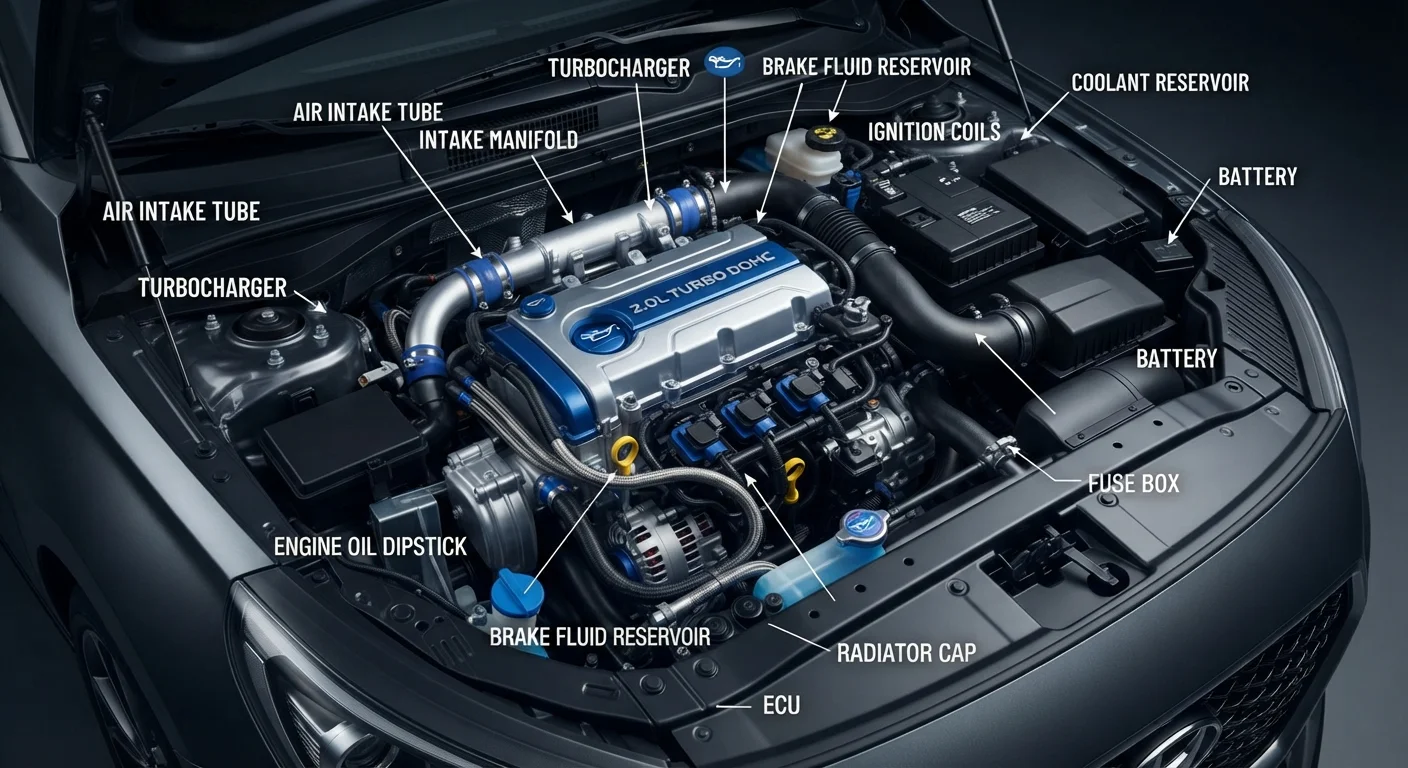
A conventional gasoline or diesel engine that burns fuel inside cylinders to generate mechanical power. The vast majority of vehicles sold in the US today use some form of ICE, either alone or paired with an electric motor.
Mild Hybrid (MHEV)
A powertrain that uses a small battery and electric motor to assist the gasoline engine — for example, during acceleration or coasting — but cannot drive the vehicle on electricity alone. Mild hybrids improve fuel efficiency without requiring plug-in charging.
Full Hybrid (HEV)
A hybrid that can drive short distances on electric power alone, but recharges its battery exclusively through regenerative braking and the engine — not from a wall outlet. The Toyota Prius is a well-known example of this category.
Plug-In Hybrid (PHEV)
A hybrid with a larger battery that can be recharged from an external power source, enabling longer electric-only driving ranges — typically 20–50 miles depending on the vehicle. After the battery depletes, it operates as a conventional hybrid.
BEV (Battery Electric Vehicle)
A vehicle powered entirely by one or more electric motors drawing energy from an onboard battery pack. BEVs produce zero tailpipe emissions and must be charged at home or at public charging stations — there is no combustion engine.
FWD (Front-Wheel Drive)
A drivetrain layout where engine power is delivered to the front wheels only. FWD vehicles are generally lighter, more fuel-efficient, and less expensive to produce than AWD alternatives, and perform adequately in mild weather conditions.
RWD (Rear-Wheel Drive)
A drivetrain where power is sent to the rear wheels. RWD is common in performance cars and trucks and is favored for its balanced handling dynamics, though it offers less traction than AWD in slippery conditions.
AWD (All-Wheel Drive)
A system that distributes power to all four wheels, either continuously or on demand. AWD improves traction on wet, snowy, or uneven surfaces and is distinct from 4WD, which is typically designed for more demanding off-road use.
CVT (Continuously Variable Transmission)
A type of automatic transmission that uses a belt-and-pulley system to provide a seamless, stepless range of gear ratios rather than fixed gears. CVTs are common in hybrids and economy cars because they can keep the engine in its most efficient operating range.
Regenerative Braking
A system used in hybrids and EVs that captures kinetic energy during deceleration and converts it into electricity to recharge the battery. It reduces brake wear and improves overall energy efficiency.
Torque
A measure of rotational force, expressed in pound-feet (lb-ft) in the US. In everyday driving terms, torque governs how quickly a vehicle feels responsive when accelerating from a stop — electric motors deliver peak torque instantly, which is why EVs feel quick off the line.
Range Extender
A small onboard combustion engine used in some electrified vehicles solely to generate electricity and recharge the battery — not to directly drive the wheels. This differs from a PHEV, where the engine can also power the wheels mechanically.
Drivetrain and Power Delivery Terms
Once power is generated, it has to reach the wheels — and how it gets there significantly affects handling, traction, and fuel efficiency. These terms describe that delivery system.
| FWD | Power to front wheels only |
| RWD | Power to rear wheels only |
| AWD | Power to all four wheels, on-demand or full-time |
| 4WD / 4x4 | Driver-selectable, high-torque system for off-road use |
| CVT | Stepless automatic transmission; common in hybrids |
| Dual-Clutch Transmission (DCT) | Automated manual transmission with two clutch sets for faster shifts |
Understanding drivetrain configurations is especially useful when choosing between variants of the same model. A front-wheel-drive version of a crossover, for example, will typically cost less and return better fuel economy than its all-wheel-drive counterpart — but may feel less planted in snow or on loose surfaces. For a comprehensive look at how all these systems fit together, the complete powertrain guide for car buyers walks through each configuration in practical detail. Buyers researching hybrid configurations can also explore hybrid vehicle options and the hybrid spec sheet glossary for additional clarity.