
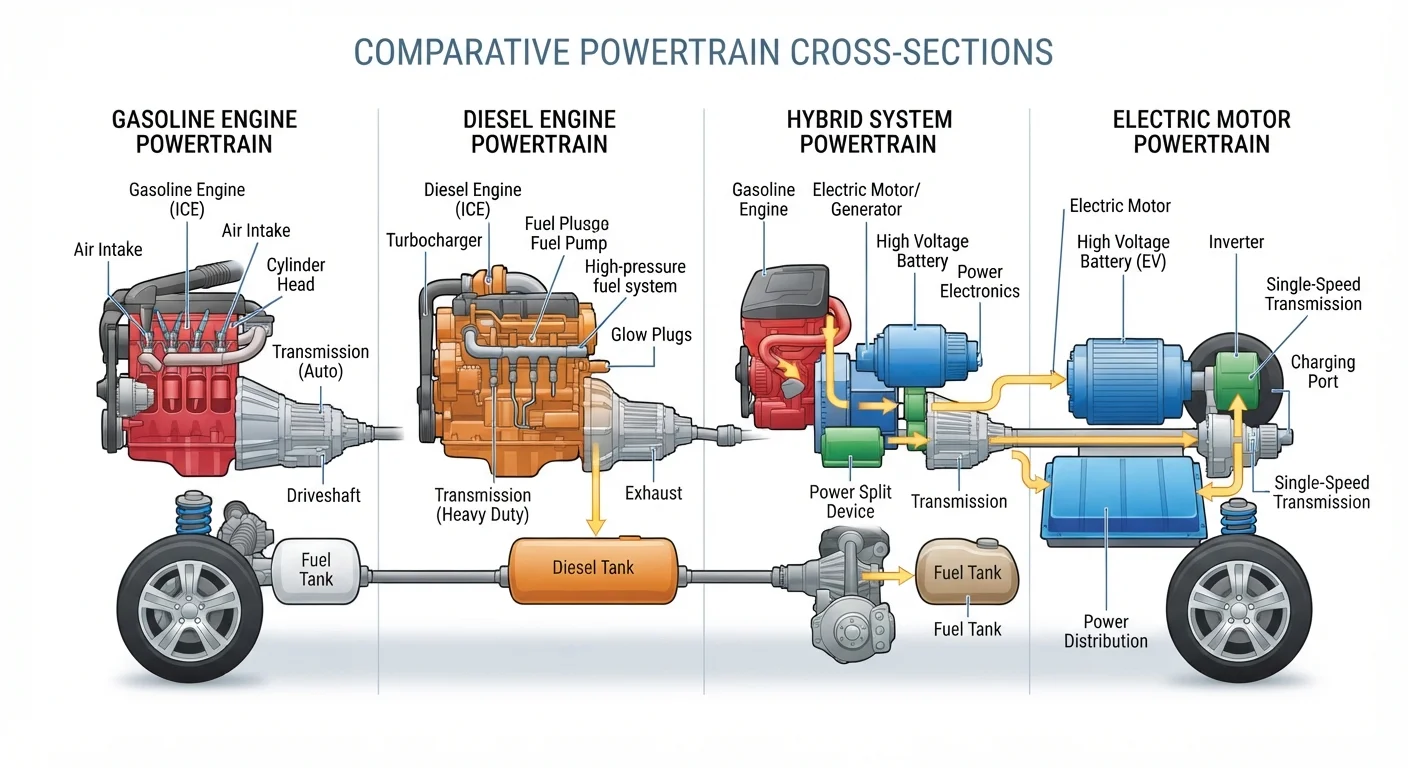
What Is a Powertrain?
The term powertrain refers to every component that generates energy and transfers it to the wheels. At minimum this includes the engine or motor, the transmission (or reduction gear in EVs), and the drivetrain connecting those to the driven wheels. The fuel source — gasoline, diesel, electrons stored in a battery — determines which category the powertrain falls into.
Choosing a powertrain is one of the highest-impact decisions in any vehicle purchase. It shapes your fueling routine, ownership costs, range, and environmental footprint for the life of the vehicle. For a plain-language breakdown of each type, see Gas, Hybrid, Electric, or Diesel: What Each Powertrain Actually Means. If unfamiliar terminology comes up while you shop, The Vocabulary of Powertrains glossary defines the most common terms in plain English.
Gasoline Powertrains
Gasoline-powered internal combustion engines (ICEs) ignite a fuel-air mixture inside cylinders to produce mechanical force. That force moves through a transmission — automatic, manual, or continuously variable (CVT) — before reaching the wheels.
Strengths: Gas vehicles are sold in every segment, refueled in minutes at hundreds of thousands of stations nationwide, and supported by the broadest network of repair technicians. Initial purchase prices are generally lower than comparable hybrids or EVs.
Limitations: Fuel costs fluctuate with pump prices, and gasoline engines require regular maintenance — oil changes, spark plugs, and timing components. Emissions regulations are tightening in many states, which may affect long-term operating costs.
Check Total Cost of Ownership, Not Just Sticker Price
A gasoline vehicle's lower purchase price may be offset over time by higher fuel and maintenance costs compared to a hybrid or EV. Before deciding, estimate your annual mileage and compare projected fuel and service expenses across each powertrain type. Many automakers and third-party sites offer ownership cost calculators to help with this comparison.
Best suited for: Buyers who prioritize upfront affordability, frequently travel to areas without reliable EV infrastructure, or simply want maximum vehicle-selection flexibility.
Diesel Powertrains
Diesel engines compress air to a higher ratio than gasoline engines, then inject fuel directly into the heated air — no spark plug required. This process produces high torque at low RPM, which is why diesel has historically dominated trucks, commercial vehicles, and European sedans.
Strengths: Diesel typically delivers 20–30% better fuel economy than a gasoline equivalent on highway driving. High torque makes it effective for towing heavy loads. Diesel engines are also known for durability in high-mileage commercial applications.
Limitations: Diesel fuel prices can exceed regular gasoline prices depending on region and season. Emissions control systems — including diesel exhaust fluid (DEF) — add maintenance complexity. Passenger car diesel options in the US market are considerably narrower than in Europe.
Diesel Passenger Cars Are a Niche US Option
Unlike Europe, the US market offers relatively few diesel passenger car choices. Diesel remains more relevant in the light and heavy truck segments. If you're specifically seeking a diesel car, verify that the model you want is actually sold with a diesel option in the US before factoring it into your decision.
Best suited for: High-mileage highway drivers, truck owners who regularly tow, and commercial operators where fuel economy at scale justifies the powertrain's premium.
Hybrid Powertrains
Hybrid vehicles pair a gasoline engine with one or more electric motors and a battery pack. The system captures energy during braking (regenerative braking) and uses it to assist the engine or power the car at low speeds — all without plugging in.
There are several distinct types:
- Standard hybrid (HEV): The battery charges itself through driving. No plug required.
- Plug-in hybrid (PHEV): A larger battery can be charged from an outlet, providing a meaningful electric-only range — often 20–50 miles — before the gas engine takes over.
- Mild hybrid (MHEV): A small electric motor assists the engine but cannot power the car alone. Primarily an efficiency aid.
For a comprehensive look at hybrid ownership — including costs, charging, and long-term value — see Hybrid Vehicles: The Complete Decision-Making Resource. You can also explore the broader Hybrid Options hub for related guidance.
When evaluating a PHEV, check whether your typical daily commute falls within its electric-only range — if it does, you could drive most days without burning any gasoline at all.
The real-world value of a PHEV depends almost entirely on how often the driver can stay within battery range; buyers who ignore this often see fewer fuel savings than expected.
Before purchasing an EV, verify the charging speed (kW) your home electrical panel can support — not just the car's maximum charge rate.
Many older homes require a panel upgrade to support Level 2 (240V) charging, an often-overlooked cost that can affect the total purchase decision.
Best suited for: Drivers who want reduced fuel bills without changing their routine (HEV), or those who do short daily commutes and want to run mostly on electricity without full EV commitment (PHEV).
Electric Powertrains
Battery-electric vehicles (BEVs) use one or more electric motors powered entirely by an onboard battery pack. There is no combustion engine, no exhaust, and no need for gasoline or diesel. Charging happens at home via a standard outlet or dedicated charger, or at public fast-charging stations.
Strengths: Electricity costs per mile are generally lower than gasoline costs. EVs have fewer moving parts — no oil changes, no exhaust system, fewer brake replacements due to regenerative braking. Electric motors also deliver immediate torque, meaning responsive acceleration.
Limitations: Range anxiety remains a real concern for some buyers, particularly on long trips. Charging time — even at fast chargers — is longer than refueling with gas. Apartment or condo dwellers without dedicated parking face home-charging challenges.
~30%
Typical highway fuel economy advantage of diesel over gasoline
Diesel engines' higher compression ratio produces more energy per gallon on sustained highway driving, per general industry benchmarks.
20–50 mi
Typical electric-only range for plug-in hybrid vehicles
PHEV electric range varies significantly by model and battery size; EPA estimates for individual models are the most accurate reference.
~3–5¢
Estimated cost per mile to charge a battery-electric vehicle
Home electricity rates vary widely by state and utility; this range is a general estimate based on average US residential electricity prices.
Before committing to an EV, explore the EV Basics hub for the foundational concepts every buyer should understand. For how EVs specifically perform on longer trips, see Powertrain Types and Long-Distance Driving.
Best suited for: Drivers with predictable daily routines within the vehicle's range, access to home charging, and interest in lower long-term operating costs.
Matching a Powertrain to Your Lifestyle
No powertrain is objectively superior — each involves real trade-offs. Use these practical questions to narrow your choice:
- How far do you drive daily? Short, predictable commutes favor EVs or PHEVs. Highly variable mileage often suits a standard hybrid or gasoline vehicle.
- Where do you park overnight? A garage or dedicated spot makes home EV charging feasible. Without it, you'll depend on public charging infrastructure.
- Do you tow or haul regularly? High-torque diesel or gasoline truck powertrains remain the practical choice for heavy-duty towing.
- How long do you plan to keep the vehicle? Hybrids and EVs tend to recoup their higher upfront cost over time through lower fuel and maintenance expenses — the payoff grows with ownership length.
- What fuel infrastructure exists along your common routes? Rural and remote areas may have limited fast-charging options, making gasoline or diesel more practical for now.
State Incentives Vary Widely
Federal tax credits and state-level rebates for EVs and PHEVs can meaningfully affect the effective purchase price. Eligibility rules — including income limits, vehicle price caps, and assembly requirements — change periodically. Always verify current eligibility with a qualified tax professional or official government sources before making a purchasing decision based on incentive assumptions.
Once you've identified your powertrain category, the next step is matching it to a body style — sedan, SUV, truck, or crossover — that fits your practical needs. Your powertrain choice and body style choice work together to define total ownership experience.