
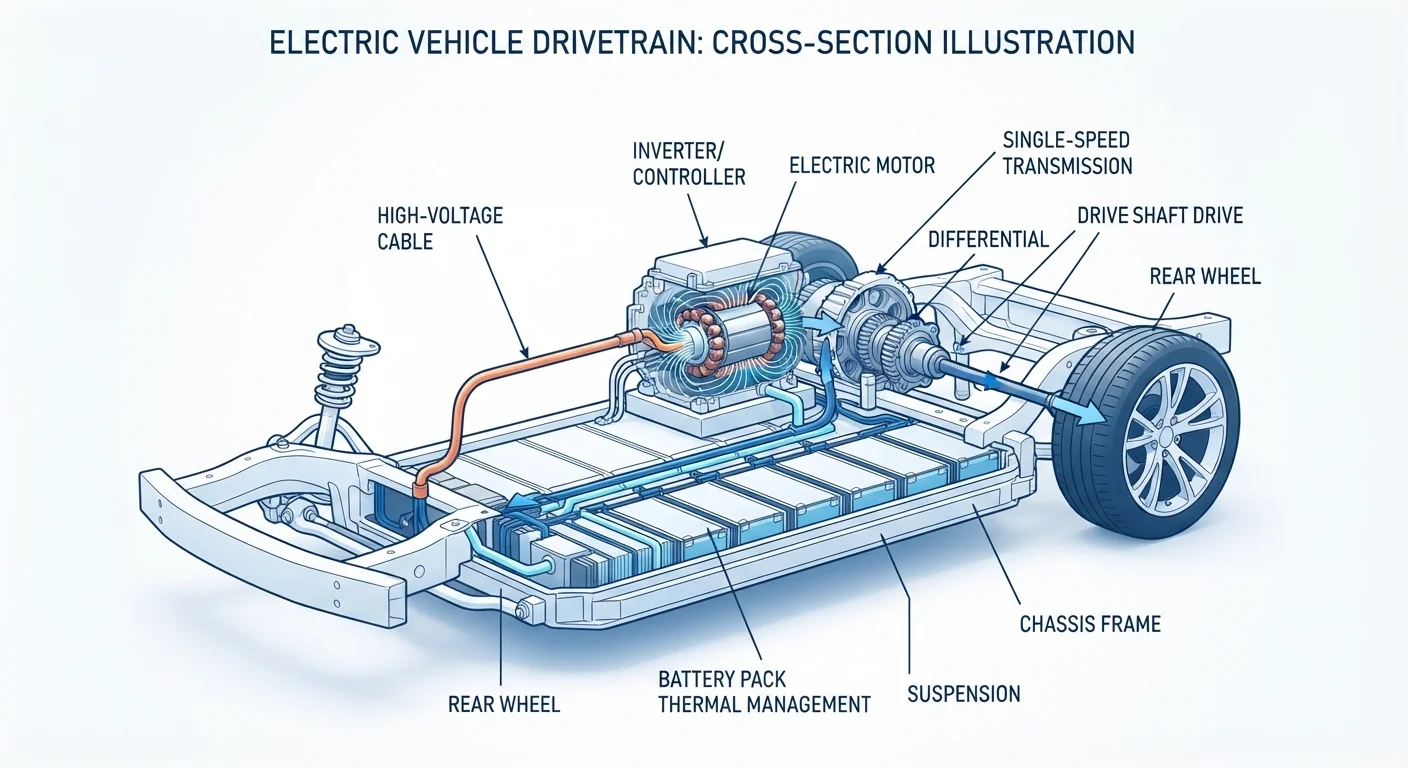
The Core Difference: Motion Without Combustion
Every conventional powertrain — gas, diesel, or traditional hybrid — relies on controlled explosions inside an engine to generate power. That mechanical energy then travels through a complex chain: clutch, gearbox, driveshaft, differential, and finally the wheels. It's a system with hundreds of moving parts, all requiring calibration, lubrication, and eventual replacement.
An electric drivetrain breaks from this entirely. A battery pack stores energy as electricity. An inverter converts that electricity into the form the motor needs. The motor spins. A single reduction gear steps that rotation down to a useful wheel speed. That's essentially it.
For a broader look at how this fits among all powertrain options, see what each powertrain type actually means.
Hybrid Drivetrains Are a Middle Ground
Full hybrids and plug-in hybrids combine an electric motor with a conventional engine, so they share some electric drivetrain characteristics — like regenerative braking — but still carry the mechanical complexity of a combustion system. A battery electric vehicle (BEV) is the only configuration that eliminates the combustion engine entirely. Explore EV basics to understand where different electrified vehicles sit on the spectrum.
Instant Torque and the Single-Speed Advantage
Torque is the rotational force that actually moves a car. Gas engines build torque as engine speed (RPM) rises, which is why you feel a surge when you press harder or downshift. Electric motors work differently: they produce their peak torque from the moment they start turning.
This has a practical consequence. Press the accelerator in an EV and the response is immediate and linear — no waiting for revs to build, no gear hunting. The absence of a multi-speed gearbox reinforces this: power delivery is smooth because there are no gear changes interrupting the flow.
85–90%
Typical electric motor energy efficiency
Electric motors convert roughly 85–90% of stored electrical energy into motion, compared to approximately 20–40% for typical internal combustion engines.
0 RPM
RPM at which peak torque is available
Unlike gas engines that must build revs, electric motors produce maximum torque from zero RPM — a fundamental property of electromagnetic motor design.
The single fixed-ratio gear also means the drivetrain has dramatically fewer mechanical interfaces to wear out or adjust over time.
Regenerative Braking: Energy Going Backward
One capability with no real equivalent in a gas drivetrain is regenerative braking. When an EV slows down, the electric motor reverses its role and acts as a generator. The car's forward momentum spins the motor, which produces electricity that flows back into the battery.
The practical effects are notable. Many EV drivers find they rarely need to touch the brake pedal in everyday driving — simply lifting off the accelerator provides meaningful deceleration. Friction brakes are still present and engage when needed, but they see less wear under normal conditions.
Learn Your EV's Regen Settings
Many electric vehicles offer adjustable regenerative braking strength — sometimes called one-pedal driving mode. Spending time in a parking lot learning how your specific car behaves at different regen levels can make city driving noticeably more comfortable and efficient.
To understand what this and other EV characteristics look like in daily use, read about the real everyday experience of going electric.
Efficiency, Simplicity, and What It Means for Maintenance
A gasoline engine converts roughly 20–40% of fuel energy into actual motion — the rest exits as heat through the exhaust or radiator. An electric motor operates at around 85–90% efficiency, meaning far less energy is wasted in the conversion from stored energy to movement.
That mechanical simplicity carries real-world maintenance implications. There is no engine oil, no timing belt, no spark plugs, no catalytic converter, and no traditional exhaust system. Fluid services are reduced to brake fluid, battery coolant, and in some cases a small amount of gear lubricant.
For a full technical walkthrough of what sits under the hood of an EV, see how EVs actually work mechanically. And if you're weighing a fully electric vehicle against plug-in or mild hybrid options, this comparison of BEV, PHEV, and MHEV drivetrains explains what sets them apart.