
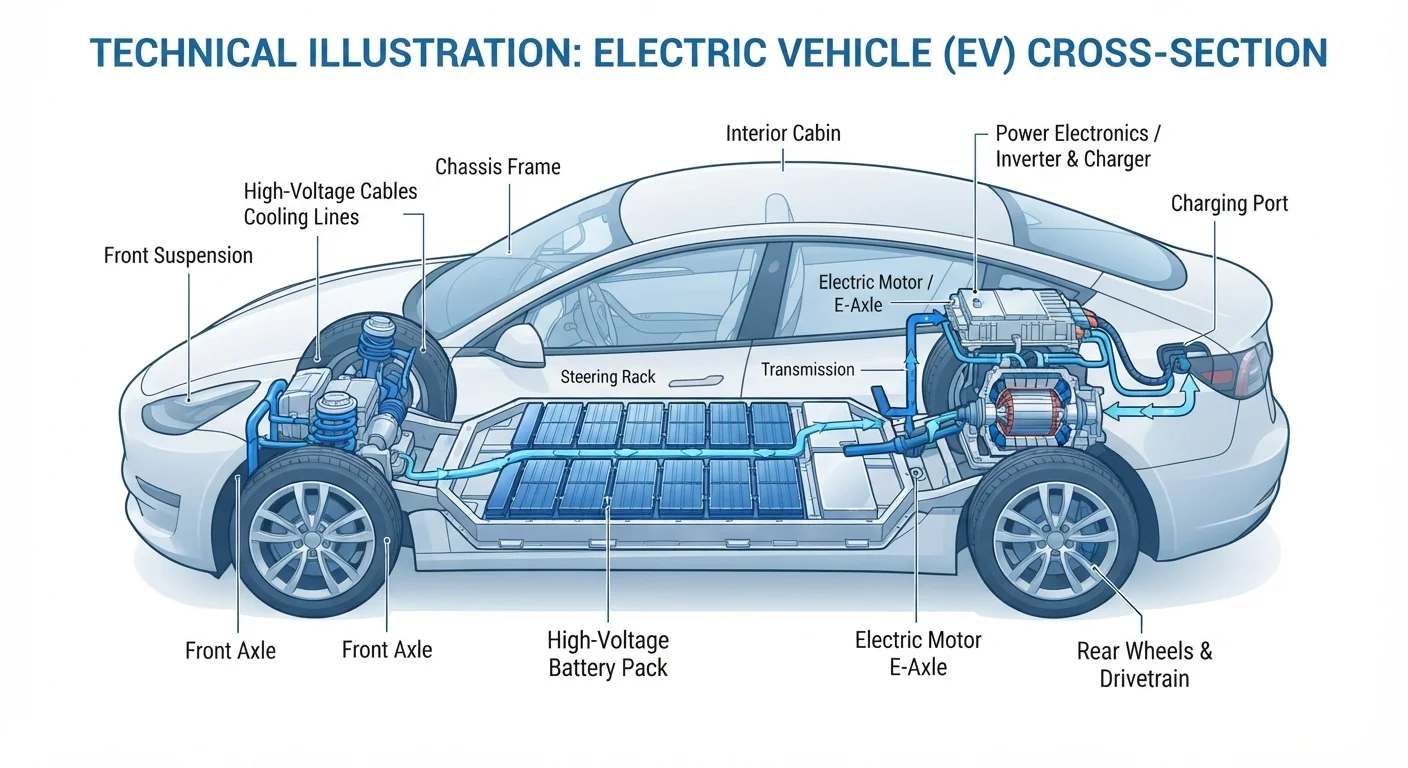
The Core Architecture: Battery, Inverter, Motor
Strip away the bodywork of a battery-electric vehicle and three components do almost all the mechanical work: the battery pack, the inverter, and the electric motor.
The battery pack — typically a large, flat assembly mounted in the vehicle floor — stores energy in kilowatt-hours (kWh), much like a smartphone battery stores energy in milliamp-hours. Capacity ranges from around 40 kWh in smaller city EVs to over 100 kWh in long-range models. A higher kWh figure generally means more available range, though efficiency (how far the car travels per kWh) matters just as much as raw capacity.
The inverter acts as the power controller between the battery and the motor. Most lithium-ion battery packs supply direct current (DC), but most traction motors run on alternating current (AC). The inverter manages this conversion and also controls how much power flows to the motor at any given moment — which is how the car translates your accelerator input into wheel movement.
The electric motor converts electrical energy into rotation. Unlike a combustion engine, which builds torque gradually as RPM rises, an electric motor delivers its peak torque almost immediately from rest. That characteristic is why EVs feel so responsive off the line. For a closer look at how this compares to other drivetrain layouts, see how an electric drivetrain differs from everything before it.
~20
Moving parts in a typical EV drivetrain
Compared to roughly 200 moving parts in a conventional internal combustion engine drivetrain, according to widely cited industry estimates.
0 RPM
Point of peak torque delivery
Electric motors produce maximum torque from a standstill, unlike combustion engines which must reach a higher RPM range to access peak torque.
10–30%
Energy recovered via regenerative braking
Estimates from various automotive engineering sources suggest regenerative braking can recover between 10% and 30% of energy in typical driving cycles, depending on conditions.
Regenerative Braking: Recovering Energy You'd Otherwise Lose
Every time a conventional car brakes, kinetic energy is lost as heat through the brake pads and discs. EVs recover a meaningful portion of that energy through regenerative braking.
When you lift off the accelerator or press the brake pedal, the electric motor switches roles and acts as a generator. The car's forward momentum spins the motor, which produces electricity that is fed back into the battery pack. The result is a braking force on the wheels (which you feel as deceleration) and a small but real increase in stored energy.
Most EVs let drivers adjust regenerative braking strength. High-regen settings — sometimes called one-pedal driving — allow the car to slow to a near-stop without touching the friction brakes at all. This is particularly efficient in urban stop-and-go driving, where energy recovery opportunities are frequent.
Maximise Efficiency With Regen Settings
If your EV offers adjustable regenerative braking levels, experiment with a higher setting during city driving. More frequent stops mean more recovery opportunities, and one-pedal driving can reduce wear on friction brake components over time. Check your owner's manual for how to adjust the setting on your specific vehicle.
What the Absence of an Engine Actually Changes
Without a combustion engine, a long list of familiar components simply disappears: no multi-speed gearbox, no exhaust system, no oil changes, no timing belt, no spark plugs, no fuel injectors. The mechanical footprint shrinks considerably.
This simplicity has practical consequences for ownership. Fewer moving parts means fewer things that wear out on a predictable maintenance schedule. For a detailed look at how service costs compare, the electric vehicle servicing cost breakdown explains what changes and what stays the same.
The interior experience changes too. There is no engine vibration at idle, no gear-change interruption during acceleration, and no exhaust noise. Cabin sound is dominated by wind and tyre noise at speed — sounds that combustion engine noise previously masked.
High-Voltage Systems Require Qualified Service
EV battery packs and associated wiring operate at high voltages — typically between 400 and 800 volts DC in modern vehicles. Inspection, repair, or modification of high-voltage components should only be carried out by trained technicians with the appropriate equipment. Do not attempt to service these systems without proper certification and tools.
If you are wondering how this compares to a hybrid setup — which keeps a combustion engine alongside an electric motor — the hybrid powertrain explainer walks through the key differences.
For drivers ready to think about what switching actually looks like day-to-day, what going electric actually looks like for an everyday driver covers the practical realities — from morning charging habits to longer trips.