
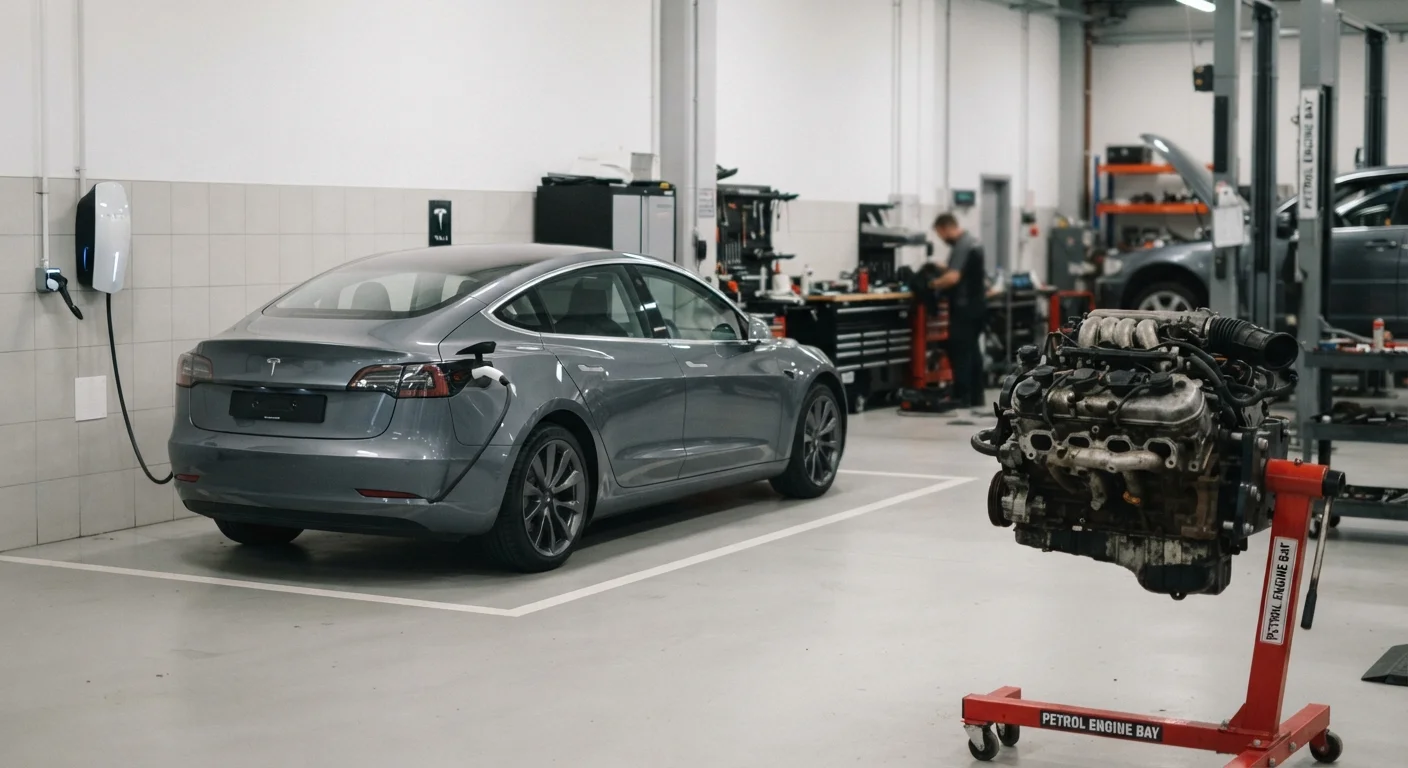
What EVs Actually Skip — and Why It Matters
The most immediate maintenance difference is what disappears entirely. An electric vehicle has no internal combustion engine in the traditional sense, which removes a significant list of recurring costs:
- Engine oil and filter changes — not applicable; there is no oil sump to drain
- Spark plugs, timing belts, and cam chains — electric motors have no ignition cycle
- Exhaust system repairs — no exhaust gases means no catalytic converter, muffler, or oxygen sensors to replace
- Transmission fluid services — most EVs use a single-speed reduction gear that requires minimal attention
- Coolant flushes (engine-side) — EVs do use thermal management fluids, but on a longer replacement interval
For a combustion vehicle averaging roughly 10,000–15,000 miles annually, oil changes alone can run $100–$200 per year depending on vehicle and oil type. Over five years, eliminating those services plus other drivetrain work adds up to a measurable saving. For a fuller picture of what that means across a full ownership period, see the real costs of owning an electric vehicle over five years.
Check Manufacturer Service Schedules Before Assuming
EV service intervals vary more between manufacturers than petrol vehicles do. Some automakers require annual inspections even if no consumables need replacing — skipping these could affect warranty coverage. Download the owner's manual or contact an authorized service center to confirm what your specific vehicle actually needs and when.
Costs That Remain — or Increase — With an EV
Skipping the engine service items does not mean skipping the service center altogether. Several maintenance categories stay constant or become more prominent with EVs.
Tyres
EVs typically weigh more than equivalent combustion vehicles due to battery packs, and instant torque delivery accelerates tyre wear. Some owners report 20–30% shorter tyre life compared to a similarly sized petrol car, though driving style plays a significant role. Budget accordingly — tyre replacement is often the largest routine maintenance cost for EV drivers.
Brake System
Regenerative braking reduces friction brake use substantially, often extending pad and rotor life well beyond typical combustion intervals. However, infrequent use can cause rotors to corrode if the car sits for extended periods. Annual inspection is still worthwhile even if replacement is rare.
Cabin Air Filters and HVAC
These service intervals are identical to combustion vehicles. HVAC performance matters more in EVs because heating and cooling draw from the traction battery, affecting range.
12-Volt Battery
Every EV also carries a conventional 12-volt auxiliary battery to run electronics and control systems. This battery has a similar replacement cycle to a standard car battery — typically 3–5 years — and is a cost many first-time EV owners overlook.
| Service Item | Petrol/Diesel | Electric Vehicle | |
|---|---|---|---|
| Engine oil & filter | Every 5,000–10,000 miles | Not applicable | |
| Spark plugs / ignition | Every 30,000–100,000 miles | Not applicable | |
| Exhaust system | Inspect & repair as needed | Not applicable | |
| Brake pads & rotors | Every 25,000–50,000 miles | Extended interval; regen reduces wear | |
| Tyre replacement | Standard wear rate | Accelerated wear; budget more frequently | |
| 12-volt battery | Every 3–5 years | Every 3–5 years | |
| Cabin air filter | Every 12,000–15,000 miles | Same interval | |
| High-voltage battery check | Not applicable | Periodic inspection recommended | |
| Coolant / thermal fluid | Every 2–5 years | Longer interval; battery loop inspection | |
| Transmission service | Every 30,000–60,000 miles | Minimal; reduction gear requires little attention |
Labor Rates and Technician Access
One underappreciated cost variable is who can work on your car. High-voltage EV systems require technicians with specific safety training and certification. This limits your options compared to a petrol or diesel vehicle, where virtually any independent garage can perform routine work.
In practice, this means:
- Franchise dealers often charge premium labor rates that independent shops cannot currently match for EV-specific work
- Independent EV specialists are growing in number but remain less common than general mechanics in many regions
- Warranty considerations may steer owners toward authorized service centers during the coverage period
For a direct comparison of how dealer and independent labor rates differ across vehicle types, see what independent garages and dealerships actually charge. As the EV technician workforce expands, labor rate competition should improve — but that shift is still underway in most US markets.
If you are weighing whether a service plan makes sense given these dynamics, fixed-price servicing vs pay-as-you-go breaks down the trade-offs.
Battery Health: The Wildcard in EV Budgeting
The traction battery is the most expensive single component in any EV — and its long-term condition directly affects both range and resale value. Most manufacturers offer 8-year or 100,000-mile battery warranties covering capacity loss below a defined threshold (commonly 70% of original capacity), but this is general industry context rather than a guarantee applicable to any specific vehicle.
Routine battery care does not require shop visits in the same way oil changes do, but owners should be aware of:
- State-of-charge habits — consistently charging to 100% or depleting to near-zero stresses battery chemistry over time
- Thermal management system checks — the coolant loop that regulates battery temperature needs periodic inspection
- Software updates — many EVs receive over-the-air updates that affect battery management, but not all do
For a detailed look at how battery age affects the financial picture over time, the real cost of owning an EV over five years covers depreciation and residual value alongside servicing. Planning assumptions around battery performance are also addressed in assumptions that can skew your EV cost calculations.
~40%
Estimated reduction in routine maintenance costs
Consumer Reports analysis has suggested EV owners spend roughly 40% less on scheduled maintenance than petrol vehicle owners over comparable mileage.
$0.06/mile
Typical EV maintenance cost per mile
The US Department of Energy has estimated average EV maintenance costs at around $0.06 per mile, compared to approximately $0.10 per mile for internal combustion vehicles.
This article provides general information about vehicle maintenance costs and is not a guarantee of any specific vehicle's performance, reliability, or repair expenses. Costs vary by make, model, region, and service provider. Consult a qualified technician for guidance specific to your vehicle.