
Purchase Price and Upfront Incentives
The sticker price of an electric vehicle is typically higher than a comparable internal combustion engine (ICE) car. Entry-level EVs start around $30,000–$35,000, while mainstream options with adequate range commonly fall in the $40,000–$60,000 range. That gap is real, but it is not the whole story.
The federal Clean Vehicle Credit — available under the Inflation Reduction Act — offers up to $7,500 for qualifying new EVs, subject to income caps, vehicle MSRP limits, and domestic content rules. Several states layer additional rebates or tax credits on top. These incentives can reduce the effective purchase price substantially, though eligibility requirements change and buyers should verify current rules with a tax professional rather than assuming they qualify.
Check Incentive Eligibility Before You Sign
Federal and state EV incentives have income limits, MSRP caps, and domestic content requirements that can affect whether you qualify. Run the numbers with your actual adjusted gross income before assuming you'll receive the full credit. A tax professional can confirm eligibility based on your specific filing situation.
For a direct comparison of how EV purchase economics compare to conventional new cars, see our breakdown of new car ownership costs.
Charging Costs: Home vs. Public
Electricity is the EV equivalent of gasoline, and the rate you pay varies widely depending on where and how you charge.
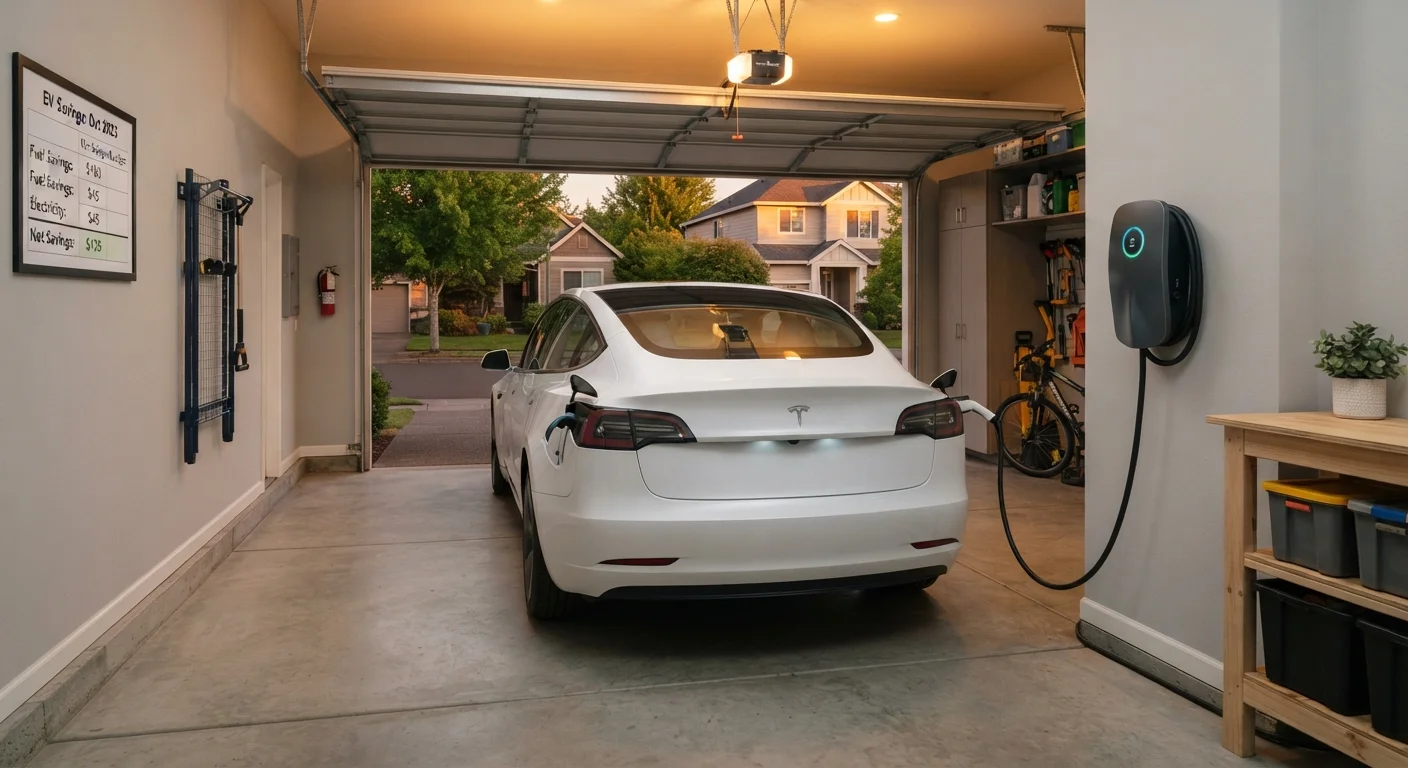
Home charging (Level 2): The average U.S. residential electricity rate is roughly 12–16 cents per kWh, according to U.S. Energy Information Administration data. A typical mid-size EV with a 75 kWh battery costs approximately $9–$12 to charge from empty at home — translating to fuel costs of around 3–5 cents per mile for drivers averaging 13,000 miles per year.
Public DC fast charging: Public chargers typically cost 25–45 cents per kWh, and some networks charge by the minute. Drivers who rely heavily on public fast charging can see per-mile energy costs that rival or exceed a fuel-efficient gasoline car. Over five years, the difference between primarily home charging and primarily public charging can amount to thousands of dollars.
3–5¢
Per-mile cost with home charging
Based on average U.S. residential electricity rates of 12–16 cents per kWh, per U.S. Energy Information Administration data.
30–40%
Maintenance cost reduction vs. ICE
Consumer Reports and AAA data indicate EV owners pay significantly less for routine maintenance over a vehicle's lifetime.
10–25%
Higher average EV insurance premiums
Analysis from industry researchers suggests EVs command higher premiums due to elevated repair costs and specialized parts.
40–60%
Typical value lost over five years
Depreciation remains the largest single cost component for most EV owners, varying by model and market conditions.
For a grounded picture of how charging fits into everyday routines, our article on what going electric actually looks like is a useful companion read.
Servicing, Maintenance, and Tyres
EVs eliminate many traditional service items: no oil changes, no transmission fluid, no spark plugs. Regenerative braking reduces brake pad wear significantly. Consumer Reports and AAA data consistently show EV maintenance costs are lower than ICE equivalents — often by 30–40% over a vehicle's lifetime.
What remains? Cabin air filter replacements, wiper blades, coolant checks for the battery thermal management system, and annual safety inspections. Battery health checks are increasingly standard at dealership service intervals.
Tyres: EVs are heavier than ICE vehicles, and instant torque delivery accelerates tyre wear. Owners frequently report replacing tyres earlier than expected — sometimes at 25,000–35,000 miles rather than the 40,000–50,000 typical for many sedans. Budget for this accordingly.
If you're comparing EV servicing costs, ask dealers for a five-year service schedule and itemized costs upfront — many will provide this and it makes budgeting far more precise.
Servicing intervals and costs vary considerably between manufacturers; getting this in writing before purchase eliminates guesswork and allows direct comparison.
Factor tyre costs into your EV budget from day one by setting aside a dedicated annual reserve — EV tyre wear can surprise owners used to conventional car schedules.
EV weight and instant torque delivery accelerates tyre wear, and EV-specific tyres (low rolling resistance) can cost more per unit than standard replacements.
For a full breakdown of what changes and what stays the same, see our guide to EV servicing and maintenance and our companion piece on how EV running costs differ from petrol and diesel.
Insurance and Registration Fees
EV insurance premiums are generally higher than those for equivalent ICE vehicles. Repair costs for EVs — particularly following accidents involving battery systems or specialized components — are higher, and fewer independent repair shops are equipped to handle them. Insurers price these factors into premiums.
Studies from organizations such as ValuePenguin and the Insurance Institute for Highway Safety suggest EV drivers pay 10–25% more in annual premiums on average, though this varies significantly by model, driver profile, and state.
Registration fees in some states are also higher for EVs. Several states charge an annual EV fee — ranging from around $50 to over $200 — as a partial substitute for gas-tax revenue that EVs don't contribute to. Check your state's DMV fee schedule before buying.
For broader context on recurring ownership costs, our Insurance & Fees hub covers what to expect across vehicle types.
Don't Overlook Annual EV Surcharge Fees
Many U.S. states charge an annual EV registration surcharge — sometimes labeled a 'road use fee' — that can range from $50 to over $200 per year. These fees are designed to offset lost gas-tax revenue and are in addition to standard registration costs. Check your state DMV's current fee schedule to avoid an unexpected bill at renewal.
Depreciation: The Largest Hidden Cost
For most owners, depreciation is the biggest single expense over five years — often representing 40–60% of the vehicle's original value lost by year five. EVs have historically depreciated faster than comparable ICE vehicles, though this pattern is shifting as the used EV market matures and consumer confidence grows.
Key depreciation drivers for EVs include battery age and remaining capacity, the rapid pace of technology advancement (making older models feel dated quickly), and changes in federal incentives (a new buyer getting a credit on a new model reduces demand for used alternatives).
“Depreciation is the expense most car buyers never see coming — it's not a bill you pay monthly, but it's often the largest cost of owning any vehicle over a five-year period.”
— Jack Gillis, Executive Director, Center for Auto Safety, and longtime automotive consumer advocate
Our detailed article on EV depreciation compared to petrol and diesel explains the mechanics in depth.
Five-Year Total Cost: Putting It Together
Adding up purchase price, financing costs, energy, maintenance, insurance, registration, and depreciation gives a true total cost of ownership (TCO). For a mainstream EV purchased in the $45,000–$55,000 range and driven 13,000 miles per year, a reasonable five-year TCO estimate — before incentives — might look like this:
| Cost Category | Estimated 5-Year Cost |
|---|---|
| Depreciation | $18,000–$28,000 |
| Financing (interest) | $5,000–$9,000 |
| Insurance | $8,000–$14,000 |
| Electricity (home charging) | $3,000–$5,000 |
| Maintenance & tyres | $3,000–$5,500 |
| Registration & fees | $500–$1,500 |
These figures are illustrative ranges, not guarantees — actual costs vary by model, location, driving habits, electricity rates, and insurance profile. A federal credit of up to $7,500 and applicable state rebates can meaningfully shift the balance.
Whether an EV makes financial sense depends on your specific situation. Drivers with home charging access, high annual mileage, and eligibility for incentives generally see the strongest TCO case. Those relying on public charging or buying with short ownership horizons may find the math tighter.
For a broader look at how these numbers compare across vehicle types, see our full guide to ongoing car ownership costs. If you're weighing how to structure the purchase itself, our article on leasing vs. buying an EV outright covers the trade-offs in detail.
This article is for general informational purposes only and does not constitute financial, tax, or legal advice. Incentive eligibility, tax credits, insurance rates, and ownership costs vary by individual circumstances, state, and model year. Consult a qualified financial or tax professional for guidance specific to your situation.