
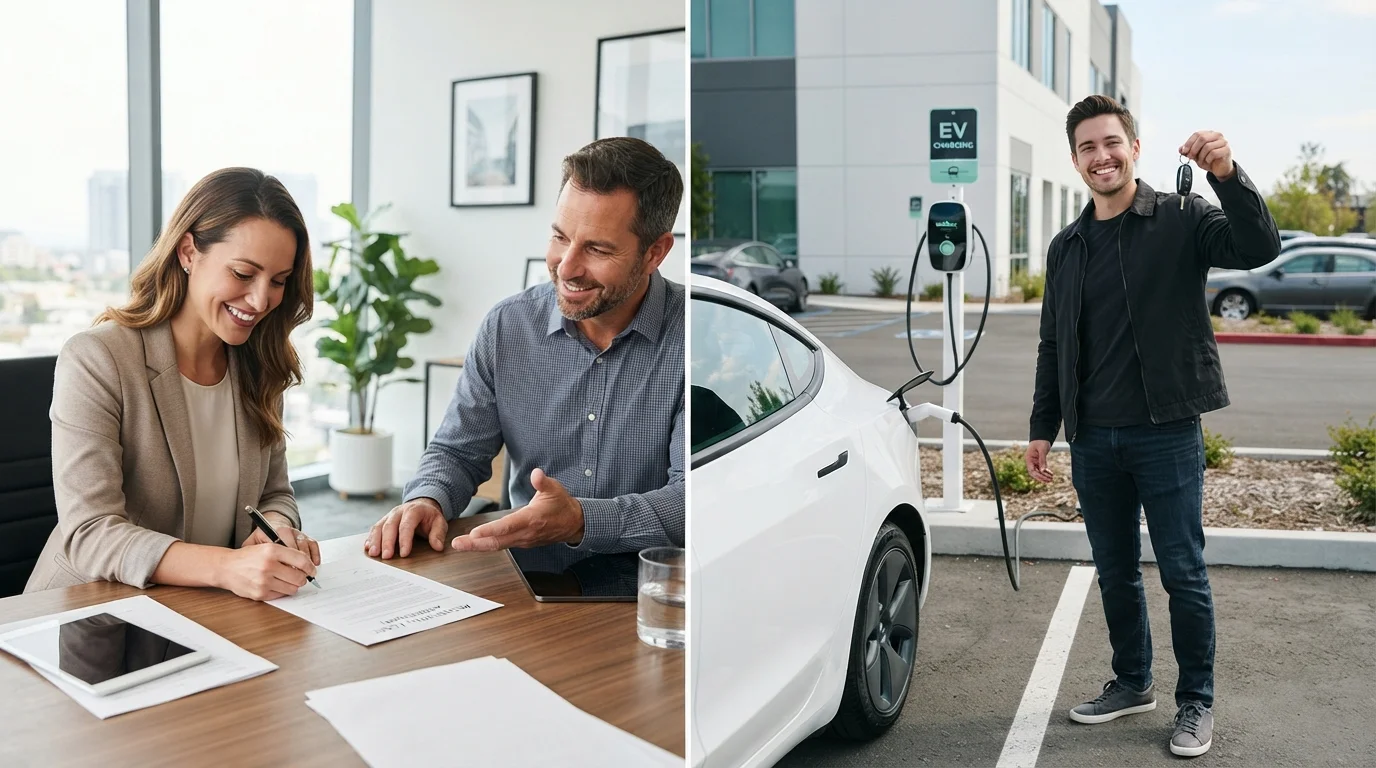
How EV Leasing and Buying Actually Work
When you lease an EV, you are paying for the vehicle's depreciation over a set term — typically 24 to 36 months — plus interest (called the money factor) and fees. You never own the car; at the end of the lease, you return it or pay a residual value to purchase it. When you buy outright, either with cash or financing, the vehicle is yours from day one, and every payment builds equity.
For EVs specifically, this distinction carries extra weight. Federal incentives, battery longevity concerns, and rapidly changing technology all affect which path delivers more value. Understanding the mechanics before comparing numbers is essential. For a broader look at EV ownership costs, see our full five-year cost breakdown.
Lease vs. Loan: A Key Terminology Note
Leasing and financing (taking an auto loan) are sometimes confused. Financing means borrowing money to purchase the vehicle — you own it and repay a lender. Leasing means renting the vehicle from the automaker or a leasing company for a fixed term. The financial structures, tax implications, and end-of-term options are fundamentally different. Always clarify which arrangement is being quoted when shopping.
Pros and Cons of Leasing an EV
Leasing has genuine advantages for many EV shoppers, particularly those uncertain about committing to current battery technology or reluctant to absorb high sticker prices upfront.
Lower monthly payments than financing a purchase
Because you are only paying for depreciation rather than the full vehicle value, lease payments are typically 20–30% lower than loan payments on the same model, easing monthly cash flow.
Access to newer technology every few years
EV battery range and charging speeds are improving rapidly. A two- or three-year lease cycle lets you move into a newer, longer-range model without dealing with trade-in values on aging technology.
Lower upfront out-of-pocket cost
Many EV leases require little or no down payment beyond the first month's payment and acquisition fee, reducing the barrier to entry compared to a cash purchase or loan down payment.
Warranty coverage typically spans the full lease term
Most new EV leases are structured within the manufacturer's bumper-to-bumper warranty period, so unexpected repair costs are largely covered, reducing financial risk.
Flexibility to reassess your needs at term end
At lease end, you can return the vehicle, buy it at the residual price, or lease a different model — useful if your household's transportation needs change within a few years.
However, leasing also carries real limitations that can erode its apparent affordability.
No equity built over the lease term
Every payment goes toward the automaker's asset, not yours. At lease end, you have nothing to trade in or sell, meaning you must enter a new payment cycle to keep a vehicle.
Mileage caps can be costly to exceed
Standard leases allow 10,000–12,000 miles per year. Excess mileage fees typically run 15–25 cents per mile, which can add hundreds of dollars at turn-in for higher-mileage drivers.
Federal tax credit may not flow directly to you
Under current rules, the $7,500 federal EV credit goes to the leasing company as owner of the vehicle. Whether that benefit is passed on through reduced payments varies by automaker and deal structure.
Wear-and-tear charges at return
Lessees are responsible for damage beyond 'normal wear,' which is often defined narrowly. Scratches, tire wear, or interior marks can trigger fees assessed at the end of the term.
Perpetual payment cycle with no exit without cost
Early termination of a lease is expensive — early termination fees can equal several months of remaining payments, making it difficult to exit the agreement if circumstances change.
The Financial Case for Buying
Purchasing an EV — whether with cash or an auto loan — tends to look more favorable the longer you hold the vehicle. The federal Clean Vehicle Tax Credit (up to $7,500 under the Inflation Reduction Act, subject to income and vehicle eligibility limits) is available to buyers, not lessees — though some lease structures pass a portion of this benefit through adjusted monthly payments, so it is worth asking about explicitly.
$7,500
Maximum federal EV purchase tax credit
The Inflation Reduction Act established this credit for eligible new EV buyers, subject to income limits and vehicle price caps set by the IRS.
~49%
Average EV depreciation after three years
Industry data has shown some EV models depreciating more steeply than comparable internal-combustion vehicles, partly due to rapid technology advancement and increased competition.
Depreciation is the largest ownership cost for any vehicle, and EVs can depreciate steeply in the first two years. Buyers absorb that loss; lessees transfer it to the automaker. But buyers who hold their vehicle for six or more years often come out ahead once per-mile costs are calculated. For a complete cost framework, our real cost of EV ownership guide walks through electricity, servicing, insurance, and depreciation in detail.
If you are also weighing whether an EV is the right powertrain at all, our hybrid vs. electric comparison can help you evaluate the full picture before committing to either a lease or purchase.
This article provides general financial information for educational purposes only. Tax credit eligibility, income thresholds, and vehicle qualification rules can change. Consult a qualified tax professional or financial adviser for guidance specific to your situation.