
What You're Actually Comparing
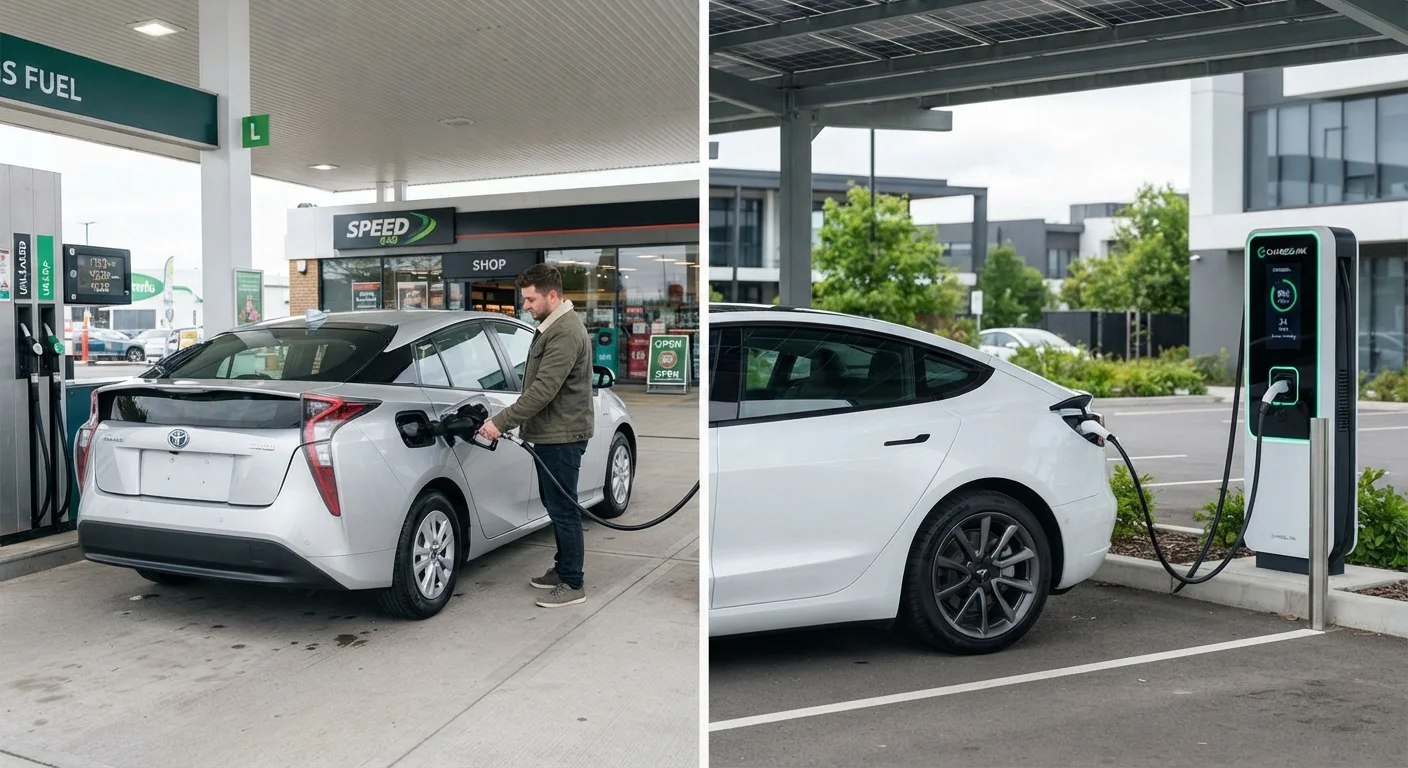
A conventional hybrid pairs a gasoline engine with an electric motor and a small battery that self-charges through regenerative braking — you never plug it in. A fully electric vehicle (EV) runs solely on a large battery pack that must be recharged from an external power source. The decision between them isn't about which technology is superior; it's about which fits your driving life.
For a deeper look at the middle-ground option that combines both approaches, see our Hybrid vs. Plug-In Hybrid comparison — this article focuses on the two endpoints of the spectrum.
| Hybrid | Electric Vehicle (EV) | |
|---|---|---|
| Refueling method | Gas station, 5 minutes | Home or public charger, 20 min–8+ hrs |
| Typical range | 400–500 miles per tank | 200–350 miles per charge |
| Upfront cost | Generally lower | Generally higher |
| Per-mile energy cost | Moderate (gasoline-dependent) | Typically lower (electricity) |
| Home infrastructure needed | None | Level 2 charger recommended |
| Maintenance complexity | Moderate (gas engine + electric) | Low (no engine, fewer wear parts) |
| Best driving environment | City and highway, flexible | Predictable urban/suburban commutes |
Range and Refueling: The Practical Divide
Hybrids inherit the full range of a gasoline car — typically 400 to 500 miles per tank — and can be refueled in minutes at any of the roughly 150,000 gas stations across the US. That flexibility is hard to overstate for drivers who take long or spontaneous road trips.
EVs carry EPA-rated ranges that commonly fall between 200 and 350 miles on a full charge, with real-world figures varying based on temperature, speed, and climate system use. Public DC fast chargers can add significant range in 20–40 minutes, but charger availability is uneven — dense in cities, sparse in many rural corridors. What going electric actually looks like for an everyday driver is a grounded read on how this plays out in practice.
Map Your Charging Options Before Deciding
Before committing to an EV, spend a week noting where you park overnight, whether a 240V outlet is accessible, and how often you take trips beyond 200 miles. If home charging isn't realistic and public fast-charger coverage in your area is thin, a hybrid may serve you better regardless of its other trade-offs.
Ownership Costs: Purchase Price vs. Running Costs
EVs generally carry a higher sticker price than comparable hybrids in the same segment, though the gap varies widely by model and trim. Running costs typically favor EVs: electricity is generally cheaper per mile than gasoline, and EVs have fewer moving parts — no oil changes, no transmission fluid, fewer brake jobs thanks to regenerative braking.
Hybrids close some of that gap through strong fuel economy, particularly in city driving where regenerative braking delivers the biggest gains. Why hybrids often shine in city driving explains the efficiency mechanics behind that pattern.
For a detailed look at hybrid running costs versus purchase price trade-offs, The Honest Trade-Offs of Going Hybrid offers a balanced breakdown. Total cost of ownership depends heavily on annual mileage, local electricity and gas prices, and whether federal or state incentives apply to the vehicle you're considering.
~$1,000
Estimated average annual fuel savings, hybrid vs. non-hybrid
The US Department of Energy notes hybrid drivers can save roughly $1,000 or more per year in fuel depending on vehicle type and driving patterns.
80%
EV charging sessions that happen at home
Research from the US Department of Energy consistently finds the large majority of EV charging takes place at the driver's residence overnight.
Charging Access: The Make-or-Break Factor
Home charging is the single biggest variable in EV ownership. Drivers with a garage or dedicated parking space can install a Level 2 charger (240V) and wake up to a full battery every morning — this transforms the EV experience. Drivers in apartments or shared parking face a genuine barrier that no amount of public infrastructure currently solves completely.
Hybrids sidestep this entirely. You fill up when the gauge drops, exactly as you always have. For households with unpredictable schedules or multiple drivers sharing a vehicle, that simplicity has real value. Our Hybrid Buyer's Checklist walks through how to assess whether your situation genuinely supports either powertrain.
Don't Assume Public Charging Fills the Gap
Public fast-charging networks are expanding, but coverage remains inconsistent outside major metro areas and Interstate corridors. Relying primarily on public charging typically means longer planned stops and occasional detours. If you lack home charging access, evaluate your specific area's infrastructure honestly before choosing an EV.
Matching Powertrain to Driving Pattern
The clearest signal is your daily mileage and route predictability. An EV is well-suited to a driver who covers 40–80 miles per day on a known route, charges at home overnight, and takes longer trips only occasionally. A hybrid fits the driver who regularly covers 300+ miles in a day, travels through areas with sparse charging networks, or simply values not thinking about charging logistics.
Consider also how you plan to acquire the vehicle. Leasing vs. buying an EV outright carries its own set of trade-offs worth examining, particularly given how quickly EV technology and residual values are evolving.
For broader context on how ownership costs and charging logistics fit together, the Charging & Costs hub consolidates the key financial considerations in one place. The goal isn't to pick the more advanced technology — it's to pick the one that genuinely fits how you live and drive.