
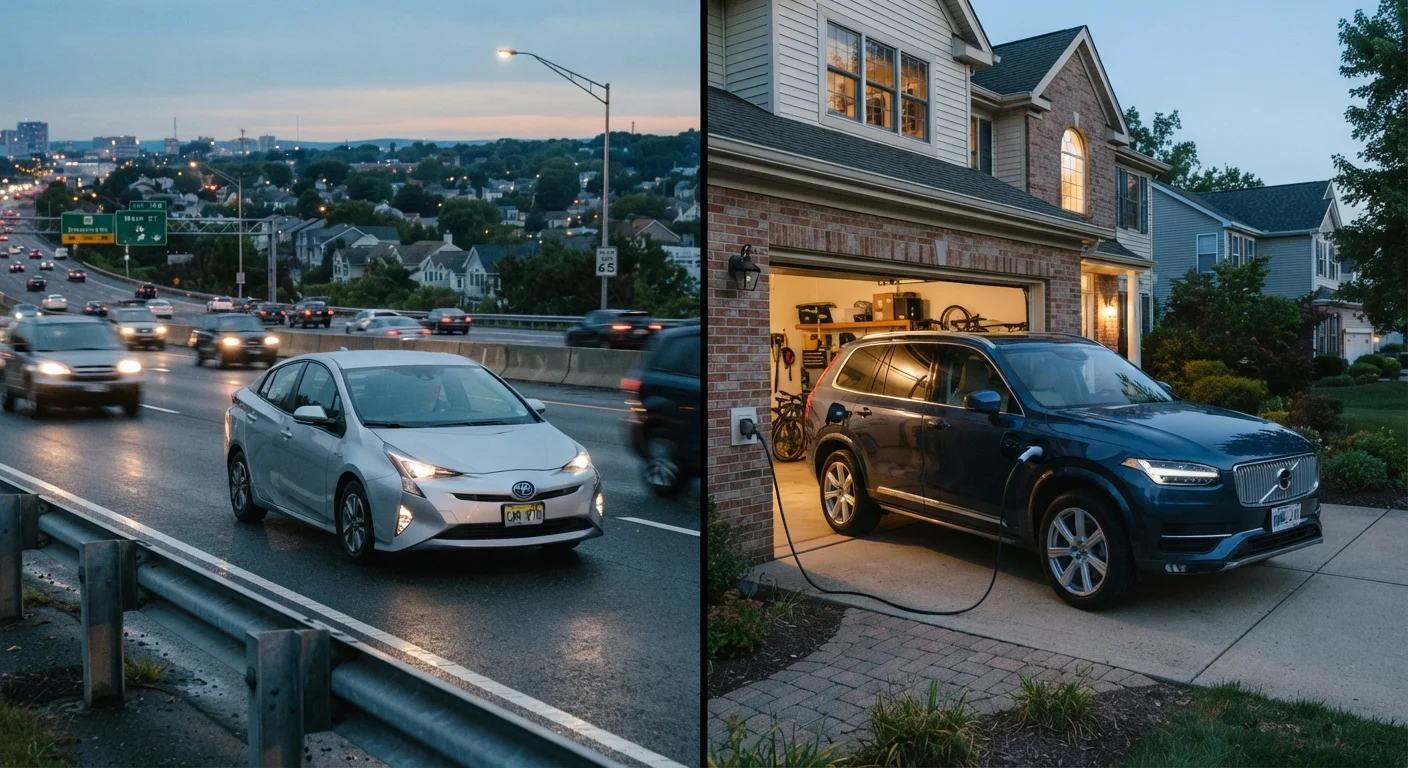
How Each Architecture Actually Works
Both powertrains pair a gasoline engine with one or more electric motors, but they differ fundamentally in how much electrical energy they store and where that energy comes from.
A conventional hybrid (HEV) carries a small battery pack — typically 1–2 kWh — that is charged entirely by the engine and by regenerative braking. The driver never plugs in. The electric motor assists the engine at low speeds and during acceleration, then fades into the background at highway speeds. The result is a meaningful fuel economy improvement, often 25–40% over a comparable non-hybrid, but the vehicle remains 100% dependent on gasoline.
A plug-in hybrid (PHEV) uses a substantially larger battery — typically 8–20 kWh — that can be charged from an external power source as well as through regenerative braking. That extra capacity enables an electric-only driving mode with EPA-rated ranges generally between 20 and 50 miles depending on the model. Once that charge is depleted, the PHEV operates essentially like a conventional hybrid. For a deeper look at how these systems fit within the broader powertrain picture, see The Hybrid Landscape.
| Criterion | Conventional Hybrid (HEV) | Plug-In Hybrid (PHEV) |
|---|---|---|
| Battery capacity (typical) | 1–2 kWh | 8–20 kWh |
| Electric-only range | None (assist only) | 20–50 miles (EPA-rated) |
| External charging required | No — never plugs in | Optional but essential for full benefit |
| Typical purchase price premium | Lower upfront cost | $3,000–$7,000 more than HEV |
| Federal tax credit eligibility | Generally not eligible | Up to $7,500 (conditions apply) |
| Best efficiency scenario | Stop-and-go city driving | Short daily commutes charged nightly |
| Worst efficiency scenario | Steady highway speeds | Driven consistently without charging |
| Infrastructure dependency | Gas stations only | Gas stations + charging access |
The Charging Variable: Why It Decides Everything
The PHEV value proposition hinges almost entirely on how often — and how conveniently — the battery gets recharged. A Level 1 (standard 120V household outlet) charge typically takes 8–14 hours for a mid-sized PHEV pack; a Level 2 (240V) home charger cuts that to roughly 2–4 hours. Drivers who can plug in nightly treat the first 30-plus miles of every day as effectively free of gasoline.
Drivers without home charging access face a different reality. Public Level 2 stations are spreading, but relying on them for routine top-ups introduces friction. A PHEV driven predominantly on a depleted battery operates less efficiently than a well-tuned HEV, because it carries the extra weight of a large, uncharged battery pack. Official PHEV efficiency figures can mislead precisely because they assume regular charging.
When Charging Access Is Uncertain
Before committing to a PHEV, verify your parking situation and local utility policies. Many utilities offer reduced electricity rates overnight — a key factor in maximizing PHEV savings. If your building or HOA restricts outlet installation, factor that friction into your decision. Some workplaces offer Level 2 charging as a benefit, which can substitute for home charging if the commute distance aligns.
For renters, condo residents, or anyone without a dedicated parking space, installing home charging may not be feasible. In those cases, an HEV often delivers better real-world value even if the PHEV's sticker looks attractive.
Cost, Incentives, and Long-Term Ownership
PHEVs typically carry a price premium of $3,000–$7,000 over comparable HEV trims, reflecting the larger battery and dual charging systems. However, PHEVs with battery packs of at least 7 kWh may qualify for the federal Clean Vehicle Credit under the Inflation Reduction Act — worth up to $7,500 — which can meaningfully narrow or even close that gap, subject to income and vehicle price limits. Consult a qualified tax adviser to understand how any credit applies to your specific situation.
Fuel savings depend heavily on driving patterns. A PHEV owner who charges daily and drives mostly within the electric range can cut fuel spending dramatically. The same vehicle driven without charging may cost more to fuel than a conventional hybrid, owing to the weight penalty of the larger battery. How the fuel cost numbers play out across typical driving patterns is explored in detail in a related comparison. For a broader look at charging logistics and ownership costs, the Charging & Costs hub provides a useful framework.
20–50 mi
Typical PHEV electric-only range
EPA ratings across currently available PHEV models in the US market vary widely by battery size and vehicle class.
Up to $7,500
Federal Clean Vehicle Credit for eligible PHEVs
The Inflation Reduction Act provides credits for qualifying plug-in vehicles; income limits and vehicle price caps apply.
25–40%
Typical HEV fuel economy improvement over non-hybrid
EPA combined ratings for hybrid versus non-hybrid versions of the same model commonly show this range of improvement.
Making the Call for Your Driving Life
The right architecture comes down to three honest questions: How far do you drive most days? Where will you charge? What does your typical week look like?
If most of your driving is highway-heavy and your garage has no outlet, a conventional hybrid is a straightforward, proven choice that delivers steady fuel savings with zero new habits required. Curious about how it stacks up against other alternatives? Comparing hybrid and fully electric trade-offs can help you widen that lens.
If your daily mileage falls consistently within a PHEV's electric range and home charging is accessible, the math often favors the PHEV — especially if a federal credit applies. Be realistic about charging discipline; the savings are real only when the battery is regularly replenished. For a balanced look at PHEV ownership beyond the specs, The Plug-In Hybrid Ownership Experience covers the genuine trade-offs alongside the advantages.
Neither choice is universally superior. Both architectures represent sensible bridges between conventional motoring and full electrification — the better one is simply the one that matches how you actually drive.