
Why Hybrid Type Matters Before You Buy
The word "hybrid" covers a surprisingly wide range of technologies — and the differences between them have real consequences for fuel bills, charging habits, and daily convenience. A driver who buys a mild hybrid expecting electric-only commuting will be disappointed. A PHEV owner who never plugs in may never capture the efficiency it was designed to deliver.
Understanding how each system works helps you match the right powertrain to your actual driving life. For a broader look at how hybrids sit within the full spectrum of powertrain options, see the Powertrain Types hub.
20–50 mi
Typical PHEV all-electric range (EPA-rated)
Range varies by model and battery size; most mainstream US PHEVs fall within this window according to EPA ratings.
~10–15%
Fuel economy improvement from mild hybrid systems
Mild hybrid efficiency gains are generally modest compared to full hybrids, reflecting the smaller role the electric motor plays.
48V
Common mild hybrid system voltage
Most modern mild hybrid systems use a 48-volt belt-integrated starter-generator, a common industry standard for entry-level electrification.
Full Hybrids: Self-Charging Efficiency
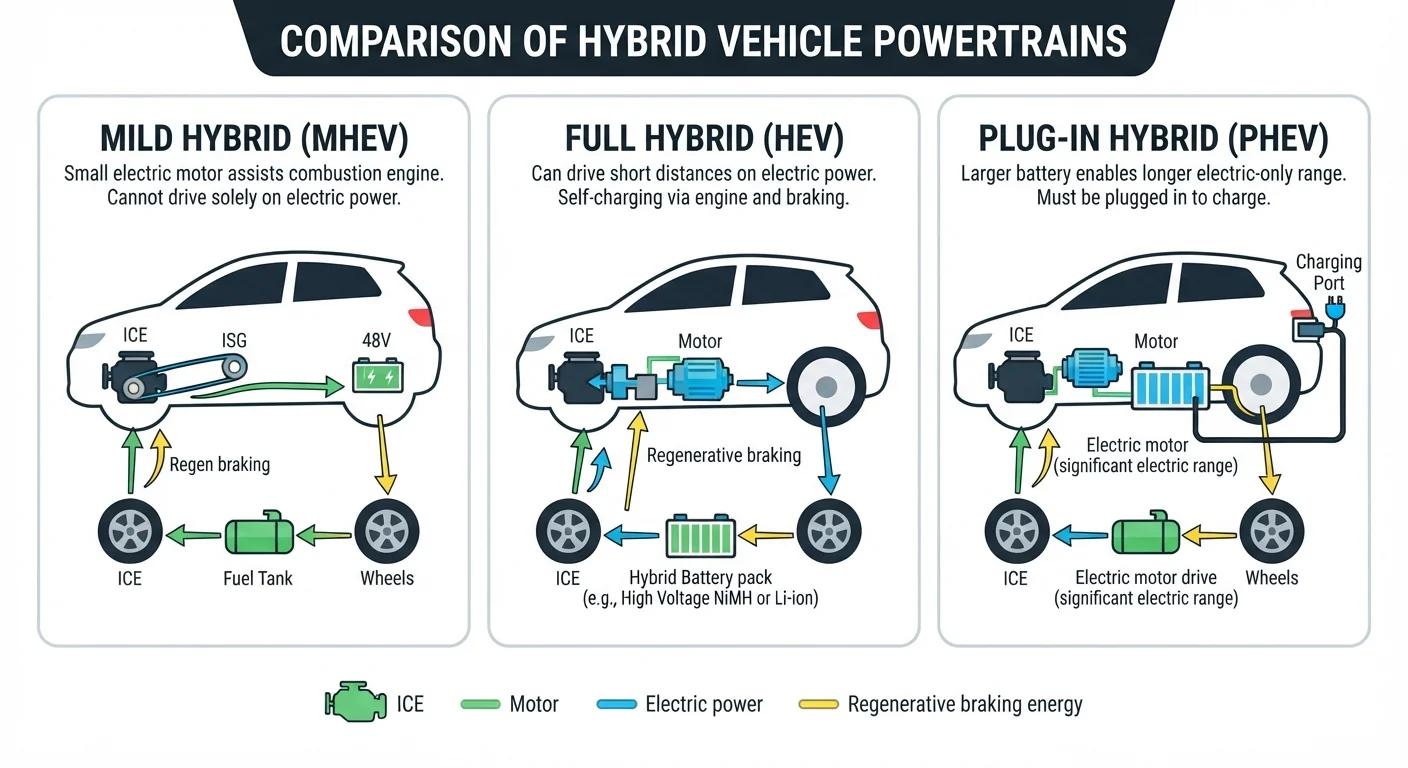
A full hybrid — sometimes called a self-charging hybrid or HEV — pairs a gasoline engine with an electric motor and a modest battery pack. The key feature: the system can propel the vehicle on electricity alone at low speeds, and the battery recharges itself through regenerative braking and the engine. No plug, no charging station needed.
Full hybrids excel in city and suburban driving, where frequent stops allow the battery to replenish. At highway speeds, the gasoline engine does most of the work, so fuel savings are more modest on long freeway hauls. Drivers who spend time in heavy traffic tend to see the most benefit.
Maximize Full Hybrid Efficiency in Traffic
Full hybrids recover energy most effectively during deceleration and braking — which means city and suburban driving patterns are where they shine. If your daily routine includes frequent stops, anticipate braking early and gently rather than braking hard at the last moment. This gives the regenerative system more time to capture energy and top off the battery.
Mild Hybrids: Assistance Without Full Electrification
A mild hybrid (MHEV) uses a small belt-integrated starter-generator — typically a 48-volt system — to assist the engine during acceleration and recover a small amount of energy during braking. The critical distinction: a mild hybrid cannot drive on electricity alone. The electric component is a support act, not a lead performer.
The practical benefits are real but incremental: smoother engine start-stop behavior, slightly improved fuel economy, and reduced engine strain. Mild hybrid technology is increasingly common because it adds electrification at lower cost and complexity than a full hybrid, making it attractive as an entry-level efficiency upgrade. For a direct comparison of how mild hybrids differ from battery-electric vehicles and PHEVs, the article Battery Electric, Plug-In Hybrid, and Mild Hybrid: What Sets Them Apart covers the distinctions clearly.
Plug-In Hybrids: The Bridge to Full Electric
A plug-in hybrid electric vehicle (PHEV) carries a significantly larger battery than a full hybrid and can be charged from an external source — a home outlet, Level 2 charger, or public charging station. That larger battery translates into genuine all-electric range, typically 20–50 miles by EPA estimates depending on the model, before the gasoline engine takes over.
PHEVs are particularly well-suited to drivers with predictable daily commutes within their electric range and access to home or workplace charging. Under those conditions, most daily miles can run on electricity while the gas engine eliminates range anxiety on longer trips. However, a PHEV driven without regular charging functions essentially as a heavier, less efficient gasoline car — so charging habits directly determine how much the technology pays off.
For comprehensive guidance on ownership costs, charging considerations, and long-term value across all hybrid types, see Hybrid Vehicles: The Complete Decision-Making Resource.
PHEV Efficiency Depends on Charging Behavior
PHEVs are sometimes criticized for poor real-world fuel economy when drivers don't charge regularly. This is a usage issue, not a design flaw — the system is built around the assumption that the battery will be recharged frequently. If consistent charging isn't realistic for your situation, a full hybrid may deliver more predictable efficiency gains without the dependency.
Choosing the Right Hybrid for Your Situation
The best hybrid type for you depends on three practical factors: your typical daily mileage, your access to charging, and your priority — upfront simplicity versus maximum fuel savings.
- Primarily city/suburban driving, no charging access: A full hybrid delivers meaningful efficiency without any infrastructure requirement.
- Mostly highway driving, want a modest efficiency bump: A mild hybrid adds economy at lower cost, though gains will be smaller.
- Regular short commutes with home or workplace charging: A PHEV can dramatically reduce fuel consumption and, depending on electricity rates in your area, lower running costs noticeably.
None of these choices is universally superior — each is engineered for a different driver profile. Matching the system to your actual routine is the decision that matters most.
“The right electrification strategy is the one that fits how people actually drive — not how they think they drive. A plug-in hybrid sitting uncharged in a driveway doesn't deliver plug-in hybrid results.”
— EV & Hybrid Guide Editorial Team, Editorial analysis based on EPA efficiency data and industry powertrain research