
How Your Morning Routine Actually Changes
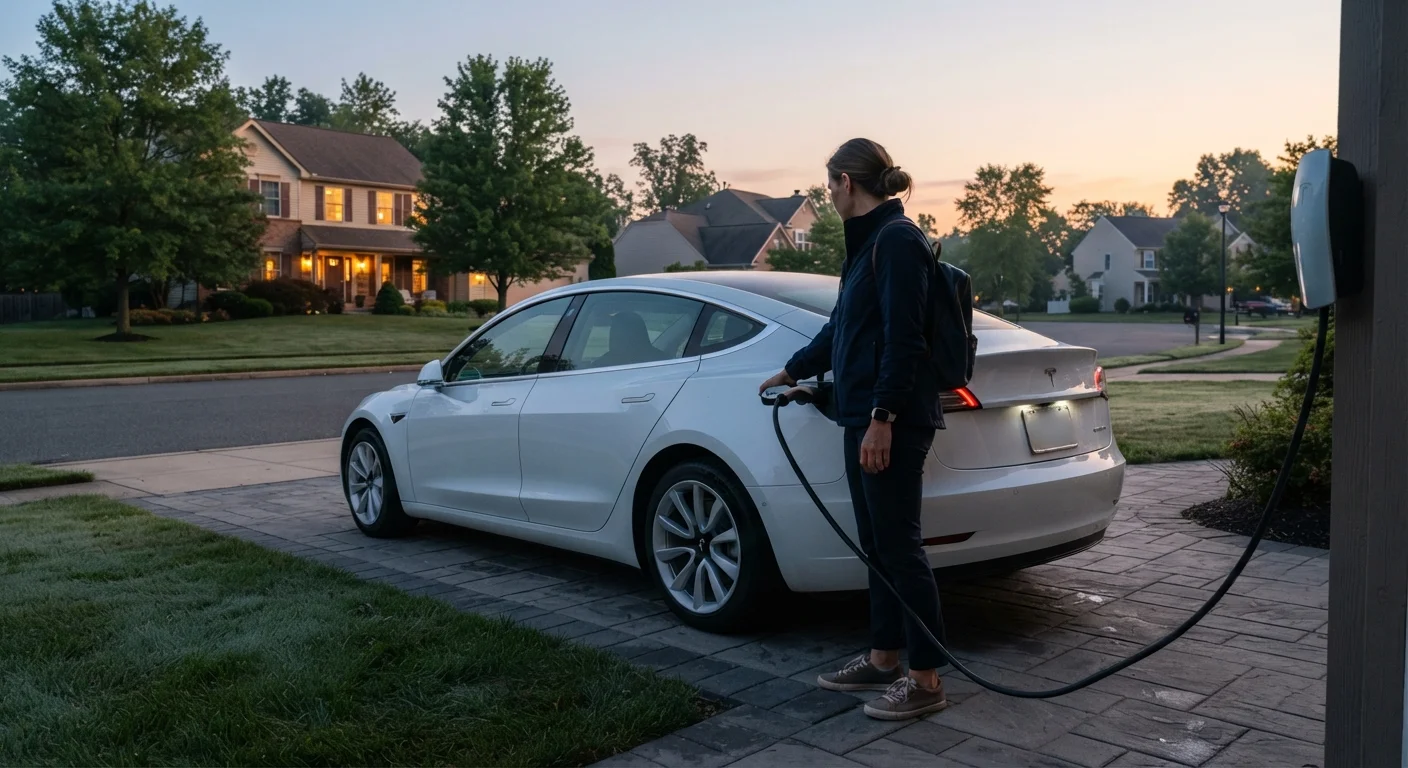
The most immediate shift new EV drivers notice isn't speed or silence — it's the morning ritual. Instead of stopping at a gas station during the week, you plug in when you get home and unplug before you leave. Your car starts every day with a predictable charge level, much like your phone.
Most EV owners set a charging schedule (available through the vehicle's app or onboard settings) to charge during off-peak electricity hours overnight, which typically offers lower rates depending on your utility plan. The practical result: you leave the driveway with a full "tank" every single morning without any detour.
Set Your Charge Limit for Daily Use
Most EV manufacturers recommend keeping the battery between 20% and 80% for everyday charging. Charging to 100% regularly can accelerate battery degradation over time. Reserve full charges for days when you need maximum range, such as before a long road trip.
This routine works seamlessly for drivers with a dedicated parking spot — a garage, driveway, or assigned space with an outlet nearby. If you rely entirely on street parking, home charging isn't available, which is a meaningful constraint worth thinking through before you buy.
Understanding Range in Real-World Terms
Every EV carries an EPA-estimated range figure — the number you see advertised. That number reflects controlled testing conditions. Real-world range depends on several variables: highway speed (faster drains the battery faster), outside temperature, use of air conditioning or heat, and cargo weight.
A vehicle rated at 280 miles of range might deliver closer to 230–250 miles on a cold winter day with the heater running at highway speeds. That's still enough for the vast majority of Americans, whose average daily driving is well under 40 miles according to U.S. Department of Transportation data. Range anxiety — the fear of running out of charge — is common among new EV buyers but typically fades once drivers see how their actual usage compares to available range.
EPA-estimated range
The official mileage figure assigned to an EV after standardized government testing. It represents a useful benchmark, but real-world range will vary based on speed, temperature, and driving style.
Level 2 charging
A 240-volt charging setup — the type most commonly installed at home or found at public parking locations — that can fully charge most EVs overnight.
DC fast charging
High-powered public charging stations found along highways that can add significant range in 20–45 minutes. Not all EVs support the same maximum fast-charge speed.
Regenerative braking
A system that uses the electric motor to slow the vehicle when you lift off the accelerator, converting that kinetic energy back into battery charge instead of wasting it as heat.
State of charge (SOC)
The percentage of battery capacity currently available, equivalent to how full your gas tank is. Most EV owners are advised to keep SOC between 20% and 80% for everyday use to preserve long-term battery health.
One-pedal driving
A driving mode where strong regenerative braking allows the driver to slow and stop the vehicle mostly by lifting off the accelerator, with minimal use of the brake pedal.
Charging at Home vs. on the Road
Home charging covers roughly 80% of what everyday EV drivers need. The remaining 20% is where public infrastructure matters — particularly for longer trips. Understanding the three charging levels helps set realistic expectations. See our EV charging levels explained for a full breakdown of what each speed means day-to-day.
- Level 1 (120V): Standard outlet, 3–5 miles of range per hour. Works for low-mileage drivers but slow for most.
- Level 2 (240V): Dedicated home charger or public station, 20–30 miles per hour. The practical choice for overnight home charging.
- DC Fast Charging: Public highway stations capable of adding 100–200 miles in under an hour for compatible vehicles.
For road trips, the planning shift is real. You'll identify charging stops in advance, factor in 20–45 minute breaks, and choose routes that pass through charging corridors. Many drivers find this less burdensome than expected — the stops often align with natural rest breaks. For the full picture on what EV ownership costs over time, including electricity and charging expenses, see the real cost of EV ownership over five years.
Public Charging Networks Are Expanding
The number of public EV charging stations in the U.S. has grown substantially in recent years, with federal and state programs directing funding toward expanding coverage along major corridors and in underserved areas. Coverage varies significantly by region, so checking network availability in your area before purchasing is worthwhile.
How EVs Feel Different to Drive
Electric motors deliver torque instantly — there's no rev-up, no gear shift, no hesitation. The result is smooth, linear acceleration that catches many new EV drivers off guard. Merging onto a highway or pulling away from a stop feels effortless in a way that takes adjustment.
The other standout sensation is regenerative braking. When you lift off the accelerator in most EVs, the motor acts as a generator, slowing the car and feeding energy back into the battery. Depending on how the driver sets their regeneration level, this can feel like mild deceleration or something closer to light braking — often called "one-pedal driving." Our article on regenerative braking and how to adapt covers this adjustment in more detail.
Cabin noise is also noticeably lower at low speeds, since there's no combustion engine. Wind and tire noise become more audible at highway speeds, but overall the driving experience is generally described as smoother and calmer than a comparable gas vehicle.
Is an EV Right for Your Situation?
Switching to electric works well for drivers who: have home or reliable workplace charging, drive primarily within the vehicle's range on most days, and take long trips occasionally rather than constantly. It requires more advance planning for road trips than a gas car, but for daily commuting and errands it's often more convenient.
It's a less natural fit if you park exclusively on public streets without reliable nearby charging, frequently tow heavy loads (which significantly reduces range), or regularly drive very long distances without flexibility in your schedule.
If you're unsure whether a full EV or a plug-in hybrid makes more sense given your driving patterns, our comparison of hybrid vs. electric trade-offs for everyday drivers lays out the key differences clearly. You can also explore hybrid vehicle options as a middle-ground alternative.
Don't Assume Your Commute Covers Every Scenario
Many buyers calculate EV suitability based only on their daily commute miles and conclude any EV will work. Before deciding, also consider your longest regular trip, how often you travel in extreme cold, and whether your parking situation realistically supports home charging. These edge cases matter more than average daily mileage alone.
This article provides general educational information about electric vehicles and is not a substitute for personalized advice from a qualified automotive or financial professional. Vehicle performance, range, and costs vary by model, driving conditions, and individual circumstances.