
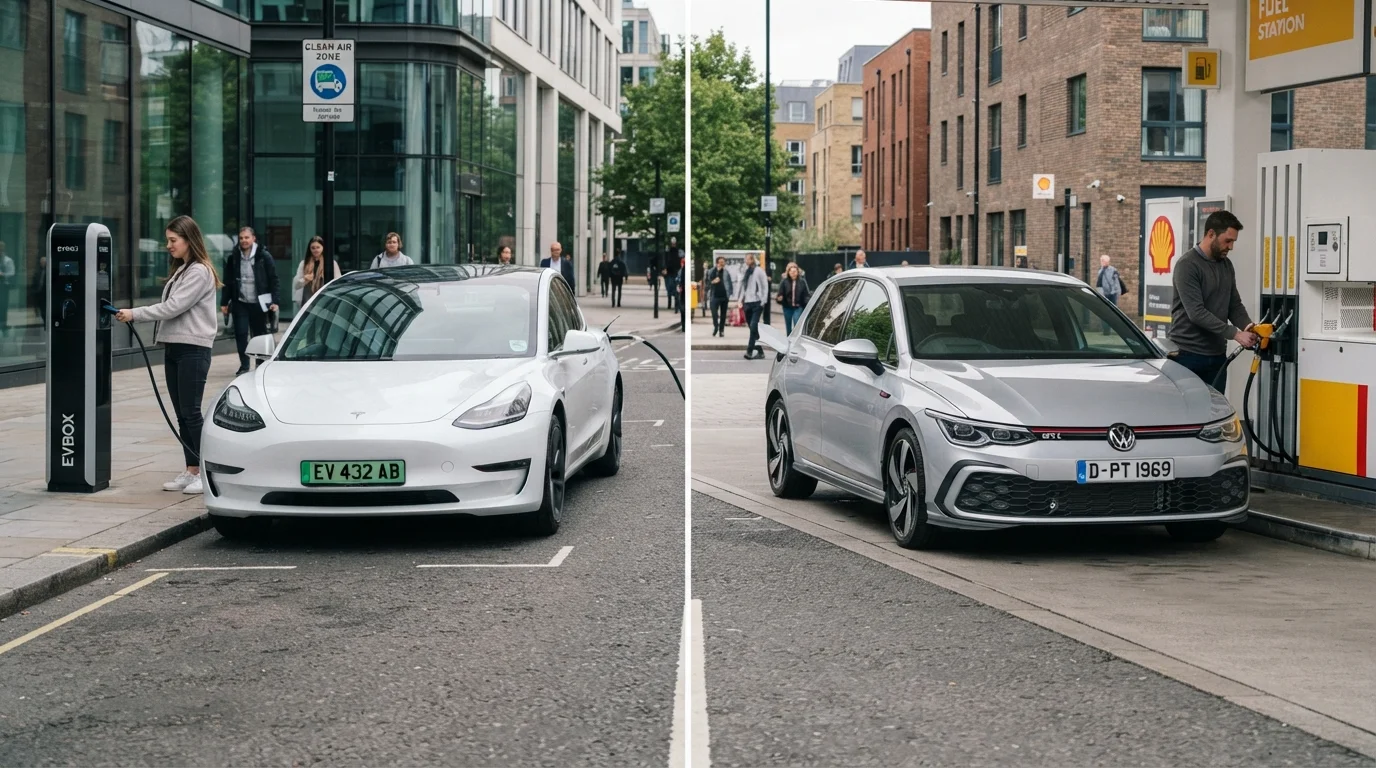
Why Depreciation Works Differently for EVs
Depreciation — the loss in a vehicle's market value over time — is one of the largest real costs of car ownership, often exceeding fuel or maintenance spend over a five-year period. But the forces driving depreciation aren't the same across powertrains.
For petrol and diesel cars, value loss follows a fairly well-understood curve: steep in the first year (often 15–25% of purchase price), then gradually flattening. Mileage, condition, and service history are the main variables. The used market for combustion vehicles is deep and liquid, which supports more predictable pricing.
Electric vehicles introduce additional variables. The most significant is battery health. Unlike a petrol engine whose performance decline is gradual and hard for buyers to quantify, an EV battery's state of health is increasingly measurable — and a battery showing meaningful degradation directly signals reduced range and future replacement costs. This creates steeper early depreciation, particularly in older EV models where battery management technology was less mature.
See the full five-year cost breakdown for context on how depreciation fits into the wider ownership picture.
The Role of Incentives and Technology Cycles
Government purchase incentives — federal tax credits, state rebates, and similar programs — have a direct and sometimes abrupt impact on used EV values. When a new incentive lowers the effective price of a new EV, the used market adjusts quickly. Buyers weighing a two-year-old used EV against a discounted new model will often choose new, which compresses used EV prices.
This mechanism has no real equivalent in the petrol or diesel market, where purchase incentives are rare and smaller in scale. It introduces a layer of policy risk into EV depreciation that is genuinely hard to forecast.
Technology pace compounds this. EV range and charging speed have improved substantially generation-over-generation. A three-year-old EV with 200 miles of range competes against new models offering 300+ miles, which erodes its residual value faster than a three-year-old petrol car with a comparable engine faces obsolescence.
| Electric Vehicle | Petrol Vehicle | Diesel Vehicle | |
|---|---|---|---|
| Typical Year 1 depreciation | 20–30%+ | 15–25% | 15–25% |
| Primary depreciation driver | Battery health & range | Mileage & condition | Mileage & emissions compliance |
| Policy/incentive risk | High — incentive changes reset used prices | Low | Moderate — emissions regulation exposure |
| Technology obsolescence risk | High — rapid range/feature improvements | Low to moderate | Low |
| Used market depth (US) | Growing but still shallow | Deep and liquid | Moderate |
| Long-hold depreciation outlook | Improves — running savings offset loss | Stable and predictable | Uncertain — regulatory direction unclear |
For buyers who want to understand how servicing costs interact with these depreciation dynamics, EV servicing costs vs petrol and diesel covers that ground in detail.
Diesel Depreciation: A Separate Pressure
Diesel vehicles present their own depreciation challenge. Historically, diesel commanded a premium on the used market — particularly for high-mileage drivers who valued fuel economy and engine longevity. That dynamic has softened in many US markets, and more sharply in some international ones, as emissions regulations tighten and urban low-emission zones expand.
In the US context, the primary depreciation risk for diesel is concentrated in older vehicles that do not meet current emissions standards, particularly light-duty trucks and SUVs subject to evolving EPA standards. Buyers considering diesel should assess both the regulatory trajectory and the depth of the used diesel market in their region.
Diesel Resale Risk Is Region-Dependent
Depreciation pressure on diesel varies significantly by geography. Urban markets with active or proposed low-emission zones tend to price diesel vehicles more aggressively downward. If you're buying a diesel with plans to sell in a major metro area, research current and proposed local emissions policy before committing — resale conditions can shift faster than a typical ownership cycle.
What modern emissions standards mean for diesel ownership provides a useful grounding if you're evaluating a diesel purchase today.
Making a Depreciation-Aware Buying Decision
No depreciation curve is fixed — all three powertrain types carry uncertainty. The practical question is which risks you're best positioned to absorb.
- If you plan to keep a vehicle for 7–10 years: EV depreciation matters less because you won't be selling into the steepest part of the curve. Running cost savings may offset early value loss.
- If you expect to sell or trade in within 3 years: Petrol vehicles currently offer more stable residual value projections, though this may shift as EV markets mature.
- If you're buying used: A used EV can represent strong value precisely because early depreciation is already priced in — but verifying battery health through a diagnostic report is essential before purchase.
Understanding running cost differences between EVs and combustion vehicles will help you build a more complete total-cost picture alongside depreciation estimates.
Check Battery State of Health Before Buying Used
When evaluating a used EV, request a battery state-of-health (SoH) report — many manufacturers and third-party services can provide this. A battery retaining 80% or more of its original capacity is generally considered healthy. Below that threshold, factor in the potential cost of eventual pack replacement when assessing the vehicle's true value.
This article provides general information about vehicle depreciation patterns and is not personalised financial or investment advice. Actual depreciation varies by vehicle, market, and individual circumstances. Consult a qualified financial adviser for guidance specific to your situation.