
What EVs Eliminate Entirely
The most immediate difference between EV and gas-car ownership is a shorter service checklist. With no internal combustion engine, entire categories of maintenance simply disappear.
- Engine oil and filter changes — no moving pistons means no oil to degrade
- Spark plugs and ignition system — there is no combustion to ignite
- Timing belt or chain — no camshafts to synchronize
- Exhaust system — no tailpipe, catalytic converter, or muffler to replace
- Transmission fluid — most EVs use a single-speed reduction gear requiring little or no fluid service
For context on why these components exist in gas vehicles in the first place, see how EVs actually move. The mechanical simplicity is the point: fewer moving parts means fewer things to wear out or fail.
If you've been budgeting around traditional service schedules, a decade-long gas-car maintenance overview illustrates just how many line items disappear when you switch to electric.
What Still Needs Regular Attention
Owning an EV does not mean owning a maintenance-free vehicle. Several components wear on the same schedule as any other car.
~30%
Fewer scheduled maintenance events vs. gas vehicles
Consumer Reports analysis indicates EV owners visit service centers significantly less often than owners of gas-powered vehicles over a comparable ownership period.
2× or more
Longer brake pad life on many EVs
Regenerative braking handles much of the deceleration load, with many EV owners and fleet operators reporting substantially extended friction brake pad intervals compared to gas vehicles.
8 yrs / 100K mi
Minimum federal battery warranty requirement
US federal regulations require EV battery packs to be warranted against significant capacity loss for at least 8 years or 100,000 miles, whichever comes first.
Tyres
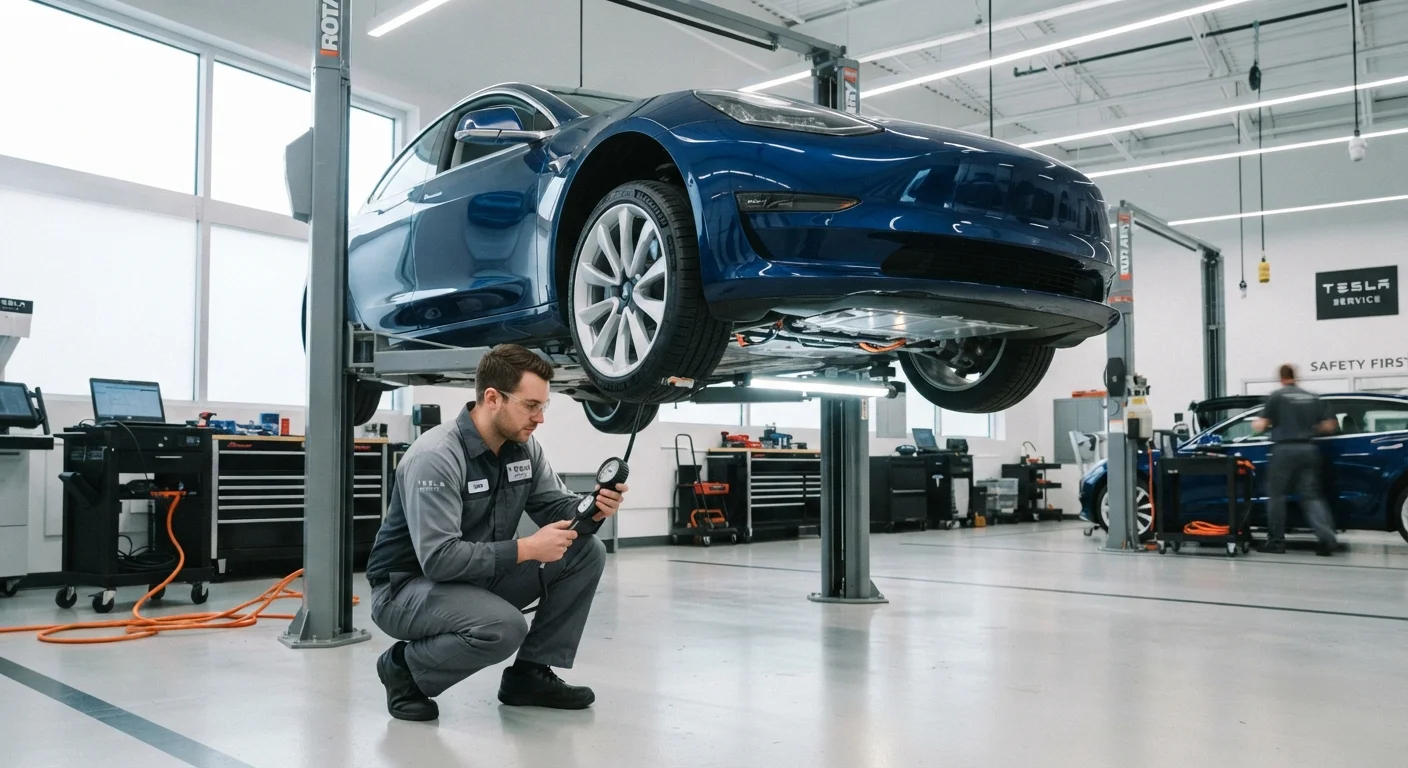
EVs are typically heavier than equivalent gas vehicles due to battery weight, and their instant torque can accelerate tyre wear — particularly on the front axle. Check pressure monthly and rotate tyres every 5,000–7,500 miles or per manufacturer guidance.
Brake Fluid
Brake fluid absorbs moisture over time, lowering its boiling point and reducing braking effectiveness. Even with regenerative braking reducing pad wear, the fluid itself still degrades. Most manufacturers recommend replacement every two years regardless of mileage.
Cabin Air Filter
The cabin filter cleans air entering the passenger compartment. It has nothing to do with the drivetrain and wears on the same schedule as in any vehicle — typically every 15,000–25,000 miles depending on environment.
Wiper Blades and Washer Fluid
These are identical in function to gas-car equivalents and should be inspected seasonally.
Coolant
EVs use liquid cooling for both the battery pack and power electronics. This coolant degrades over time; intervals vary by manufacturer but should not be ignored. Check your owner's manual for specifics.
Battery Health: The Unique EV Consideration
Unlike any component in a gas vehicle, the high-voltage battery pack is the most consequential long-term variable in EV ownership. Capacity gradually declines with charge cycles and age — this is normal chemistry, not a defect.
Support Battery Health With Charging Habits
Consistently charging to 100% and letting the battery drain to near zero puts more stress on cells over time. For daily driving, most manufacturers suggest targeting a charge range of roughly 20%–80%. Reserve full charges for long trips when you need maximum range.
Practical steps that support battery longevity include keeping the daily charge level between roughly 20% and 80% for routine use, avoiding frequent DC fast charging when not necessary, and storing the vehicle in moderate temperatures when possible. These are general guidelines supported by most EV manufacturers, though specific recommendations vary by battery chemistry and vehicle design.
Federally, EV batteries sold in the US must be warranted against significant capacity loss for at least 8 years or 100,000 miles, whichever comes first. Checking the specific terms of your vehicle's battery warranty before purchase is worthwhile — coverage thresholds differ by manufacturer.
For a fuller picture of how battery considerations factor into total ownership costs, a five-year EV cost breakdown is a useful reference.
How EV Service Intervals Compare in Practice
Because there is no oil change driving a fixed service rhythm, EV maintenance tends to be event-driven and condition-based rather than mileage-based. Most manufacturers still recommend an annual multi-point inspection to catch wear items and update vehicle software.
“The biggest surprise for new EV owners is realizing that 'less maintenance' doesn't mean 'no maintenance.' Tyres, fluids, and inspections still matter — the checklist is just shorter and the rhythm is different.”
— EV & Hybrid Guide Editorial Team, Editorial team covering electric and hybrid vehicles for US car buyers
Software updates are a genuinely new maintenance category. EVs receive over-the-air (OTA) updates that can adjust charging behavior, improve range estimates, or address safety issues — similar in concept to a smartphone update. Some updates require a dealer visit; many do not.
When comparing overall ownership costs, the reduced service frequency is meaningful. how EV running costs differ from gas vehicles breaks down those differences in dollar terms. And if you want straightforward habits to stay on top of any vehicle's maintenance needs, practical maintenance habits for everyday owners applies equally to EVs.
This article provides general educational information about electric vehicle maintenance. Actual service requirements vary by make, model, and driving conditions. Always consult your vehicle's owner's manual and a qualified, EV-certified technician for guidance specific to your vehicle.