
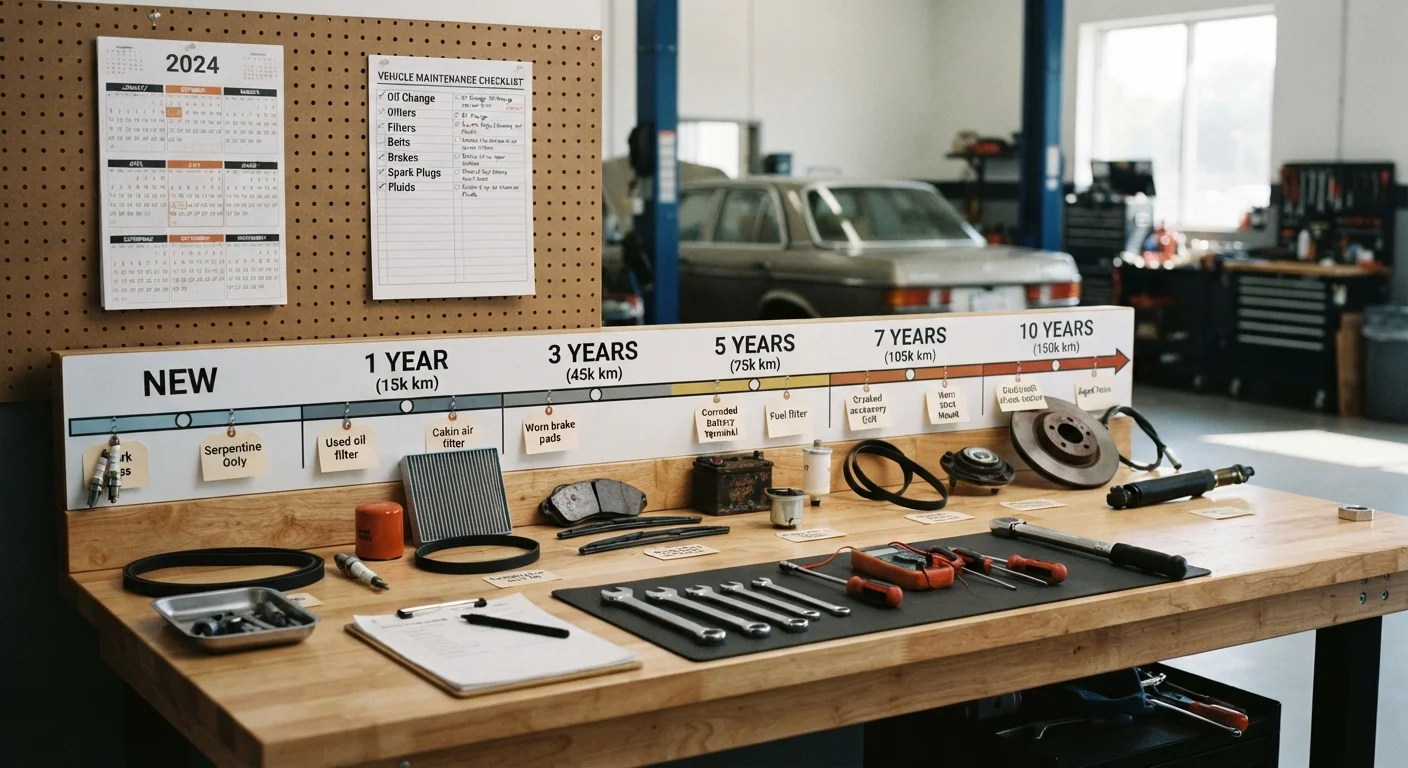
Why a Decade-Long View Matters
Most buyers focus on the sticker price and monthly payment. The smarter question is: what will this car cost me to keep running for the next ten years? Maintenance expenses follow a fairly predictable arc — modest in the early years, then rising as wear accumulates on higher-cost components. Understanding that arc lets you budget before you buy, not after the invoice lands.
This reference covers a typical gas-powered passenger car driven roughly 12,000–15,000 miles per year under normal conditions. Costs vary by make, model, region, and shop rates, so treat the figures here as general benchmarks rather than guarantees. If you're comparing this to an electric vehicle, the intervals look quite different — see how EV servicing differs for a direct comparison.
| Typical annual maintenance cost, years 1–3 | $400–$700 (General industry benchmark; varies by vehicle and region) |
| Typical annual maintenance cost, years 4–6 | $800–$1,500 (Includes brake service; varies by driving conditions) |
| Typical annual maintenance cost, years 7–10 | $1,000–$2,500+ (Varies widely based on components due for replacement) |
| Average battery lifespan | 3–5 years (General industry estimate; climate affects range) |
| Timing belt replacement interval (typical) | 60,000–100,000 miles (Varies by manufacturer; check owner's manual) |
| Oil change interval (full synthetic) | 7,500–10,000 miles (Manufacturer guidance varies; confirm in owner's manual) |
Years 1–3: Low Cost, High Frequency
A new car's maintenance calendar is dominated by oil and filter changes (every 5,000–10,000 miles depending on oil type and manufacturer guidance), tire rotations every 5,000–7,500 miles, and cabin and engine air filter replacements around the 15,000–30,000 mile mark. These are inexpensive individually — typically $30–$120 per visit — but they add up to roughly $400–$700 per year when completed on schedule.
The wiper blades will likely need replacing once or twice. The battery is fresh and rarely a concern. Most manufacturers cover some scheduled maintenance under warranty or complimentary service plans for the first two to three years, which can offset out-of-pocket costs significantly.
What to watch for: Don't skip rotations. Uneven tire wear that develops early accelerates the timeline to an expensive full set replacement.
Years 4–6: Mid-Life Service Milestones
This window typically brings the first genuinely significant expenses. Around 30,000–60,000 miles, expect:
- Brake pads: Front pads often reach replacement threshold first, typically between 25,000–50,000 miles depending on driving style. Rotors may need resurfacing or replacement at the same time. See typical brake replacement costs and warning signs for more detail.
- Spark plugs: Standard copper plugs are often due by 30,000 miles; iridium or platinum plugs can last 60,000–100,000 miles. Check your owner's manual.
- Transmission fluid and coolant flushes: Often recommended in this mileage band, especially if the vehicle has seen stop-and-go driving.
- Battery: Most car batteries last 3–5 years. Testing annually after year three is advisable.
Annual maintenance spend in this period commonly runs $800–$1,500 once brake work is factored in.
Interference engine
An engine design where the pistons and valves occupy the same space at different times. If the timing belt fails on an interference engine, the pistons and valves collide, causing severe internal damage.
Timing belt
A reinforced rubber belt that synchronizes the rotation of the engine's crankshaft and camshaft. Replacement on schedule is critical because failure can destroy the engine.
Coolant flush
A service that drains the old engine coolant, cleans the cooling system, and refills it with fresh fluid. Degraded coolant loses its corrosion-inhibiting properties and can damage the radiator and water pump.
Struts
Structural suspension components that support the vehicle's weight and absorb road shocks. Worn struts reduce handling stability and increase stopping distances.
Years 7–10: Wear Items and Bigger-Ticket Repairs
By 75,000–120,000 miles, the vehicle transitions from routine servicing to a mix of routine and component replacement. The costs here are less predictable but follow recognizable patterns:
- Timing belt (interference engines): Many manufacturers recommend replacement between 60,000–100,000 miles. Missing this interval risks catastrophic engine damage — it is one of the most cost-consequential items on the schedule. Common repair cost ranges covers what timing belt work typically costs.
- Suspension and steering components: Shocks, struts, tie rod ends, and sway bar links begin wearing noticeably in higher-mileage vehicles, particularly in regions with rough roads or harsh winters.
- Tires: A second full tire replacement is likely in this window for most drivers.
- Oxygen sensors and other emissions components: These become more common failure points after 80,000 miles.
Annual costs in years seven through ten can realistically range from $1,000 to $2,500 or more, depending on what service coincides. Building a dedicated repair reserve is worthwhile — a practical maintenance budgeting framework can help you structure that reserve methodically.
$9,282
Average annual cost to own and operate a new vehicle
According to AAA's annual Your Driving Costs study, which includes fuel, maintenance, tires, insurance, depreciation, and finance charges.
~$100B
Annual U.S. spending on vehicle maintenance and repairs
A broadly cited industry estimate reflecting the scale of the U.S. aftermarket service sector.
If you're buying a used vehicle already in this mileage band, reviewing its service history critically matters enormously. Evaluating a used car's maintenance history walks through how to read service records and identify gaps that signal future problems.
This article provides general maintenance information for educational purposes only. Actual service intervals, costs, and component lifespans vary by vehicle, driving conditions, and region. Always consult your owner's manual and a qualified mechanic for guidance specific to your vehicle.