
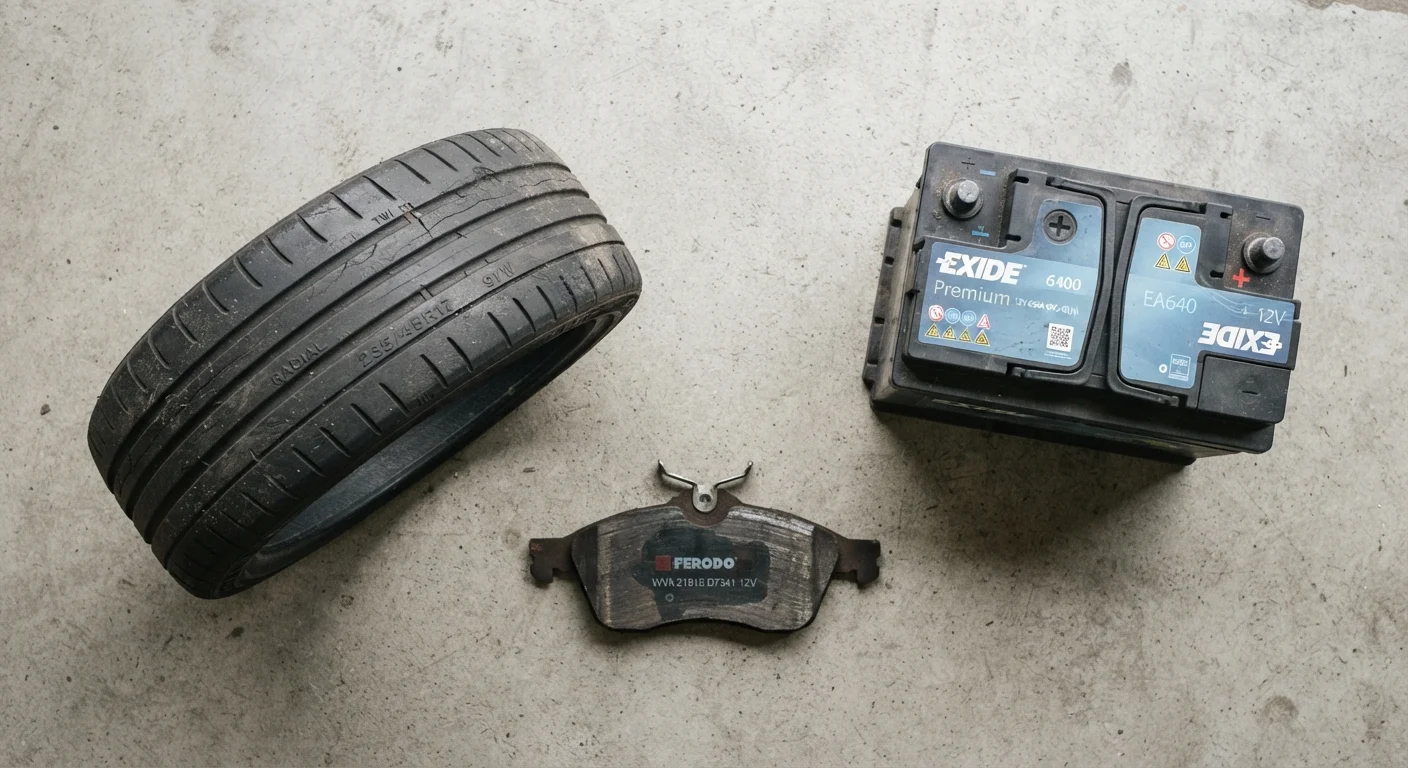
The Consumables That Drain Budgets Quietly
Most car owners expect to pay for fuel and insurance. Fewer plan specifically for the three mechanical categories that wear down on a clock regardless of how carefully they drive: tyres, brakes, and batteries. Together, these items can represent $800 to $2,500 or more in a single year, depending on vehicle type, driving habits, and how long replacement gets delayed.
Understanding typical lifespans and warning signs — before you're standing in a shop under pressure — is what separates reactive owners from prepared ones. See our full breakdown of ongoing ownership costs for how these line items fit into the broader picture.
Tyres: Lifespan, Wear Patterns, and What They Actually Cost
Most passenger tyres are designed to last between 25,000 and 50,000 miles, though this range is highly dependent on tyre grade, vehicle weight, alignment, and driving style. Performance tyres on the lower end of that range can wear significantly faster, especially in warmer climates where rubber compounds degrade more quickly.
The built-in wear indicators — small rubber bars sitting flush in the tread grooves — signal the legal minimum tread depth (2/32 inch in most states). Reaching that point on a highway is a very different risk than reaching it on a dry local road. Many safety-focused drivers choose to replace at 4/32 inch, particularly before winter.
Budget for a full set every three to six years for average drivers. A full set of four mid-range all-season tyres typically runs $400–$900 installed, depending on size. Add in rotation every 5,000–7,500 miles (often under $50) and annual alignment checks to extend that lifespan meaningfully.
Reaching the legal tread minimum on a highway is a very different risk than on a dry local road.
Brake Pads and Rotors: How to Read the Warning Signs Early
Brake pads on a conventional vehicle typically last 25,000 to 70,000 miles — a wide range that reflects driving environment more than almost any other factor. Stop-and-go city driving can halve the life of pads compared to steady highway use. Rear pads often outlast fronts by a significant margin because the front axle handles the majority of braking force.
Most pads include a metal wear indicator that produces an audible squeal when the friction material gets low. A grinding sound that follows typically means metal-on-metal contact — at that stage, rotors are likely scoring and the repair bill climbs. Catching pads early usually means a $150–$300 job per axle; waiting can push that to $400–$600 or more once rotors need resurfacing or replacement.
Owners of hybrid and electric vehicles should note that regenerative braking substantially reduces mechanical brake wear. It's common for EV owners to find their brake pads in surprisingly good condition at standard inspection intervals — though rotors can actually corrode faster from underuse in wet climates.
A grinding sound means metal-on-metal contact — at that stage, rotors are likely scoring and costs climb fast.
The 12-Volt Battery: Short Life, High Failure Rate, Poor Timing
The standard lead-acid 12-volt battery that starts your engine — separate from any high-voltage EV pack — typically lasts three to five years. Heat is the primary accelerant of degradation; batteries in hot-climate states often fail closer to the three-year mark. Cold weather doesn't kill batteries directly but exposes weakness in a battery that's already losing capacity.
Unlike tyres or brakes, the 12-volt battery rarely gives clear progressive warnings. Many fail suddenly after passing a routine visual check. A load test — available free at many auto parts retailers — measures actual cold cranking amps against rated capacity and gives a more accurate picture of remaining life. Testing annually after year three is a reasonable precaution.
Replacement costs for a standard battery run $120–$220 installed for most passenger vehicles. Some import models or vehicles with advanced start-stop systems require AGM (absorbent glass mat) batteries that can push that figure to $250–$350. Factor in the inconvenience cost of a dead battery — roadside assistance, towing, or a canceled trip — and the case for proactive replacement before failure becomes clear.
Testing your battery annually after year three is a low-cost way to avoid a sudden, inconvenient failure.
EV High-Voltage Battery Packs: A Different Planning Problem
The high-voltage traction battery in a battery electric vehicle (BEV) operates on a completely different timeline and cost scale than a 12-volt battery. Most manufacturers provide warranty coverage for eight years or 100,000 miles on the pack, with a minimum state-of-health threshold (commonly 70%). Real-world degradation data suggests many packs retain 80–90% capacity well beyond that point under normal use.
Out-of-warranty pack replacement — if ever needed — has historically been expensive, though costs have fallen as the market matures. More commonly, owners deal with gradual range reduction rather than outright failure. Charging habits matter: frequent DC fast charging and consistently charging to 100% state of charge accelerate cell degradation over time, as does storing the vehicle at very high or very low charge for extended periods.
For EV owners planning long-term budgets, the EV charging and ownership costs hub covers how charging patterns and battery management affect the real financial picture over time.
Frequent DC fast charging and consistently charging to 100% can accelerate long-term battery cell degradation.
Timing Matters: Avoiding the Compounding Failure Problem
One pattern that reliably amplifies repair bills is the coincidence of multiple consumable replacements in the same year. A five-year-old vehicle approaching 50,000 miles might simultaneously need new tyres, brake pads, and a battery — all legitimate wear items reaching end-of-life at roughly the same point. Without a budget reserve, that $1,500–$2,200 outlay feels like a crisis rather than routine maintenance.
Staggering replacements where possible — for example, replacing rear pads now and fronts at the next inspection, or replacing two tyres at a time if the others have life remaining — can spread costs across calendar years. This isn't always advisable (mismatched tyres on an AWD vehicle, for instance, can cause drivetrain stress), so the approach needs to account for vehicle-specific requirements.
Refer to our maintenance habits guide for non-experts for practical ways to track wear across all three categories without needing technical expertise. Our annual ownership cost checklist also helps identify when multiple cost events are likely to cluster.
A five-year-old vehicle at 50,000 miles may need tyres, brakes, and a battery simultaneously — plan for it.
Building These Costs Into Your Annual Budget
The most practical approach is to treat consumable replacement as a recurring line item rather than a surprise expense. Divide each component's estimated replacement cost by its expected lifespan in years, then set that amount aside monthly. A set of mid-range tyres lasting five years on a sedan, for example, might average out to $120–$180 per year — a manageable figure when saved incrementally rather than paid in a lump sum.
Track Replacement Dates in a Simple Spreadsheet
Record the date and mileage every time you replace a tyre, brake pad set, or battery. A simple spreadsheet with purchase date, mileage at installation, and expected lifespan lets you calculate roughly when each item will next need attention. This takes five minutes per event and pays off substantially when budgeting for the year ahead.
For a structured way to build this reserve, our practical maintenance budgeting framework walks through the full calculation method. You can also cross-reference our decade-by-decade maintenance schedule to anticipate when multiple consumables might fall due in the same year.
This article provides general vehicle ownership information for educational purposes only. Actual costs vary by vehicle, region, driving conditions, and service provider. Consult a qualified mechanic for assessments specific to your vehicle.