
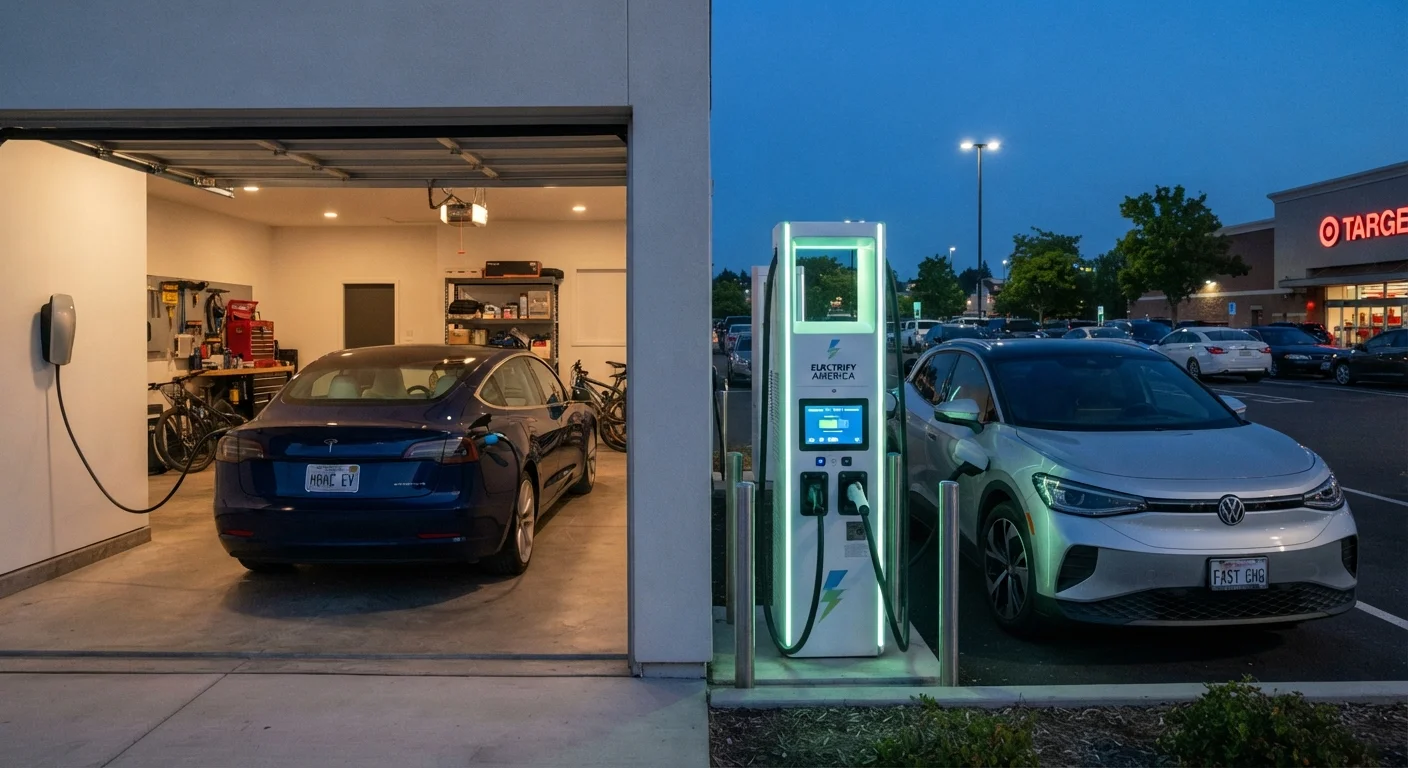
How Each Charging Method Actually Works
Home charging uses either a standard 120V outlet (Level 1) or a dedicated 240V wall unit (Level 2). Level 1 adds roughly 3–5 miles of range per hour — useful for plug-in hybrids but painfully slow for a full battery electric vehicle (BEV). Level 2 chargers, which require a dedicated circuit installation, deliver 15–30 miles of range per hour, enough to replenish a typical 250-mile battery pack overnight. Before installing, review what to sort out before your EV arrives — from panel capacity to installer qualifications.
Public charging spans three tiers. Level 2 public units (common in parking garages and retail lots) match home Level 2 speed. DC fast chargers — sometimes called Level 3 — operate at 50 kW to 350 kW and can add 100–200 miles in under 30 minutes, depending on the vehicle's onboard charging limit. Network availability, connector compatibility, and pricing structures vary significantly by provider and location.
| Criterion | Home Charging | Public Charging |
|---|---|---|
| Typical cost per kWh | ~$0.08–$0.16 (off-peak to standard) | ~$0.30–$0.60 (Level 2 to DC fast) |
| Charging speed (Level 2) | 15–30 miles of range per hour | 15–30 miles per hour (Level 2); up to 200+ miles/hr (DC fast) |
| Setup requirement | 240V circuit installation needed | No installation; app or card access |
| Daily convenience | Very high — plug in at home nightly | Variable — depends on proximity and availability |
| Access requirement | Off-street parking or garage required | Open to all EV drivers |
| Best use case | Everyday commuting and routine top-ups | Road trips, apartment living, emergency charging |
| Reliability | High — fully within your control | Variable — uptime rates improving but not guaranteed |
Cost Comparison: What You Actually Pay Per Mile
The financial difference between these two approaches is substantial. The average U.S. residential electricity rate sits around 16 cents per kWh (U.S. Energy Information Administration, 2024). At that rate, fueling a vehicle with a 3-mile-per-kWh efficiency costs roughly 5–6 cents per mile. With a time-of-use tariff, off-peak rates can fall to 8–12 cents per kWh in many utility regions, pushing that cost even lower.
Public fast charging typically runs 30–60 cents per kWh — or in some cases, flat per-minute pricing that can equal or exceed gas costs if your vehicle charges slowly. The convenience premium is real. That said, occasional public charging for road trips may still be worth it in aggregate if home charging covers 90% of your miles. Smart charging habits that schedule overnight sessions can stretch your budget further while also protecting battery longevity.
~$0.05
Estimated home charging cost per mile
Based on the U.S. national average residential electricity rate of approximately 16 cents per kWh and a typical EV efficiency of 3 miles per kWh (U.S. EIA, 2024).
80%+
Share of EV charging that happens at home
U.S. Department of Energy studies consistently find the large majority of EV charging sessions occur at drivers' residences rather than public stations.
20–30 min
Typical DC fast charge session for 100+ miles
Actual times vary by vehicle battery size, state of charge, ambient temperature, and charger output capacity.
Practical Realities: Convenience, Reliability, and Access
Home charging wins decisively on daily convenience. Plugging in at night requires no planning, no queuing, and no detour. You wake up to a full battery every morning. The main barrier is access — you need off-street parking and either own or have landlord permission to install equipment. If that's not your situation, see charging options for flat dwellers and renters.
Public networks introduce variables that home charging eliminates: charger availability, out-of-order units, app-based payment friction, and wait times during peak hours. First-time EV buyers often underestimate these friction points — common public charging misconceptions are worth reviewing before you commit to a public-only strategy. For road trips specifically, planning ahead with a route app is essential; see our guide on planning charging stops without the stress.
Public Charging Network Reliability Is Improving
Reported uptime rates for public DC fast chargers in the U.S. have historically varied, but major network operators and federal infrastructure funding are pushing toward higher reliability standards. Before relying on a specific corridor for a road trip, check real-time status through your vehicle's built-in navigation or a third-party network app. Availability and functionality can still differ meaningfully by region and operator.
Making the Right Choice for Your Situation
For most homeowners with a garage or driveway, the math strongly favors installing a Level 2 home charger. Installation typically costs $500–$1,500 including hardware and labor, and federal or state incentives may offset part of that expense — explore available grants and incentives before budgeting. Use this home readiness checklist to assess your electrical panel and driveway situation early.
If public charging must be your primary solution, calculate a realistic monthly charging cost based on your actual miles driven and local network pricing — don't rely on manufacturer estimates alone. Either way, the two approaches are complementary rather than mutually exclusive. Most EV drivers find that pairing routine home overnight charging with strategic use of fast chargers on longer trips delivers the best balance of cost, convenience, and flexibility.