
Why This Question Matters More Than Ever
Around one-third of U.S. households live in multi-unit dwellings or rented properties without dedicated off-street parking. For this group, the standard EV ownership advice — install a Level 2 home charger in your garage — simply doesn't apply. Yet EV adoption is growing quickly, and the assumption that EVs are only practical for homeowners with driveways is becoming increasingly outdated.
The options available to renters and flat dwellers have expanded meaningfully in recent years, spanning landlord negotiations, on-street infrastructure, workplace charging, and public fast-charging networks. None of these is a perfect substitute for overnight home charging, but understanding how they fit together can help you decide whether EV ownership makes sense for your situation right now.
If you're weighing a full battery-electric vehicle against a plug-in hybrid or standard hybrid, our guide on hybrid vehicle options offers useful context for that decision. And if you do have some form of off-street access, what to sort out before your EV arrives covers home setup essentials.
Talk to Your Landlord About a Dedicated Charger
This is worth attempting before assuming it's impossible. Landlords are increasingly open to EV charger installation because it adds value to the property and may attract tenants. In many states, landlords are legally restricted from unreasonably refusing a tenant's request to install an EV charger — California, Florida, and New York are among those with such provisions, though rules vary significantly by state.
When approaching your landlord, come prepared: present a specific proposal rather than a vague request. Identify a Level 2 charger that could be installed in an assigned parking space, clarify who pays for installation and electricity, and reference any available government incentives that could reduce the landlord's costs. Our overview of government grants and incentives for EV charging covers schemes that may apply.
Many states restrict landlords from unreasonably refusing a tenant's EV charger request.
Use Workplace Charging as Your Primary Source
If your employer offers workplace EV charging — or might be persuaded to — this can effectively replace home charging for the majority of your weekly needs. A full workday plugged into a Level 2 charger (typically delivering 10–30 miles of range per hour) can replenish most commuter ranges before you drive home.
The U.S. Department of Energy's Alternative Fuels Station Locator can help you identify whether your workplace or nearby commercial areas already have charging. If your employer doesn't yet offer it, frame the request in terms of staff retention and sustainability goals — fleet and facilities managers often respond better to a business case than an individual ask.
A full workday on a Level 2 charger can replenish most commuter driving ranges.
Rely on On-Street and Destination Charging Networks
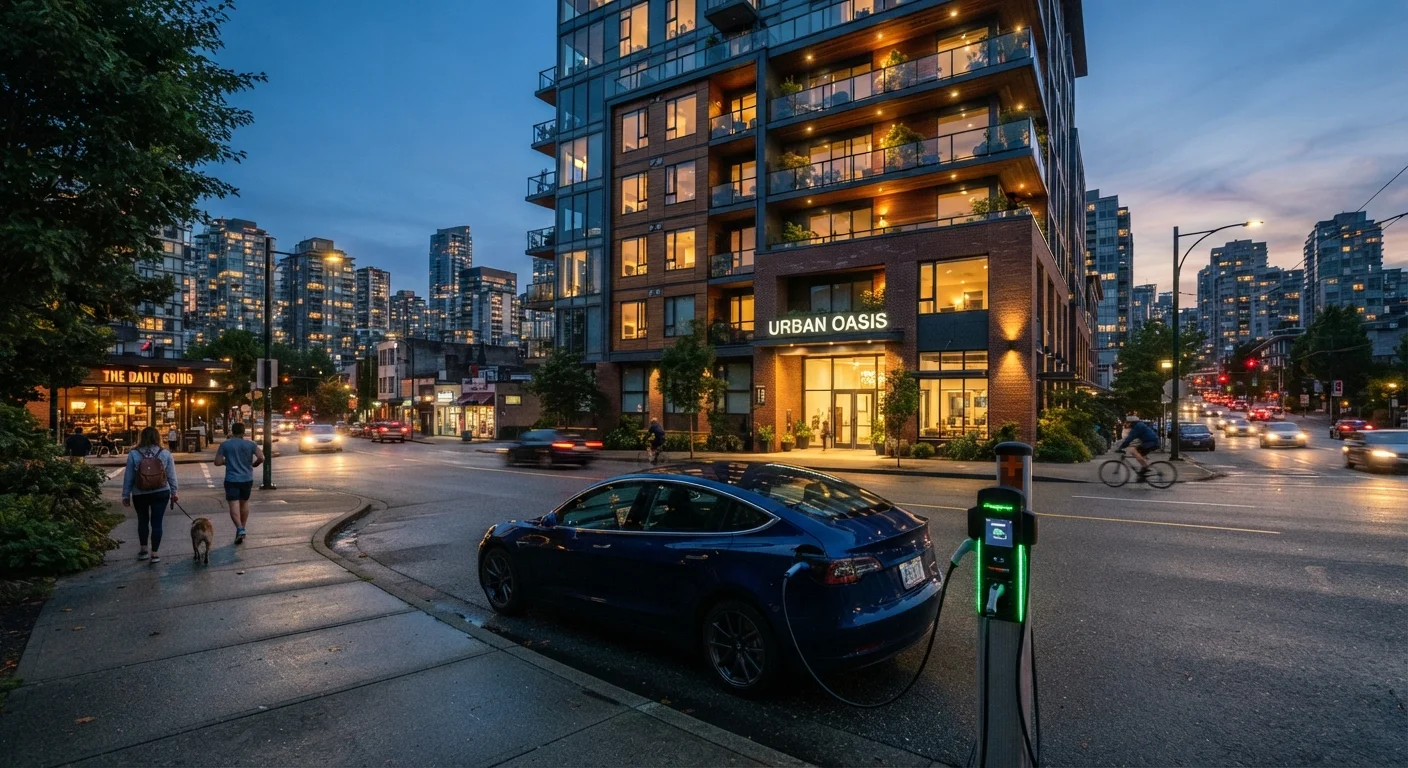
Public on-street charging has expanded substantially in urban areas. Curbside Level 2 chargers — often installed by cities or utilities — are increasingly common in dense neighborhoods and can be used overnight if your vehicle is parked nearby. Availability and reliability vary by city, so checking local infrastructure before you buy is essential.
Destination chargers at hotels, parking garages, grocery stores, and shopping centers add another layer. These are typically Level 2 and free or low-cost, making them well-suited to opportunistic top-ups during errands. Apps like PlugShare provide real-time availability and user reliability ratings, which helps you avoid wasted trips to out-of-service units.
Curbside Level 2 chargers are expanding in urban areas and can serve as overnight options.
Supplement with DC Fast Charging Strategically
DC fast chargers (also called Level 3 or DCFC) can add 100–200 miles of range in 20–45 minutes depending on the vehicle and charger output. For renters who lack reliable slow-charging access, periodic fast-charging sessions can keep the battery topped up without requiring daily charging logistics.
The trade-off is cost and wear: fast charging typically costs more per kWh than Level 2 charging, and frequent use of DC fast charging over many years is generally considered harder on battery longevity than regular slow charging, though modern battery management systems have reduced this concern significantly. Treat fast charging as a weekly or occasional supplement rather than your sole charging source where possible.
DC fast charging adds 100–200 miles of range in under an hour — useful for periodic top-ups.
Consider a Hybrid as a Practical Middle Ground
If reliable EV charging genuinely cannot be arranged in your situation, a plug-in hybrid electric vehicle (PHEV) or a conventional hybrid may be a more practical near-term choice. PHEVs carry a smaller battery (typically 20–50 miles of electric range) that can be charged from a standard 120V outlet — meaning even a standard outdoor outlet at your building may be sufficient. The gasoline engine removes range anxiety entirely on longer trips.
A traditional hybrid (non-plug-in) charges its battery through regenerative braking and requires no external charging at all, making it genuinely driveway-agnostic. The trade-off is lower electric-only range and no ability to use cheap off-peak electricity. If this route interests you, our hybrid options hub explores the different powertrain types in more detail.
A PHEV can be charged from a standard 120V outlet, making it viable for renters with minimal access.
Explore Shared Charging in Multi-Unit Buildings
Some apartment complexes and condominium associations are installing shared EV charging stations in parking structures — often managed through a reservation or payment app. If your building doesn't yet have this, raising it with the building management or homeowners association may be more productive than you expect, particularly if multiple residents share the interest.
Federal and state incentives exist specifically for multi-unit dwelling charging infrastructure, which can substantially reduce the installation cost for building owners. Bringing this information to a management conversation — rather than just expressing a preference — makes approval considerably more likely. Check the available government grants relevant to your state before that conversation.
Federal incentives exist specifically for multi-unit building charging — a strong argument for management.
Building a Charging Routine Without a Driveway
Living without dedicated home charging doesn't mean improvising every time your battery runs low. The renters and flat dwellers who make EV ownership work tend to approach charging the same way they approach other logistics: with a routine. They identify two or three reliable charging touchpoints in their weekly life — a workplace charger, a nearby public hub, a supermarket lot — and build charging into existing stops rather than treating it as a separate errand.
Track Your Mileage Before You Decide
Before committing to an EV without home charging, spend a month logging your weekly mileage and identifying where you spend the most time parked. Most urban commuters drive fewer than 40 miles per day — well within range of a weekly or twice-weekly public charging session. Knowing your actual numbers removes guesswork and helps you evaluate whether a full BEV or a hybrid is the right fit.
Before committing to any EV, it's worth stress-testing your charging plan honestly. Track your weekly mileage for a month, map the nearest public Level 2 and DC fast chargers using tools like PlugShare or ChargePoint's network map, and estimate how often you'd realistically need to charge. If the math feels tight, a plug-in hybrid may offer a more manageable transition. Our comparison of home charging versus public charging can help you assess which approach fits your lifestyle — and common public charging misconceptions is worth reading before you rely heavily on the public network.