
Why Public Charging Surprises So Many New EV Drivers
For most people switching from gasoline, the mental model of refueling is a pump that works the same way at every station. Public EV charging breaks nearly every part of that assumption. Networks are fragmented, speeds vary enormously, and not every charger you find on a map will be functional when you arrive.
Understanding these realities before you buy — not after your first frustrating road trip — makes a significant difference in how satisfied you'll be with EV ownership. The mistakes below reflect patterns that come up repeatedly among first-time buyers. See our Charging & Costs hub for a broader look at what public and home charging actually involves.
Assuming every charger labeled 'fast' will charge at the same speed.
Why it happens: Marketing language around 'fast charging' is inconsistent. Drivers often conflate Level 2 AC chargers (typically 7–19 kW) with DC fast chargers (50–350 kW), which operate on entirely different timescales.
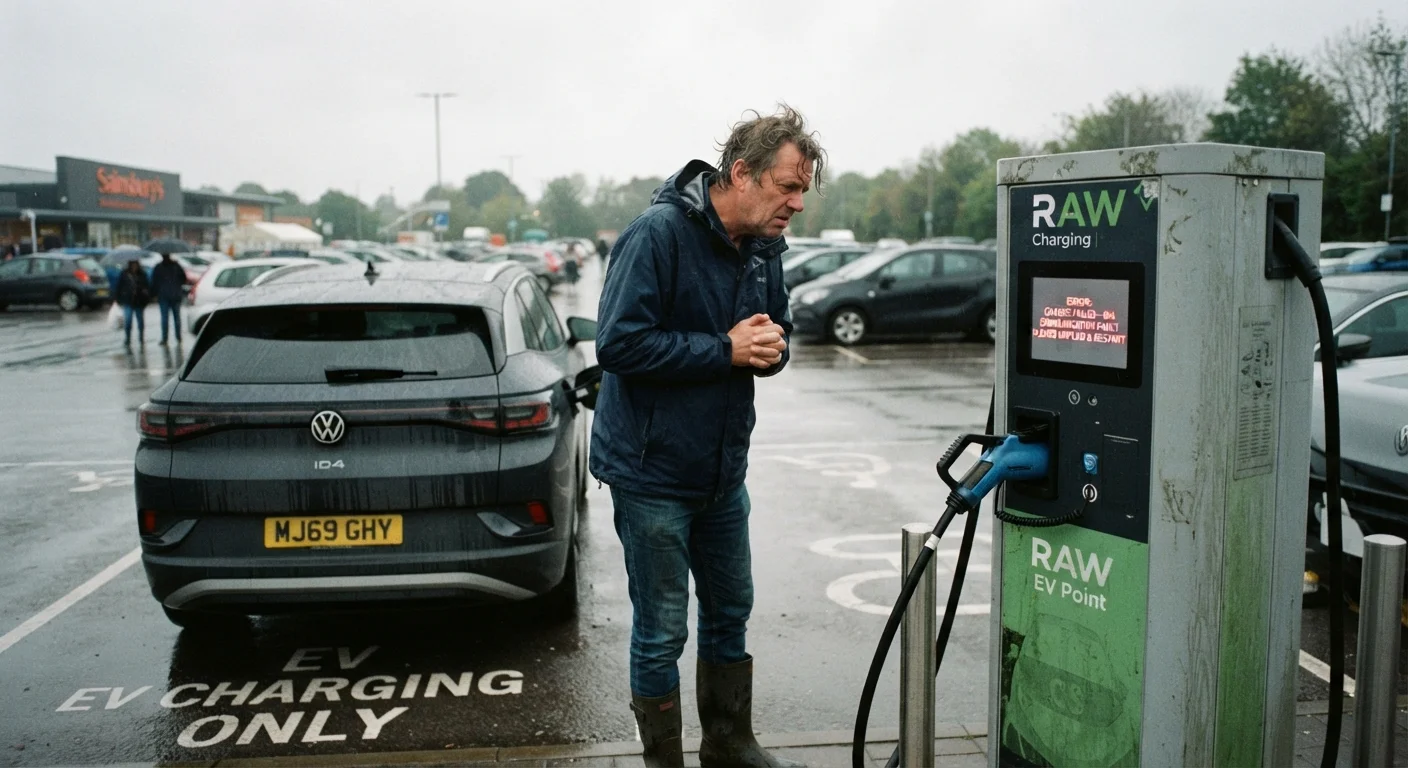
Expecting chargers to always be available and functional.
Why it happens: Drivers used to gas stations assume the same density and uptime. Public charging infrastructure is still maturing, and utilization data from the U.S. Department of Energy has flagged meaningful downtime rates at some networked stations.
Believing a single network membership covers all public chargers.
Why it happens: The U.S. public charging landscape includes multiple competing networks — ChargePoint, EVgo, Blink, Electrify America, and others — each with its own app, account, and payment system.
Misjudging how long a charging session will actually take.
Why it happens: Time estimates are often based on best-case figures. Real-world factors — battery state of charge, ambient temperature, charger congestion, and the charging curve slowing above 80% — routinely extend sessions beyond initial estimates.
Underestimating how much cold weather affects public charging sessions.
Why it happens: Battery chemistry slows in low temperatures, reducing both available range and the rate at which the battery can accept a charge. First-time buyers in colder climates often don't account for this when planning winter trips.
Planning Around Reality: What Prepared EV Drivers Do Differently
Drivers who report high satisfaction with public charging share a few consistent habits. They treat home charging as their primary source — arriving at work or the grocery store with 80–100% battery rather than depending on en-route top-ups. When they do need public charging, they plan ahead using real-time apps (such as PlugShare or their vehicle's native navigation) rather than assuming availability.
~80%
EV miles charged at home
U.S. Department of Energy data consistently shows that roughly 80% of electric vehicle charging takes place at home, underscoring why home charging is the practical backbone of EV ownership.
50–350 kW
DC fast charger output range
DC fast charger power levels span a wide range; a vehicle's onboard charger acceptance rate — not just the station's output — determines real-world charging speed.
For long journeys, route planning around DC fast charger locations — rather than treating charging as something to figure out on the fly — removes most of the friction. Our guide on planning charging stops on road trips walks through that process in detail. If you don't have home charging access, the home vs. public charging comparison can help you assess whether your situation is workable before committing to a purchase.
Don't Rely Solely on In-Car Charge Estimates
Built-in navigation systems show estimated charging times based on ideal conditions. Battery temperature, station load, and your vehicle's actual acceptance rate can all push real times higher. Cross-reference with network apps and add buffer time when your charging stop is time-sensitive.
One final note: public charging costs per kWh vary substantially by network, location, and time of day. Factoring those rates into your real-world cost calculations matters. Common assumptions that skew EV cost calculations covers this in more depth.