
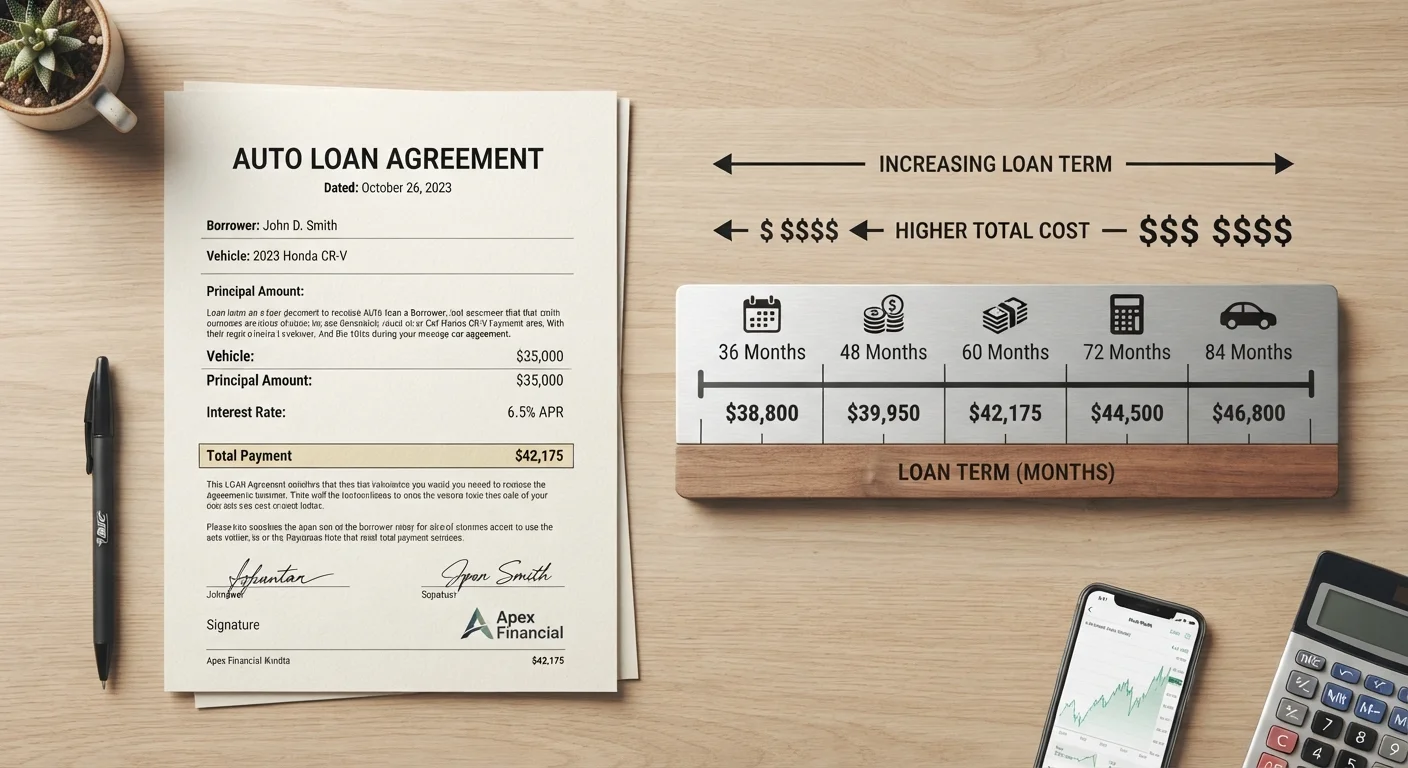
How Term Length Changes Your Monthly Payment vs. Total Cost
When lenders present financing options, the monthly payment figure often takes center stage. But focusing solely on the monthly amount can obscure a more important number: the total cost of the loan from first payment to last.
Consider a $28,000 loan at a 6% APR. Over 48 months, the monthly payment is approximately $658, and total interest paid comes to roughly $3,580. Stretch that same loan to 72 months, and the monthly payment drops to around $464 — but total interest climbs to approximately $5,390. The monthly savings of $194 come at a cost of nearly $1,800 over the life of the loan.
That gap widens further when lenders charge higher APRs on longer terms, which is common practice. For a full breakdown of how principal, interest, and APR interact, see our auto loans explained guide.
~$1,800
Extra interest on 72-month vs. 48-month loan
Illustrative example: $28,000 loan at 6% APR — total interest rises from ~$3,580 over 48 months to ~$5,390 over 72 months.
84 months
Longest common auto loan term available
Seven-year auto loans are increasingly offered by some lenders, though they typically carry the highest APRs and greatest depreciation risk.
15–20%
Typical first-year vehicle depreciation
Industry estimates suggest most new vehicles lose a significant portion of their value in the first 12 months, increasing upside-down loan risk on long terms.
The APR Factor: Why Longer Terms Often Come With Higher Rates
Lenders treat longer-term loans as higher-risk because a lot can change in six or seven years — your financial situation, the car's condition, and its resale value. To offset that risk, many lenders assign higher APRs to 72- and 84-month loans compared to 48- or 60-month loans for the same borrower.
This means choosing an extended term has a compounding effect: you pay interest for more months and you pay it at a higher rate. Even a difference of 0.5 percentage points in APR across 72 months can add several hundred dollars to your total repayment on a mid-range vehicle loan.
Ask for the Total Cost, Not Just the Payment
Before agreeing to any loan, ask the lender to show you the total amount repaid — principal plus all interest — for each term option side by side. This single comparison does more to reveal the true cost of term length than any monthly payment figure. If a lender won't provide this clearly, calculate it yourself: multiply the monthly payment by the number of months, then subtract the loan principal.
For a deeper look at how rates and payment structures interact, the Rates & Payments hub covers APR calculation and comparison in detail.
Depreciation and the Risk of Going Underwater
Vehicles depreciate fastest in their early years — often losing 15–20% of their value in the first year alone. With a long-term loan, early monthly payments are heavily weighted toward interest rather than principal, meaning your loan balance decreases slowly while the car's market value drops quickly.
This creates a window where you owe more than the vehicle is worth — commonly called being upside down or underwater. If you need to sell the car, trade it in, or deal with a total loss during this period, you may face a shortfall that you're responsible for covering out of pocket.
Understanding this risk is part of structuring financing in your favor. The Loan Basics hub provides additional context on how lenders evaluate loan-to-value ratios.
Practical Strategies to Manage Term Length Trade-Offs
If a shorter term's higher monthly payment feels out of reach, there are ways to reduce the loan amount itself rather than simply extending the term:
- Increase your down payment. A larger upfront payment reduces the principal you're financing, which lowers both the monthly payment and total interest — without requiring a longer term.
- Consider a less expensive vehicle. Reducing the purchase price has the same effect as a bigger down payment on the math of your loan.
- Compare total loan cost, not just monthly payment. Ask lenders to show you the full amount repaid over the life of the loan for each term option before deciding.
- Review prepayment terms. If you do choose a longer term for cash-flow flexibility, confirm whether you can make extra principal payments without penalty — this can reduce total interest if your financial situation improves.
For more on how term selection fits into new vehicle financing, see how loan terms shape what you really pay on a new car.
This article is for general informational and educational purposes only and does not constitute personalized financial advice. Loan costs vary based on your credit profile, lender, and loan terms. Consult a licensed financial adviser before making financing decisions.