
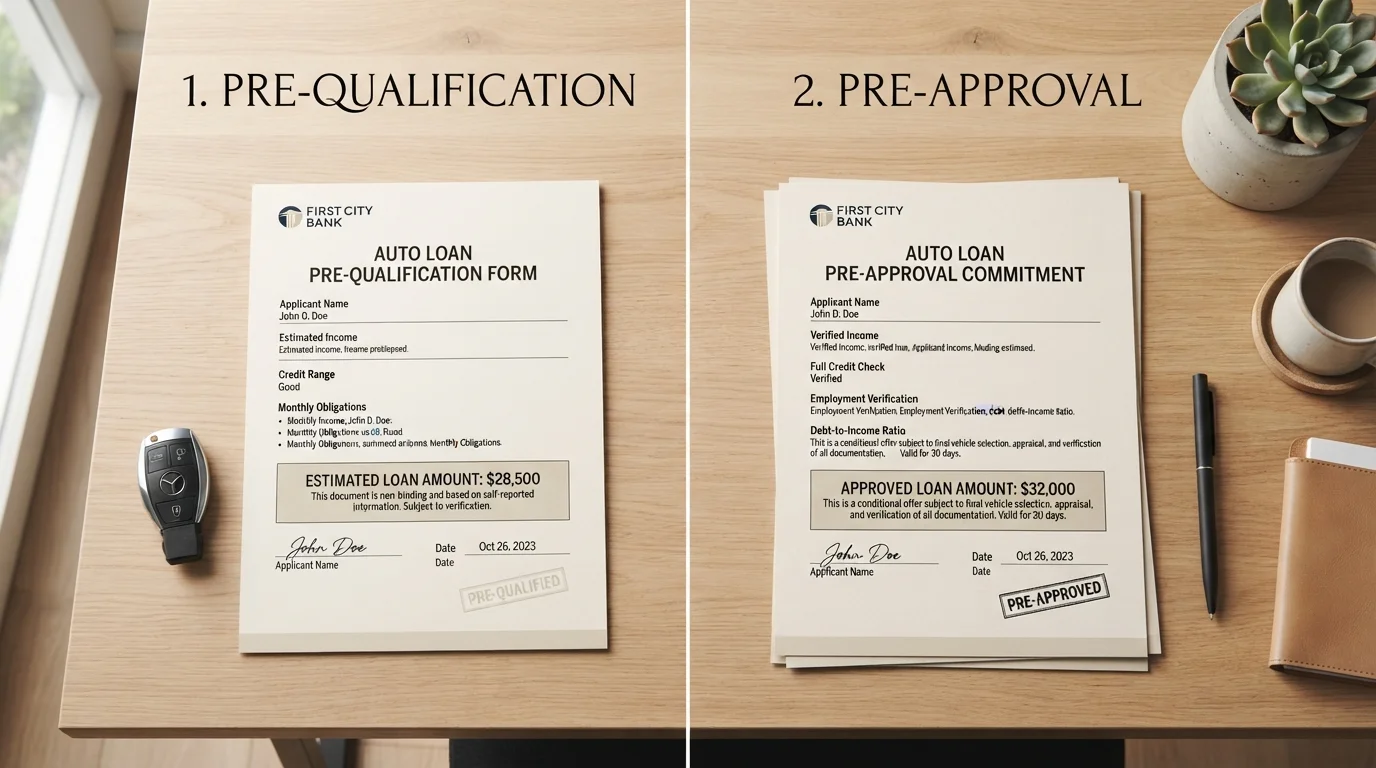
What Pre-Qualification Actually Means
Pre-qualification is an early-stage assessment in which a lender reviews basic financial information — typically income, self-reported credit range, and existing debts — to estimate how much you might be eligible to borrow and at roughly what interest rate. Critically, this check almost always relies on a soft credit inquiry, which does not appear on your credit report as a hard pull and has no impact on your credit score.
The result is a loan estimate, not a commitment. Because the lender hasn't verified your documentation or pulled a full credit report, the figures are conditional and subject to change once formal underwriting begins. Think of it as a financial snapshot: useful for setting a budget ceiling and ruling out loan amounts that are clearly out of reach, but not something you can take to a dealership as proof of financing.
Pre-qualification is most valuable in the planning stage. If you're comparing how different down payment amounts might affect your estimated monthly payment, or trying to decide between buying used versus new, a pre-qualification figure gives you a working range without any credit risk.
What Pre-Approval Involves — and Why It Carries More Weight
Pre-approval is a more rigorous step. The lender pulls a hard credit inquiry, reviews your actual credit report, and typically asks for documentation such as pay stubs, bank statements, and proof of residence. Based on verified data, the lender issues a conditional offer specifying a maximum loan amount, an interest rate (APR), and a loan term.
That conditionality matters: the offer is still tied to the specific vehicle passing the lender's requirements (age, mileage, and loan-to-value ratio all play a role), and final approval follows underwriting after you've chosen a car. But a pre-approval letter is substantively different from a pre-qualification estimate — it represents a lender's actual willingness to extend credit under defined terms.
Because pre-approval involves a hard pull, your credit score may dip by a few points temporarily. However, credit scoring models generally treat multiple auto loan inquiries made within a short window (often 14–45 days, depending on the scoring model) as a single inquiry, allowing you to rate-shop without compounding the impact. For more on what lenders are actually evaluating at this stage, see how lenders decide whether to approve your auto loan.
| Criterion | Pre-Qualification | Pre-Approval |
|---|---|---|
| Credit inquiry type | Soft pull (no score impact) | Hard pull (minor, temporary impact) |
| Information reviewed | Self-reported income and credit range | Verified documents, full credit report |
| Output | Estimated loan range | Conditional offer with rate and term |
| Binding on lender? | No | Conditional yes (vehicle must qualify) |
| Useful at dealership? | Limited — estimate only | Yes — serves as rate benchmark |
| Best timing | Early research phase | 30–60 days before purchase |
How to Use Both Steps Strategically
The most practical approach treats pre-qualification and pre-approval as sequential tools rather than alternatives. Start with pre-qualification to establish a realistic budget range and identify lenders whose products fit your situation. Once you have a target vehicle category and a purchase timeline in mind, pursue pre-approval from one or more lenders — a bank, credit union, or online lender — before stepping onto a lot.
Arriving at a dealership with a pre-approval in hand serves two purposes. First, it gives you a concrete rate to evaluate the dealer's financing offer against. If the dealer's rate is lower, you can take it; if it's higher, you already have an alternative. Second, it signals financial preparedness, which can shift the conversation away from monthly payment manipulation and toward the vehicle's actual price. For a full walkthrough of this strategy, see getting pre-approved before visiting a dealership.
~14–45 days
Rate-shopping window for auto loan inquiries
Major credit scoring models consolidate multiple auto loan hard inquiries made within this window into a single inquiry, limiting score impact during comparison shopping.
3–5 points
Typical temporary credit score dip from a hard inquiry
According to general credit scoring guidance from consumer financial education sources, a single hard inquiry typically lowers a score by fewer than five points.
Before signing any loan offer — whether it came from a lender directly or the dealership's financing office — verify the rate, total cost, fees, and term length carefully. A structured review process, like the one outlined in this pre-loan review checklist, can prevent costly oversights under time pressure.
This article provides general financial information for educational purposes and does not constitute personalized financial or lending advice. Loan terms, eligibility criteria, and credit inquiry practices vary by lender. Consult a qualified financial professional regarding your specific circumstances.