
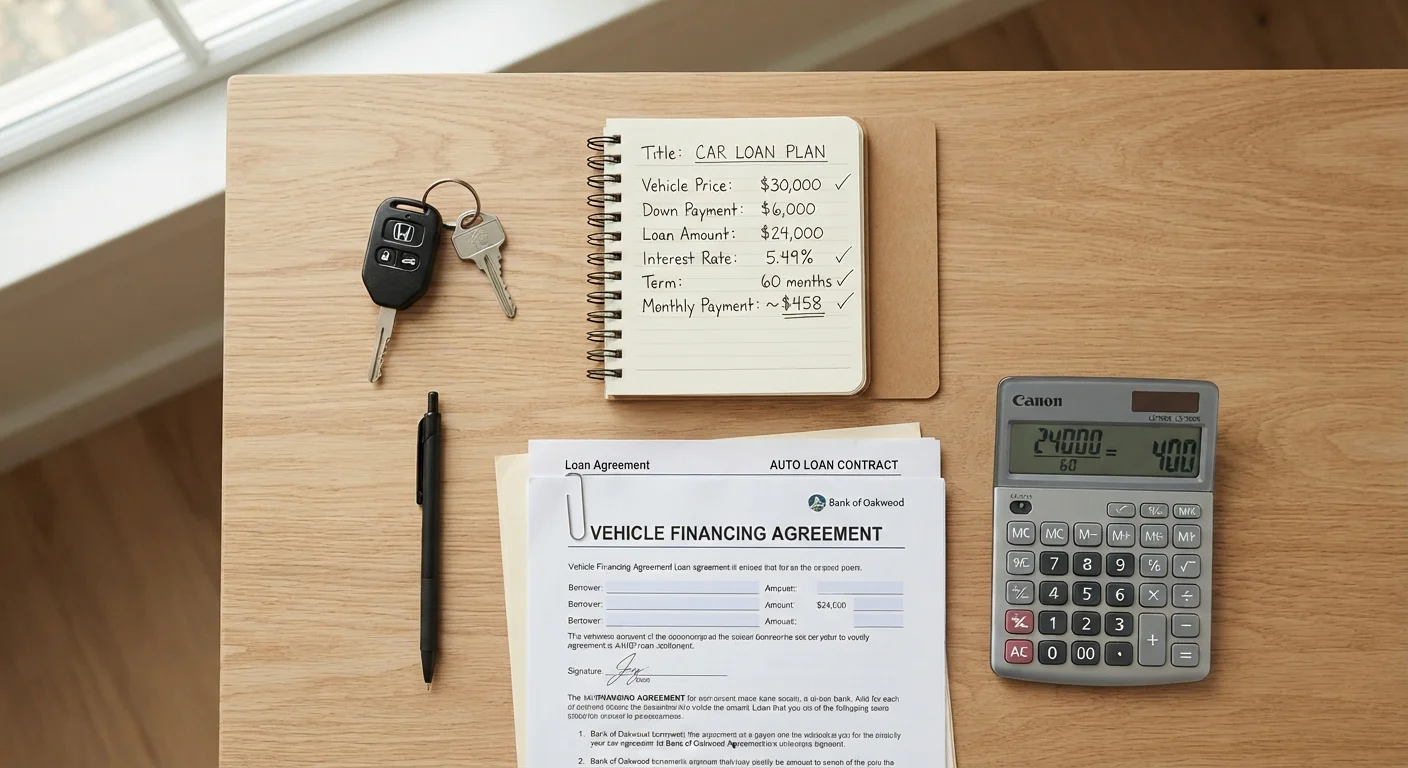
How Auto Loan Financing Actually Works
When you finance a vehicle, a lender pays the seller on your behalf and you repay the lender over time — with interest. The vehicle itself typically serves as collateral, meaning the lender can repossess it if you default. This secured structure is why auto loan rates are generally lower than unsecured personal loan rates.
Every auto loan has three core components: the principal (the amount borrowed), the interest rate (the lender's charge for extending credit), and the loan term (the repayment period, expressed in months). Your monthly payment is a function of all three, calculated using an amortization formula that front-loads interest early in the loan. For a detailed breakdown of how each payment splits over time, see how to read an amortization schedule.
Before diving into rate comparisons, make sure you're clear on the foundational vocabulary. The auto loan glossary covers terms like LTV, pre-approval, and amortization in plain language.
Principal
The original amount of money you borrow — not including interest. Your monthly payments gradually reduce the principal over the loan term.
APR (Annual Percentage Rate)
The yearly cost of a loan expressed as a percentage, incorporating the interest rate and certain fees. It's the most reliable number to compare across loan offers.
Loan Term
The length of time you have to repay the loan, expressed in months (e.g., 48, 60, or 72 months). Longer terms mean lower monthly payments but more total interest.
Amortization
The process of paying off a loan through regular scheduled payments. Early payments in an amortized loan are weighted more heavily toward interest; later payments go more toward principal.
Debt-to-Income Ratio (DTI)
The percentage of your gross monthly income that goes toward debt payments. Lenders use this to gauge whether you can comfortably take on an additional loan payment.
Loan-to-Value Ratio (LTV)
The ratio of your loan amount to the vehicle's market value. A lower LTV — achieved with a larger down payment — reduces lender risk and can improve your rate.
Decoding APR, Interest Rate, and Loan Terms
APR — Annual Percentage Rate — is the figure that matters most when comparing loan offers. Unlike the base interest rate, APR folds in certain fees and financing charges, expressing your borrowing cost as a single annualized percentage. Two loans with the same stated interest rate can carry meaningfully different APRs if their fee structures differ.
Loan term works as a lever. A 72-month loan will have a lower monthly payment than a 48-month loan at the same rate, but you pay interest for 24 additional months — which adds up significantly on a typical vehicle purchase. As a practical illustration: on a $25,000 loan at 7% APR, extending the term from 48 to 72 months saves roughly $130 per month but adds approximately $2,200 in total interest paid.
Use Total Cost, Not Monthly Payment, to Compare
When evaluating loan offers, multiply the monthly payment by the number of months and add any upfront fees to get the true total cost. This single number makes it straightforward to compare a 48-month offer against a 72-month offer — even if one has a lower monthly figure. The loan basics hub has additional tools and concepts to support this kind of analysis.
For a comprehensive look at how rates are set and how to read your first loan statement, the auto loan rates and payments guide walks through every stage in detail.
How Lenders Evaluate Your Application
Lenders assess risk before setting a rate or approving an application. The primary factors they examine include:
- Credit score: A numerical summary of your borrowing history. Higher scores signal lower default risk and typically unlock lower rates.
- Debt-to-income (DTI) ratio: The share of your gross monthly income already committed to debt payments. Lower DTI generally improves your application.
- Income and employment stability: Lenders want evidence you can sustain payments throughout the loan term.
- Loan-to-value (LTV) ratio: The loan amount relative to the vehicle's market value. A substantial down payment lowers LTV, reducing lender risk.
If you haven't yet reviewed your credit report or calculated your DTI, working through a pre-application checklist is a useful step. The pre-financing checklist walks through exactly what to review before submitting any application.
Multiple Credit Inquiries Can Affect Your Score
When lenders pull your credit to evaluate a loan application, it creates a hard inquiry that can temporarily lower your score. Most credit scoring models treat multiple auto loan inquiries within a short window (typically 14–45 days) as a single inquiry, so rate-shopping within that period limits the impact. Avoid spreading applications out over several months, and check with each lender whether they use a hard or soft pull for pre-qualification.
Reading and Comparing Financing Offers
When evaluating a loan offer, don't anchor on the monthly payment alone. The payment can be reduced by extending the term — without changing the rate — which inflates total interest. Instead, compare offers on APR and total cost of the loan (principal plus all interest paid over the full term).
Getting pre-approved through a bank or credit union before visiting a dealership is a practical strategy. It gives you a benchmark: a real rate based on your credit profile, not an estimate. Dealer financing isn't automatically worse — manufacturers sometimes offer subsidized rates — but you need an independent reference point to evaluate it honestly. The comparison of dealer vs. independent financing lays out the trade-offs clearly.
Once you have multiple offers, line them up by APR and total repayment cost. If two offers have the same APR but different terms, the shorter term is almost always cheaper overall. For a broader view of how to structure a loan in your favor — including down payments and trade-in timing — see the complete auto financing strategies framework.
Common First-Timer Mistakes to Avoid
First-time buyers are vulnerable to a handful of recurring errors that cost real money:
- Negotiating on monthly payment only. Dealers can stretch the term to hit any payment target while increasing total cost significantly. Always negotiate on price and APR separately.
- Skipping pre-approval. Without an independent offer, you have no objective reference for whether the dealer's rate is competitive.
- Ignoring total loan cost. A lower monthly payment is not automatically a better deal. Calculate what you'll pay in aggregate before signing.
- Financing extras into the loan. Extended warranties, GAP insurance, and add-ons financed into the loan accrue interest over the term. Evaluate these separately.
- Not reviewing the contract before signing. Confirm the APR, term, monthly payment, and total repayment amount match what was agreed verbally.
If you're starting from scratch on the broader process, the complete car financing walkthrough covers budgeting through closing in one structured guide. For first-time buyers with limited credit history, car financing for first-time buyers addresses those specific challenges directly.
This article provides general financial information for educational purposes only. It is not personalized financial or legal advice. Loan terms, eligibility, and rates vary by lender and individual circumstances. Consult a qualified financial professional before making financing decisions.