
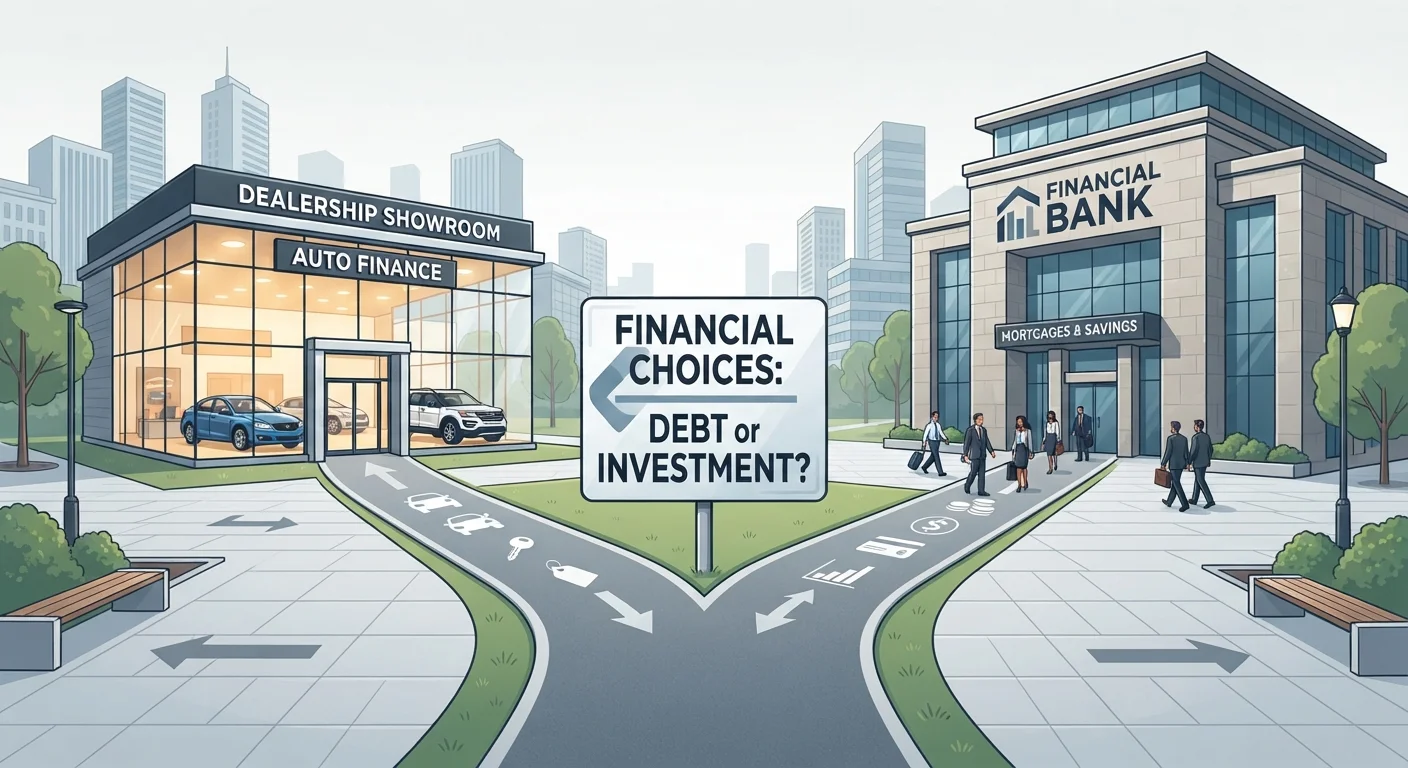
How Each Financing Route Actually Works
When you finance through a dealership, the dealer's finance and insurance (F&I) office submits your credit application to one or more lenders — often banks or captive finance companies owned by the automaker. The lender sets a buy rate (the base APR you qualify for), and the dealer may mark that rate up before presenting it to you. The difference is called a dealer reserve and represents additional profit for the dealership.
With a direct loan from a bank or credit union, you apply independently. If approved, the lender issues a pre-approval or a blank check up to a specified amount, and you bring that to the dealership as a committed financing option. The rate you receive is determined solely by the lender's underwriting — there is no intermediary markup built in.
Understanding this structural difference is the foundation for evaluating any deal. See how each route operates mechanically for a deeper breakdown of the process.
Rate Structures: Where the Numbers Diverge
APR (Annual Percentage Rate) is the standardized cost of borrowing expressed annually, and it's the only apples-to-apples figure for comparing loan offers. Monthly payment amounts are easy to manipulate by extending the loan term, so they are a poor primary comparison metric.
| Dealer Financing | Bank Loan | Credit Union Loan | |
|---|---|---|---|
| Rate transparency | Buy rate may be marked up | Rate set directly by lender | Rate set directly by lender |
| Pre-approval available | No — approval at point of sale | Yes — before you shop | Yes — before you shop |
| Promotional/subsidized rates | Available on qualifying new vehicles | Generally not available | Generally not available |
| Typical rate competitiveness | Varies; markup possible | Market-rate competitive | Often below market rate |
| Membership or account required | No | Account may be required | Membership required |
| Application process | In-dealership, fast | Online or branch, 1–2 days | Branch or online, 1–2 days |
Manufacturer-subsidized rates — sometimes advertised as 0% or low APR financing — are genuine promotional offers funded by the automaker, not the dealer. However, they typically require strong credit scores, apply only to specific trim levels or model years, and may require you to forgo a cash rebate. Always calculate whether taking the rebate and financing at market rate saves more over the loan term than the promotional APR.
Credit unions, as member-owned nonprofits, frequently offer rates below those of commercial banks, particularly for borrowers with good-to-excellent credit. Their underwriting may also be more flexible for members with limited credit history. For a side-by-side look at how rates differ by vehicle type, see how new and used car loan terms compare.
Always Compare the Full APR, Not the Payment
When a dealer quotes a monthly payment, ask for the corresponding APR and total interest cost over the loan term. A lower payment achieved by extending the term by 12 months often costs more in total interest than a higher payment on a shorter loan. Request the full loan disclosure — principal, APR, term, and total finance charge — in writing before agreeing to anything.
Using Pre-Approval as a Negotiating Tool
Arriving at the dealership with a pre-approved offer fundamentally changes the financing conversation. You know your ceiling rate, and the dealer's finance office must beat it — or offer something genuinely better — to win your financing business. This separates the vehicle price negotiation from the financing negotiation, which is a meaningful structural advantage.
Pre-approval does not lock you in. If the dealer presents a lower APR, you can accept it. If the dealer cannot compete, you use your outside loan. Either way, you benefit from having established a concrete benchmark. For a fuller comparison of these two approaches, financing through a dealership vs. arranging your own loan examines the trade-offs in detail.
~80%
New car buyers using dealership financing
Industry estimates consistently show the majority of new vehicle purchases are financed through dealership F&I offices rather than direct lenders.
0.5%–2.5%
Typical dealer reserve markup range
The markup a dealer applies over a lender's buy rate commonly falls in this range, though it varies by lender agreement and state regulations.
One practical note: multiple credit inquiries for auto loans within a short window — typically 14 to 45 days depending on the scoring model — are generally counted as a single inquiry. Shopping several lenders in a compressed timeframe therefore has minimal credit score impact.
This article provides general financial education about auto loan structures and is not personalized financial or lending advice. Rates, terms, and eligibility vary by lender and individual credit profile. Consult a qualified financial professional for guidance specific to your situation.