
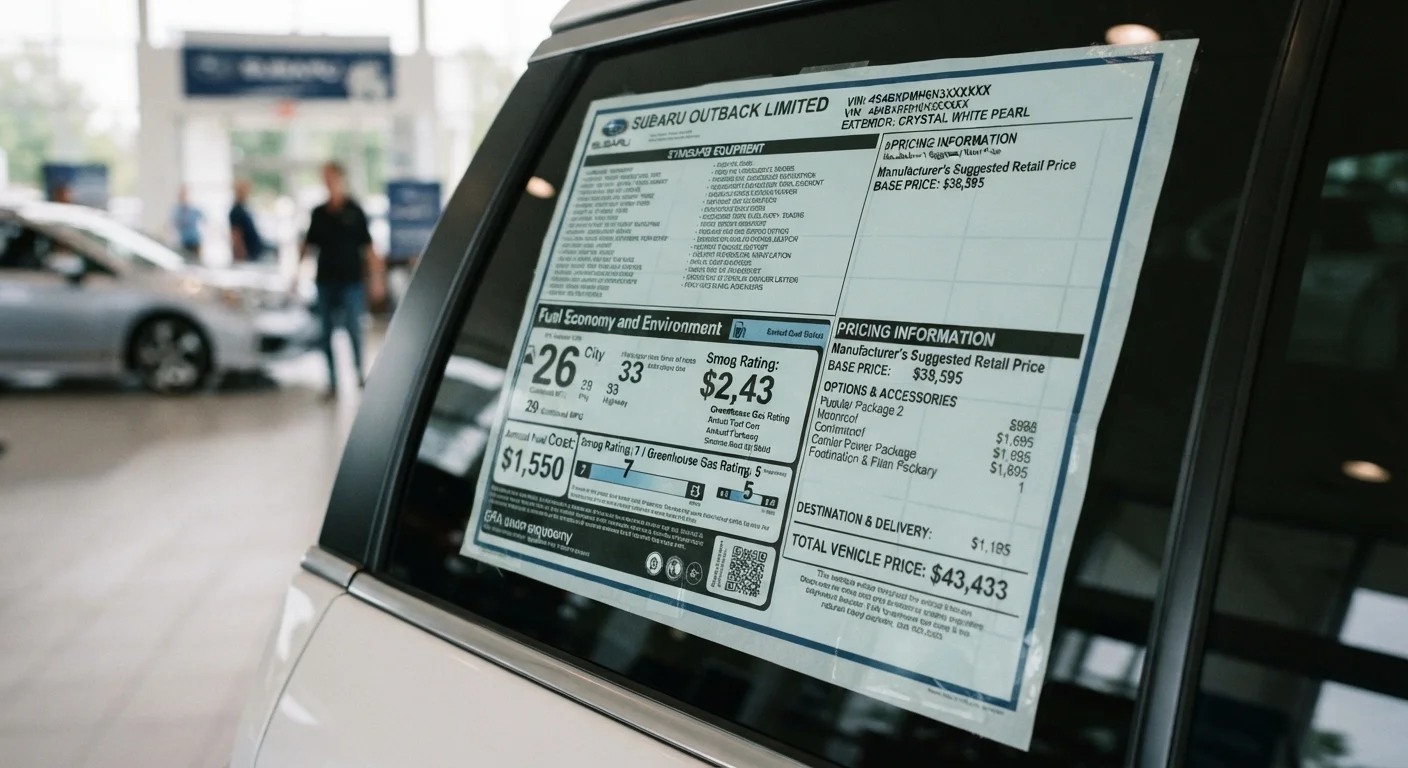
What the Monroney Sticker Actually Is
Every new car on a dealer's lot carries a standardized label affixed to the window, commonly called the Monroney sticker — named after the 1958 federal legislation that mandated it. Removing the sticker before sale is a federal offense; only the buyer can legally take it down. Its purpose is consumer transparency: to give you a consistent, government-regulated snapshot of what you're being asked to pay and what fuel economy to expect.
The sticker is not the final price you pay. It is the manufacturer's suggested retail price (MSRP) — a starting point for negotiation, not a fixed transaction number. Understanding each line item on that label is the first step toward knowing where you have leverage and where you don't. For context on what the sticker leaves out entirely, see the true cost of new car ownership.
Line-by-Line Breakdown of Every Sticker Section
The Monroney sticker is divided into distinct sections. Here's what each one actually means:
Base MSRP
This is the manufacturer's suggested price for the vehicle in its lowest trim configuration — no options added. It sets the pricing floor and is typically the number featured most prominently. Dealers can sell above or below this figure.
Optional Equipment and Packages
Individual options (like a moonroof or heated seats) and bundled packages are listed separately from the base price, each with its own line-item cost. These are often where margin hides — a package priced at $2,000 on the sticker may cost the manufacturer far less to produce. Review each one and determine which, if any, you'd have chosen yourself.
Destination and Delivery Charge
This fee covers transport from the manufacturing plant to the dealership. It is set by the manufacturer — not the dealer — and is non-negotiable in the traditional sense. However, it is a fixed, known cost you can verify against manufacturer websites. Do not allow a dealer to list it twice under different labels.
Fuel Economy Ratings
EPA-estimated city, highway, and combined miles-per-gallon (or MPGe for electrics) figures appear prominently. These are standardized test results, not guarantees of real-world performance. The sticker also includes an estimated annual fuel cost based on national average fuel prices and a set mileage assumption — useful for comparison shopping but not a precise prediction.
Total MSRP
The sum of base price, all options, and the destination charge. This is the number that anchors negotiation — but it is not your out-the-door cost. Taxes, registration, documentation fees, and any dealer add-ons come later. For a complete picture of what you'll actually pay at signing, see negotiating the out-the-door price vs. the sticker price.
MSRP
Manufacturer's Suggested Retail Price — the price the automaker recommends the dealer charge. It is a suggestion, not a ceiling or a floor, and is the primary figure on the Monroney sticker.
Destination charge
A fixed fee covering the cost of transporting the vehicle from the factory to the dealership. It is set by the manufacturer and is uniform for a given model regardless of where you buy.
Monroney sticker
The federally mandated window label on new vehicles, disclosing MSRP, options, destination charge, and EPA fuel economy ratings. Named after Senator Mike Monroney, who sponsored the 1958 legislation.
Dealer-installed options sticker
A separate, non-federally mandated sticker placed by the dealer listing add-ons (e.g., paint sealant, accessories) and their dealer-set prices. These items are typically negotiable.
MPGe
Miles Per Gallon equivalent — the EPA's unit for expressing the energy efficiency of electric and plug-in hybrid vehicles in terms comparable to gasoline fuel economy.
Out-the-door price
The total amount you actually pay to drive the vehicle off the lot, including MSRP, taxes, registration, documentation fees, and any financed add-ons. This is the only number that fully captures your cost.
What the Sticker Doesn't Tell You
The Monroney sticker is a regulatory document, not a complete buying guide. Several costs that materially affect your purchase are absent:
- Dealer add-ons: Paint protection film, nitrogen-filled tires, fabric sealant — these appear on a separate dealer-installed options sticker, sometimes placed next to the Monroney. They carry dealer-set prices and are almost always negotiable or removable.
- Documentation fees: Administrative charges for processing paperwork vary widely by state and dealer. They do not appear on the Monroney. For a full glossary of these charges, see dealer fees explained in plain English.
- Taxes and registration: Sales tax, title transfer, and registration fees are calculated after the sale price is set and vary by state and county.
- Financing costs: Interest, loan origination fees, and any back-end add-ons financed into the loan don't appear anywhere on the window sticker. Those mechanics are covered in detail at what happens at the back end of an auto loan.
Dealer Add-On Stickers Are Not the Monroney
Dealers sometimes place a second sticker alongside the federally required Monroney label, listing additional accessories or protection packages at marked-up prices. This supplemental sticker is not regulated by the same federal law and carries prices set entirely at the dealer's discretion. Always identify which sticker is which before accepting any line item as fixed.
Recurring ownership costs — insurance, maintenance, depreciation — are an entirely separate calculation. The Insurance & Fees hub is a practical starting point for mapping those numbers.