
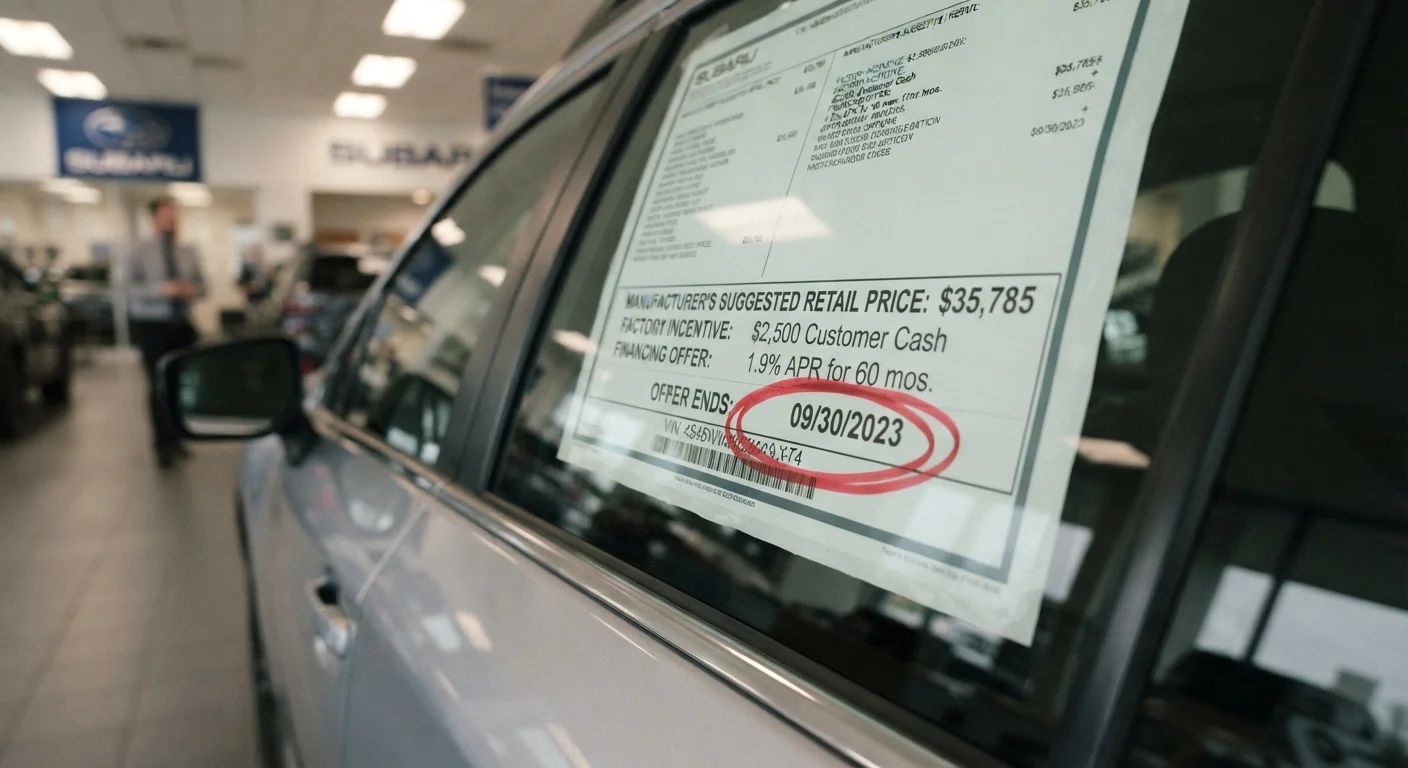
Why Incentive Windows Behave Like Expiring Contracts
Manufacturer incentives are not open-ended promotions. They are structured programs that automakers release — typically monthly — to manage inventory levels, respond to competitive pressure, and hit retail volume targets. Each program has a defined start date, an end date, eligible vehicle configurations, and regional variations. When the window closes, the offer disappears from the system entirely; dealers cannot honor it after the fact, regardless of what was discussed beforehand.
Understanding this mechanism changes how you approach timing. Rather than treating an incentive as a vague discount that's 'usually available,' you treat it as a contract with a counter. That shift makes the research steps below feel less optional and more essential.
For broader context on how outgoing model-year vehicles interact with these incentive cycles, model-year changeover often produces the most generous incentive stacks of any point in the annual calendar.
What you will need
Tools and Setup Before You Track
Tracking incentive windows doesn't require specialized software, but it does require a consistent process. The tools below keep your research organized and auditable — important when a dealer disputes an offer amount at the table.
Manufacturer Incentives Page
Primary source for current offer amounts, eligible trims, and exact expiration dates.
Spreadsheet or Notes App
Track multiple incentive windows, expiry dates, and the trims each applies to in one place.
VIN Decoder Tool
Confirm the specific vehicle's trim and build date to verify it qualifies for a given incentive.
Confirm Before You Negotiate
Dealer staff may quote an incentive that has already expired or apply it to a trim level that doesn't qualify. Always verify the current offer directly on the manufacturer's official website or consumer-facing portal before you set foot in a showroom. A five-minute check prevents hours of wasted negotiation.
Step-by-Step: Reading and Acting on an Incentive Window
Follow these steps in order. Skipping straight to the dealership without completing the research phase is the most common reason buyers miss valid incentives or get quoted ones that have already expired.
Identify the incentive type on the vehicle you want
Before tracking any window, establish which category of incentive applies to your target vehicle: a customer cash rebate, a manufacturer-subsidized APR offer, or lease support. Each runs on its own schedule and comes with different eligibility rules. Mixing them up leads to miscalculating your actual out-of-pocket cost.
Go directly to the manufacturer's incentives page
Navigate to the official manufacturer website and locate its current offers or incentives section. Enter your ZIP code — programs vary by region — and filter by the exact model and trim you are considering. Note the offer amount and, critically, the published end date. Screenshot or copy this information; do not rely on memory or dealer verbal quotes.
Map the expiry date against your purchase timeline
Place the incentive's expiration date on a simple timeline alongside your realistic purchase readiness — financing pre-approval, trade-in appraisal, and test drive. If the window closes before you can complete these steps, you have two choices: accelerate your preparation or wait for the next incentive cycle and assess whether that offer is comparable. Do not rush a major purchase purely to catch an expiring deal.
Check whether the incentive applies to in-stock vehicles
Some programs are limited to vehicles already on dealer lots and exclude factory orders. Others apply only to specific production months, identifiable via the vehicle's build date. If inventory is thin, confirm with two or three dealers in your area that qualifying stock exists before you invest time in a negotiation. Low-inventory conditions can also shift broader leverage dynamics — market conditions worth understanding before you walk in.
Verify stacking rules before building your offer
Pull up the full program terms for each incentive you intend to use and confirm whether they can be combined. Document the ruling in writing — a printed page from the manufacturer site works. Present this during negotiation if a dealer claims two offers stack when they don't, or vice versa.
Enter the negotiation with a dated confirmation
Bring your documented incentive details — amount, eligible trim, expiration date, stacking rules — into the negotiation as a reference document. This anchors the conversation in verifiable facts rather than dealer-quoted figures. If the dealer's system shows a different amount, ask them to pull up the manufacturer portal together in real time. Once the deal is written, ensure the final contract reflects the incentive exactly as published. Be alert to the back-end add-ons that can quietly offset your savings — where buyers give back savings is worth reading before you reach the F&I office.
Set a Calendar Alert for Expiry Dates
When you identify an incentive you plan to use, note its expiration date and set a reminder three days before it closes. This gives you a clear action deadline and prevents the common mistake of assuming the offer will roll over into the next month — it often doesn't, or it reappears at a lower value.
Stacking Restrictions Are Common
Most manufacturers prohibit combining a cash rebate with a subsidized APR offer on the same vehicle. Assuming two incentives will stack — without confirming the fine print — can produce a budget shortfall at signing. Read the program terms for each offer individually before making any purchase decision.
What to Do When a Window Has Already Closed
If you arrive at the research stage and find the incentive you planned around has expired, don't manufacture urgency around whatever replaced it. Assess the new offer on its own merits. Manufacturer incentive cycles are relatively predictable — many programs renew monthly with modest changes in value, and a vehicle that qualified last month will likely qualify again.
Waiting one additional month to capture a stronger or cleaner incentive is often the rational move, particularly on a purchase of this size. Pair that patience with awareness of the financing strategies available to you so that your loan timing also works in your favor.
This article is for general informational and educational purposes only. It does not constitute personalized financial, legal, or purchasing advice. Incentive availability, amounts, and terms vary by manufacturer, region, model, and time period. Verify all offers directly with the manufacturer and consult a qualified financial professional regarding your specific situation.