
What a Down Payment Actually Does to Your Loan
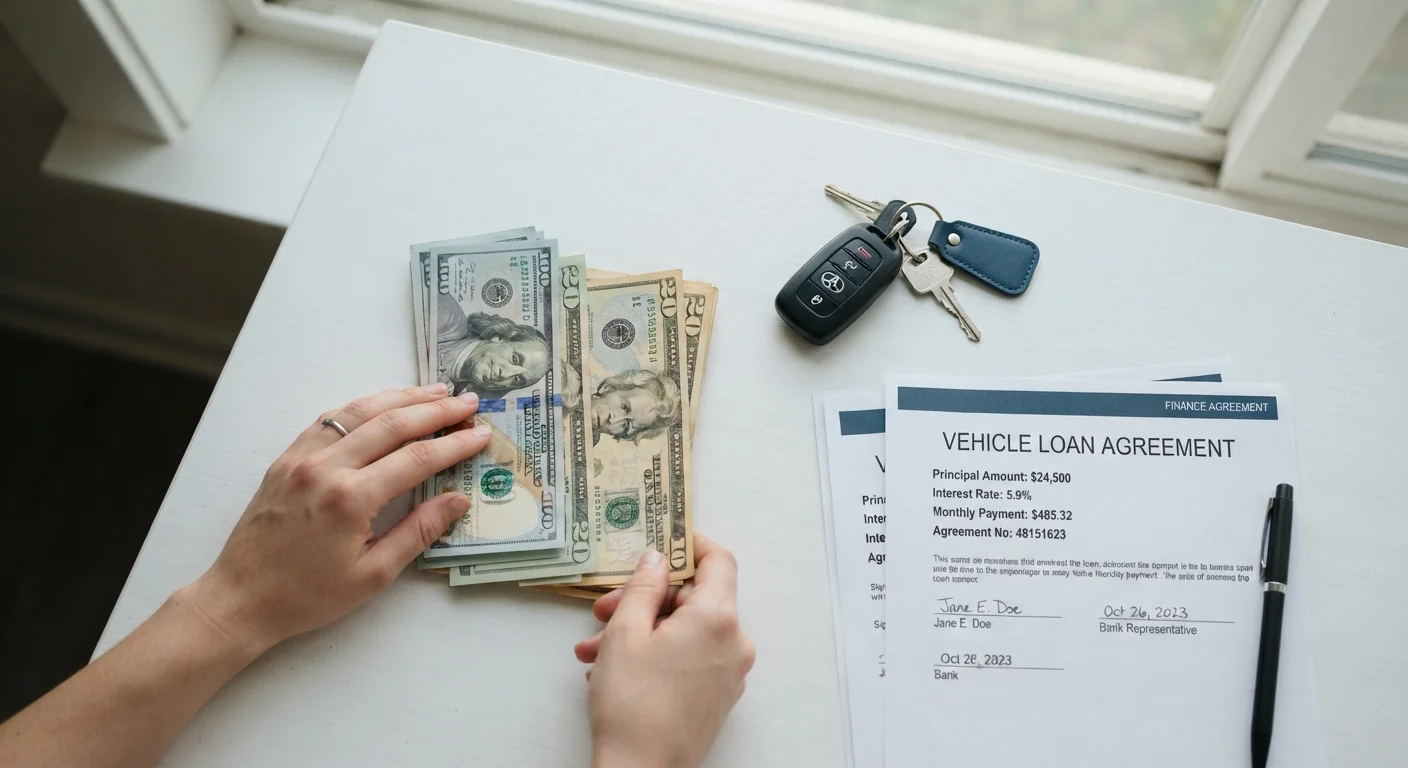
When you finance a vehicle, the lender pays the seller on your behalf and you repay the lender over time — with interest. Your down payment reduces the starting balance of that loan, known as the principal. Every dollar of principal you eliminate upfront is a dollar that never accrues interest over the loan term.
Consider a straightforward example: financing $28,000 versus $22,000 at the same APR and term produces meaningfully different monthly payments and a significant gap in total interest paid. The $6,000 difference is the down payment — and its effect compounds over months of interest charges.
For a deeper look at how loan terms interact with this math, see how loan terms shape what you really pay.
~10–20%
Commonly cited down payment guideline for new vehicles
Financial educators and consumer advocacy groups frequently reference this range as a general benchmark for reducing negative equity risk on new car purchases.
~20%
Average first-year depreciation for many new vehicles
Industry data consistently shows most new vehicles lose a substantial portion of their value in the first 12 months, underscoring the equity risk of low or zero down payments.
The Equity Problem: Why Low Down Payments Carry Real Risk
New vehicles depreciate quickly — often losing a significant portion of their value within the first year of ownership. When you finance with little or no money down, your loan balance can easily exceed the car's market value for an extended period. This is called being underwater or having negative equity.
Negative equity creates practical problems. If your vehicle is totaled or stolen, your insurance settlement is based on market value — not what you owe. That gap comes out of your pocket unless you carry GAP insurance. Similarly, if you need to sell or trade the vehicle before you've built equity, you may owe more than you receive, with the shortfall either paid in cash or rolled into a new loan — worsening your position.
A meaningful down payment helps you start closer to, or at, an equity-positive position from the beginning. For more on this dynamic, see how your down payment reshapes your equity position.
Consider GAP Coverage If You Finance Heavily
If your down payment is low and your loan term is long, Guaranteed Asset Protection (GAP) insurance can cover the difference between your loan balance and your car's market value if the vehicle is totaled or stolen. It doesn't substitute for a strong down payment, but it does limit your financial exposure during the period when negative equity is most likely. Terms and costs vary by provider — review your options carefully before purchasing.
Down Payments, Rates, and How Lenders Think About Risk
From a lender's perspective, the loan-to-value ratio — the amount financed relative to the vehicle's value — is a core measure of risk. A borrower financing 95% of a vehicle's price is a higher-risk proposition than one financing 75%. Some lenders respond to lower down payments by charging a higher APR, though the rate relationship is not purely mechanical and credit score remains the dominant factor.
What this means practically: improving your down payment percentage may marginally improve your rate offer in some cases, but it more reliably improves your loan structure — smaller balance, lower payment, faster equity build. These structural benefits are dependable regardless of any rate change. Explore the relationship between down payments and total cost in more detail.
Credit Score Remains the Primary Rate Factor
While down payment size can influence a lender's risk assessment, your credit score, income, and debt-to-income ratio typically carry more weight in determining the APR you're offered. A larger down payment helps your loan structure regardless of rate changes, but it is not a substitute for strong credit when negotiating financing terms.
What Counts as a Down Payment — and How to Build One
Cash is the most straightforward down payment, but it isn't the only form. A trade-in vehicle's equity — the portion of its value exceeding any amount still owed — can offset your purchase price dollar-for-dollar. Manufacturer rebates or incentives, where offered, may also reduce the financed amount, depending on how the deal is structured.
If your trade-in carries negative equity — you owe more on it than it's worth — that balance is typically rolled into the new loan, effectively reducing your down payment or creating a negative starting point. This is worth understanding before you step into a dealership.
Building a cash down payment over time is the most straightforward approach. Setting a savings target tied to a percentage of your target vehicle's price — commonly 10–20% — gives you a concrete goal. For broader guidance on structuring an auto purchase financially, see the financing and budgeting hub or review financing strategies for down payments and loan timing.
This article is for general informational and educational purposes only and does not constitute personalized financial advice. Consult a qualified financial professional before making decisions specific to your situation.