
The Core Distinction: Collateral
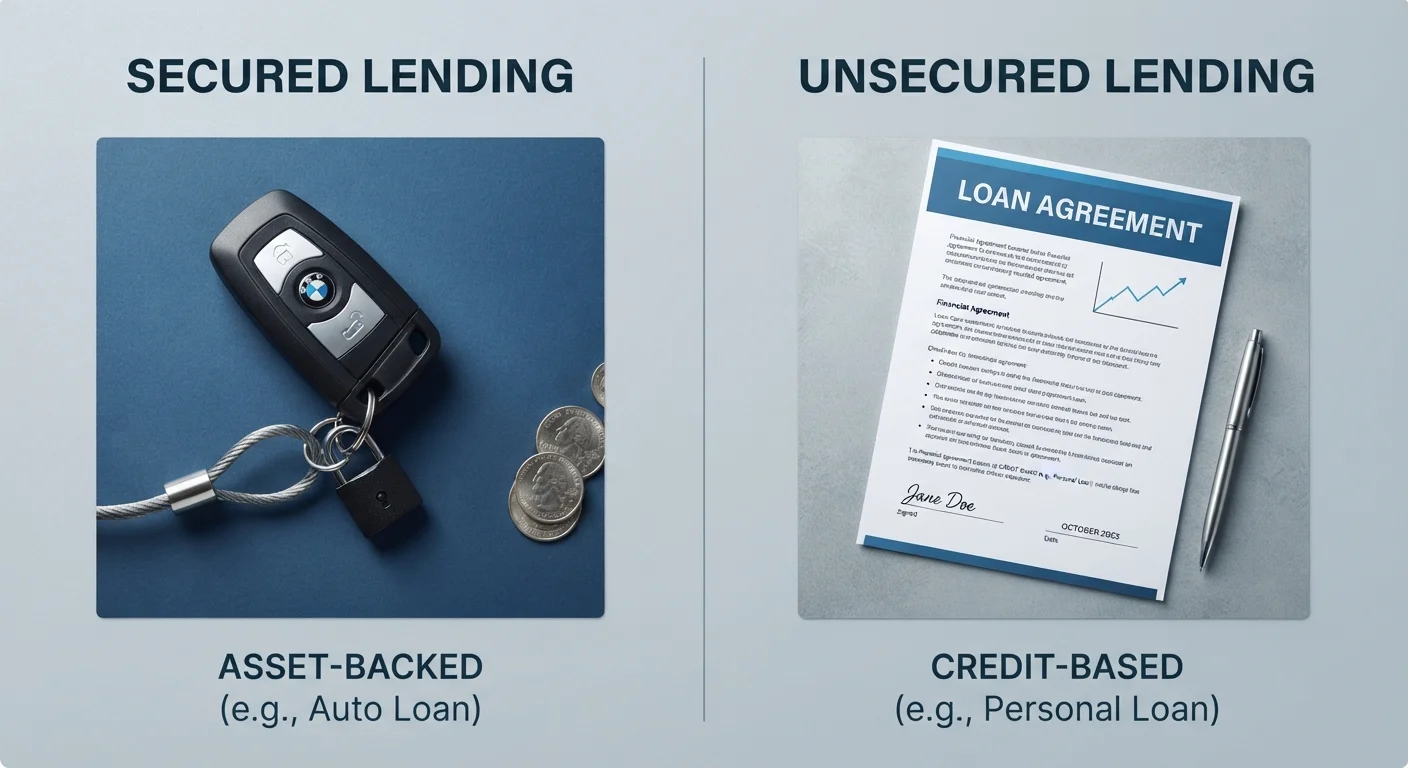
The defining difference between secured and unsecured auto financing is simple: does the lender hold a legal claim on the vehicle? In a secured loan, the answer is yes. The car itself serves as collateral — an asset the lender can seize and sell to recover its money if you default. In an unsecured loan, no such claim exists; the lender extends credit based solely on your creditworthiness.
The vast majority of auto loans in the United States are structured as secured debt. When you finance through a dealership, bank, or credit union and the lender places a lien on the title, that's a secured arrangement. The lien means you cannot transfer clear title to another party until the loan is repaid in full. Only then does the lender release the lien, and you receive the title free and clear.
For a deeper look at how loan components like principal, interest, and term interact, see our overview of auto loan anatomy before signing any agreement.
| Criterion | Secured Auto Financing | Unsecured Auto Financing |
|---|---|---|
| Collateral required | Yes — the vehicle | No collateral |
| Lien on vehicle title | Yes, until loan is repaid | No lien placed |
| Typical APR | Lower — collateral reduces risk | Higher — credit risk only |
| Available loan terms | Up to 84 months common | Often shorter (24–60 months) |
| Default remedy | Repossession without court order (varies by state) | Court judgment required |
| Vehicle age restrictions | Yes — older vehicles may not qualify | None — vehicle condition irrelevant |
| Credit score weight | Important, but collateral offsets risk | Primary qualifying factor |
What Happens When Payments Stop
The practical stakes of this distinction become clearest at the point of default. With a secured auto loan, lenders in most U.S. states have the legal right to repossess the vehicle without obtaining a court judgment first — provided the loan agreement grants that right and you are in breach. Repossession can happen quickly, sometimes within days of a missed payment, depending on state law and lender policy. After repossession, the vehicle is typically sold at auction, and if the sale proceeds don't cover the outstanding balance plus fees, you may still owe the difference — known as a deficiency balance.
With an unsecured personal loan used to finance a vehicle purchase, the lender has no automatic right to take the car. Instead, if you default, the lender must pursue collection through the courts — a slower and more expensive process. However, a court judgment can still result in wage garnishment or bank account levies, depending on state law. The lender's path is harder, but the consequences of default are not eliminated.
~85%
Auto loans that are secured by the vehicle
The large majority of U.S. auto financing is structured as secured debt, with the vehicle serving as collateral for the lender.
2–7%
Typical APR gap between secured and unsecured auto financing
The rate premium for unsecured personal loans versus secured auto loans varies based on borrower credit profile and lender policies.
Understanding these remedies matters when evaluating how much risk you're accepting. Review how financing strategy choices — including down payment size — can affect your default risk and equity position.
Interest Rates and Loan Terms: Why Structure Affects Cost
Because collateral reduces the lender's exposure, secured auto loans typically carry lower annual percentage rates (APR) than unsecured personal loans for the same borrower. The lender's reduced risk is priced into the rate you're offered. Conversely, unsecured lenders compensate for higher risk by charging more — sometimes significantly more, depending on your credit profile.
Loan terms also differ. Secured auto loans commonly extend to 60, 72, or even 84 months. Unsecured personal loans used for vehicle purchases often cap at shorter terms, which raises the monthly payment even if the borrowed amount is similar. For borrowers comparing rate and payment structures, this interplay between term length, APR, and total interest paid is critical to evaluate — not just the monthly figure.
The type of vehicle being financed can also determine whether secured financing is even available. Lenders frequently decline to secure loans against vehicles older than a set model year or above a certain mileage threshold, because the collateral's value is too uncertain. In those cases, an unsecured personal loan may be the only financing path. See how new and used vehicles differ in lender requirements for more context.
Fixed vs. Variable Rates Apply to Both Structures
Whether your auto financing is secured or unsecured, the interest rate itself can be structured as fixed or variable. A fixed rate stays constant over the loan term; a variable rate can change with market benchmarks. This is a separate dimension from the secured/unsecured distinction. See our comparison of fixed and variable rate auto loans to understand how rate structure affects your payment predictability.
This article provides general financial information for educational purposes only and does not constitute personalised financial or legal advice. Loan terms, lender rights, and state laws vary. Consult a licensed financial adviser or attorney for guidance specific to your circumstances.