
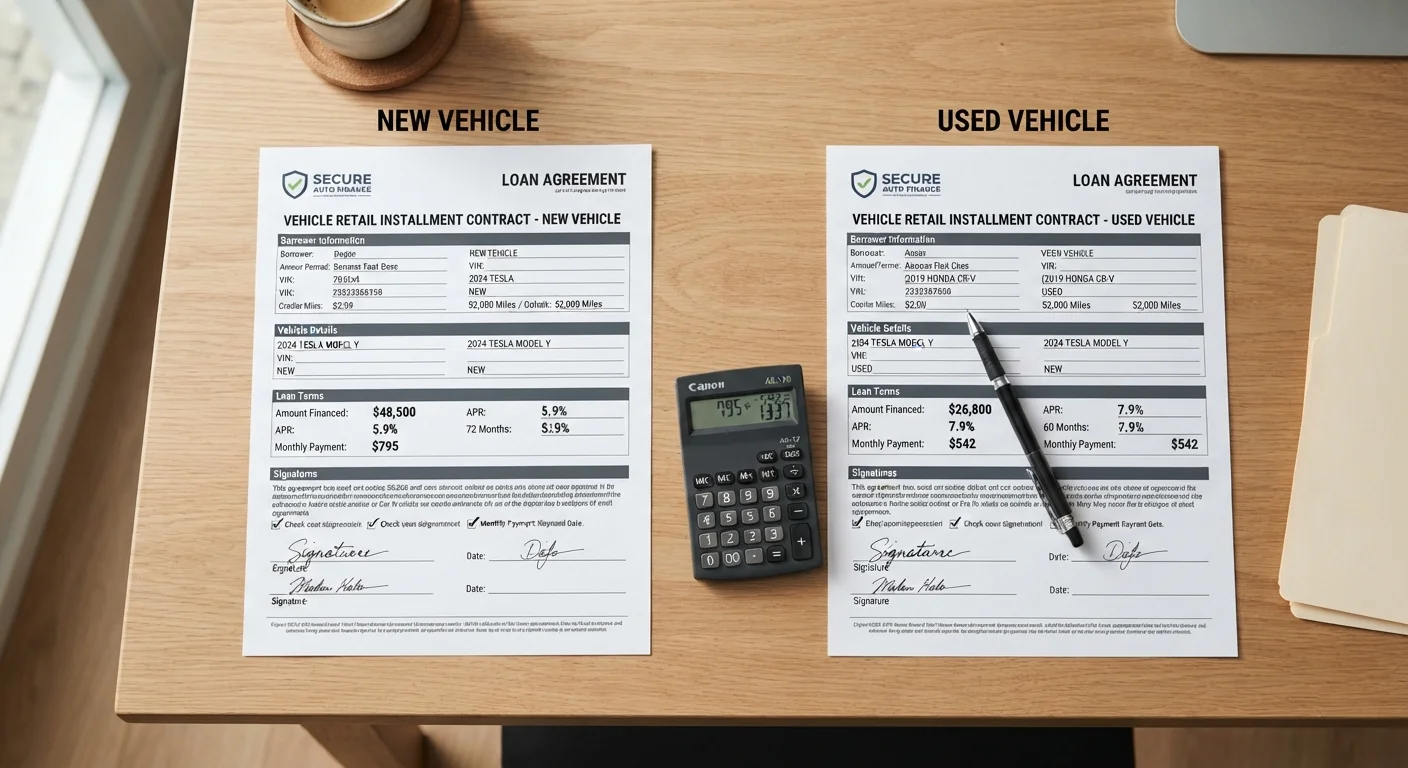
Why New and Used Auto Loans Are Structured Differently
Lenders treat new and used vehicles differently because the collateral — the car itself — depreciates at different rates and carries different risk profiles. A new vehicle has a known market value and a manufacturer warranty; a used vehicle's condition and future value are less certain. That risk differential flows directly into the loan terms you're offered.
For a full breakdown of how lender criteria shift between the two, see how new and used car loan terms compare. This article focuses specifically on the numbers: rates, terms, loan-to-value ratios, and total interest cost.
| New Car Loan | Used Car Loan | |
|---|---|---|
| Typical APR range | Lower; often 1–4% below used | Higher; varies by vehicle age |
| Maximum loan term | Up to 72–84 months common | 48–72 months; shorter for older cars |
| Loan-to-value flexibility | Up to 100%+ of MSRP/invoice | Limited to guide value; gaps not financed |
| Incentive/subsidized rates | Available via manufacturer programs | Rarely available; market rates apply |
| Credit score sensitivity | Moderate; wider tier spread | High; rate jumps sharply below prime |
| Required insurance coverage | Comprehensive and collision required | Comprehensive and collision required |
Interest Rates: The Gap Is Real but Variable
On average, new car loans carry lower annual percentage rates (APR) than used car loans. The spread varies by lender and credit tier, but it's common for used car rates to run one to four percentage points higher than new car rates for the same borrower. That gap widens further for older vehicles — lenders often apply a rate premium to cars beyond a certain model year or mileage threshold.
Manufacturer-subsidized financing complicates this picture. Automakers periodically offer below-market rates through their captive finance arms to move inventory. These deals can be genuinely attractive, but they're typically reserved for buyers with top-tier credit and may require forgoing a cash rebate. Before assuming the promotional rate is the better deal, compare the math: sometimes taking a standard loan plus the rebate results in a lower total payment. Understand the full picture at APR vs. interest rate on a car loan.
1–4%
Typical APR premium on used car loans
Used car loan rates commonly run one to four percentage points above new car rates for equivalent borrowers, based on general lender market patterns.
48–72 mo
Maximum term range for used car loans
Most lenders cap used vehicle loan terms shorter than new car loans, particularly for vehicles five or more model years old.
Loan Terms and Loan-to-Value Limits
New car loans routinely extend to 72 or 84 months. Used car loans are more constrained — most lenders cap terms at 60 to 72 months for recent-model vehicles, and shorter for older ones. A vehicle that's five or more years old may only qualify for a 48-month term, which raises the monthly payment even if the purchase price is lower.
Loan-to-value (LTV) limits also differ. New car lenders will often finance up to 100% — or slightly above — of the vehicle's invoice or MSRP. Used car lenders typically lend against a recognized wholesale or retail guide value, and they're less willing to finance above that figure. If the asking price exceeds the guide value, you'll need to cover the gap out of pocket. This is a common source of surprises for used car buyers who haven't checked the vehicle's market value before applying.
For context on how these variables interact with total cost, loan terms shape what you actually pay offers a detailed walkthrough on new car scenarios specifically.
Check the Vehicle's Guide Value Before Applying
Used car lenders lend against an independently assessed market value, not the dealer's asking price. If the asking price is above guide value, you'll need cash to cover the difference — a dealer won't always tell you this upfront. Pull a valuation estimate from a recognized pricing source and compare it to the purchase price before you enter a finance office. This single step can prevent a significant last-minute funding shortfall.
Total Interest Cost: Running the Real Numbers
A used car's lower purchase price doesn't automatically produce lower total interest. Consider a simplified example: a $28,000 new car at 5.5% APR over 60 months generates roughly $4,100 in interest. A $19,000 used car at 8.5% APR over 48 months generates roughly $3,400 in interest — cheaper overall, but the monthly payment is higher. Stretch that used car loan to 60 months and total interest climbs to around $4,300, exceeding the new car scenario despite the lower principal.
This is why term length is often the most consequential variable buyers overlook. The lowest monthly payment is rarely the cheapest loan. Running the full-term interest cost before signing is a basic but frequently skipped step. For scenarios where a used car's costs can actually exceed those of a new one, see when a used car actually costs more than a new one.
Also factor in insurance: lenders on both loan types typically require comprehensive and collision coverage, but premiums differ between new and used vehicles. Insurance costs for new vs. used vehicles covers how coverage requirements interact with total ownership cost.
This article provides general financial information for educational purposes only and does not constitute personalized financial or lending advice. Loan rates, terms, and eligibility vary by lender, credit profile, vehicle, and region. Consult a qualified financial adviser or licensed lending professional before making borrowing decisions.