
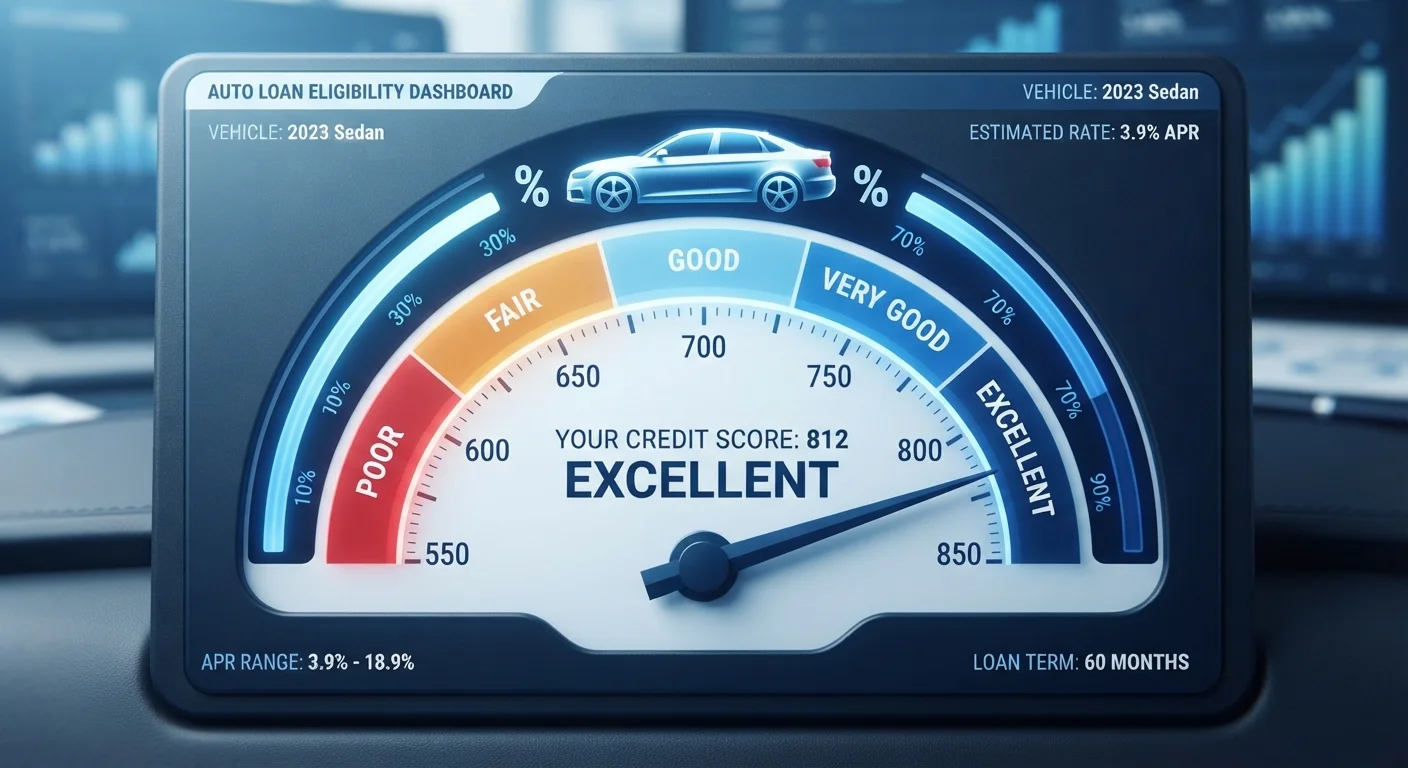
How Lenders Translate Your Score into a Rate
Auto lenders don't assign rates borrower by borrower in isolation. Instead, they use credit tiers — defined score ranges that map to rate bands. A lender might offer its lowest rates to borrowers scoring 740 and above, a slightly higher range to those between 680 and 739, and progressively higher rates as scores fall below that. The exact thresholds differ by lender, but the tiered structure is consistent across the industry.
This matters because rates don't slide smoothly — they step. A borrower at 701 and a borrower at 699 may land in entirely different tiers, with meaningfully different monthly payments, even though their scores are nearly identical. Understanding where the tier boundaries fall for a given lender can help you gauge whether pushing your score up even modestly before applying is worth the wait.
For a detailed breakdown of how those tiers typically line up with specific rate ranges, see how credit score ranges translate to auto loan rates.
100+ pts
Typical score gap between subprime and prime borrowers
Credit scoring models generally classify scores below 620 as subprime and scores above 720 as prime, a range that corresponds to dramatically different rate offers from most auto lenders.
~5–10%
Common rate spread between top and bottom credit tiers
Industry data consistently shows that the rate difference between the best and worst credit tiers on auto loans spans five to ten percentage points or more, depending on lender and market conditions.
The Real Dollar Cost of a Higher Rate
A rate difference of two or three percentage points can sound abstract — until you run the numbers. On a $28,000 vehicle financed over 60 months, moving from a 6% rate to a 10% rate adds roughly $3,200 in total interest. Stretch that to a 72-month term and the gap widens further. The rate isn't just a percentage — it's a concrete dollar amount subtracted from your budget every month for years.
This is also why the annual percentage rate (APR) — not just the stated interest rate — is the more complete comparison figure. APR folds in certain lender fees alongside interest, giving you a truer picture of total borrowing cost. Learn more in our explainer on APR vs. interest rate on a car loan.
“The interest rate on a loan is the price of risk. Lenders are pricing the probability that you won't repay — and your credit history is the primary evidence they have.”
— Consumer Financial Protection Bureau, U.S. federal agency responsible for consumer financial protection and education
What Goes Into Your Score — and What Lenders Also Consider
Your credit score is built from five broad categories: payment history (the most heavily weighted), amounts owed, length of credit history, credit mix, and new credit inquiries. Late payments and high revolving balances tend to drag scores down the most; consistent on-time payments and low utilization push them up.
But your score alone doesn't fully determine your rate. Lenders simultaneously evaluate your debt-to-income (DTI) ratio — how much of your gross monthly income goes toward existing debt obligations — as well as the loan-to-value ratio of the vehicle. A strong credit score paired with a high DTI can still result in a less favorable offer. See how DTI factors in at debt-to-income ratio and the invisible ceiling it places on your loan.
Check Your Credit Report Before You Apply
You're entitled to a free credit report from each of the three major bureaus annually at AnnualCreditReport.com. Reviewing your report before applying lets you spot and dispute errors that could be suppressing your score. Even a modest score improvement before you apply could shift you into a better rate tier.
This article provides general financial education and is not personalized financial or lending advice. Loan terms, rate availability, and lender requirements vary. Consult a qualified financial professional for guidance specific to your situation.