
How Lenders Translate Your Score Into a Rate
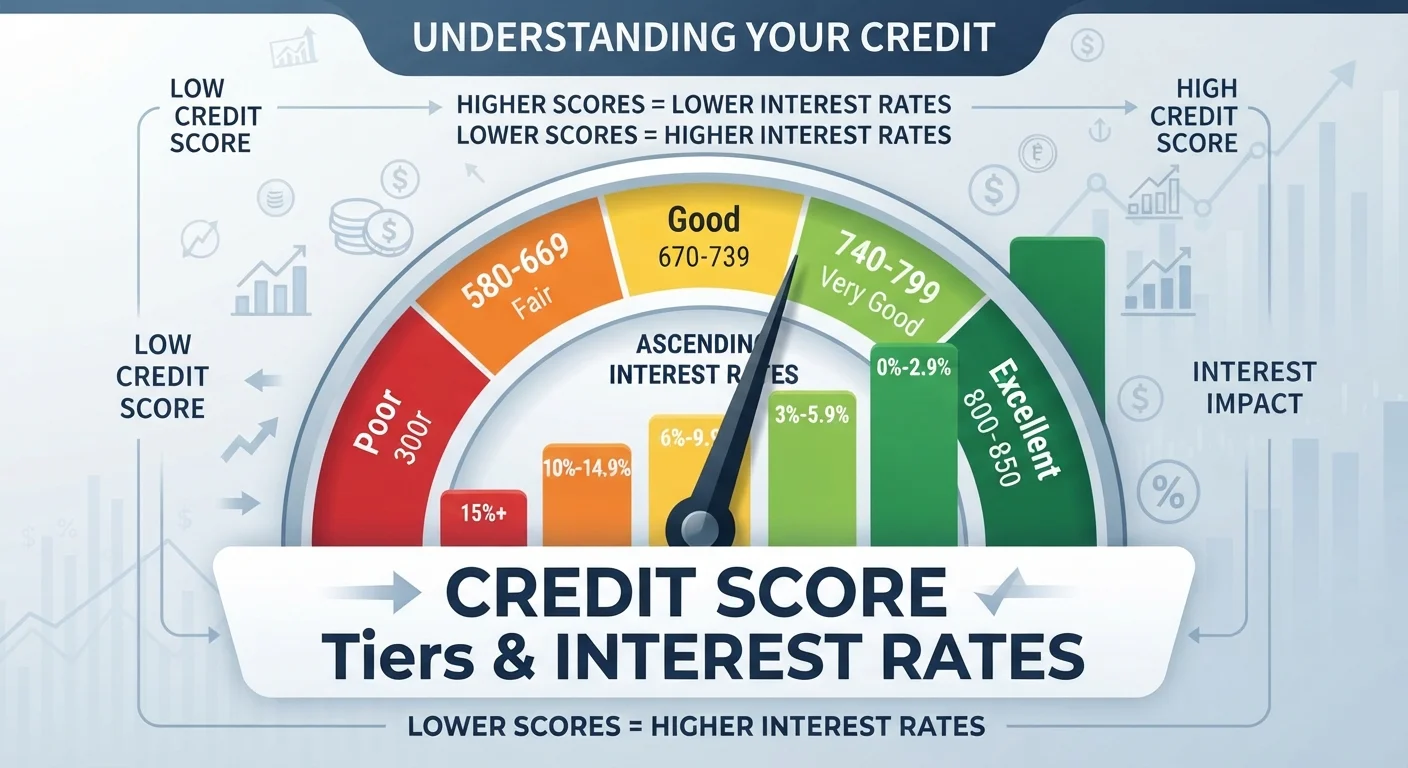
When you apply for an auto loan, the lender doesn't simply look at your credit score as a pass/fail check — it uses your score to place you into a credit tier, and that tier determines the interest rate band you're offered. This tiering system is how lenders price risk at scale.
While exact boundaries differ by institution, a broadly representative structure looks like this:
| Tier Label | Typical Score Range | Rate Implication |
|---|---|---|
| Super Prime | 720–850+ | Lowest rates available |
| Prime | 660–719 | Competitive, moderate rates |
| Near Prime | 620–659 | Elevated rates; more scrutiny |
| Subprime | 580–619 | Significantly higher rates |
| Deep Subprime | Below 580 | Highest rates; limited lenders |
The rate spread between tiers is not cosmetic. Moving from subprime to near-prime can represent a 4–6 percentage point APR difference — which translates directly into hundreds or thousands of dollars over a typical 48- to 72-month loan term. For a deeper look at how that math plays out, see the end-to-end guide on auto loan rates and payments.
~5–8%
Typical APR spread between super prime and subprime tiers
Industry data from sources including Experian's State of the Automotive Finance Market consistently show rate gaps of this magnitude between the highest and lowest credit tiers for new vehicle loans.
~48%
Share of new auto loans going to prime and super-prime borrowers
According to Experian automotive finance market reports, borrowers in prime and super-prime tiers have accounted for roughly half of new vehicle loan originations in recent years.
$5,000+
Additional interest on a $30K loan across a 6-point rate difference
A calculated illustration: on a $30,000, 60-month loan, a rate of 13% vs. 7% results in over $5,000 more in total interest paid over the life of the loan.
What the Tier Boundaries Actually Mean in Practice
Credit tiers are not an industry standard set by any single regulatory body — each lender defines its own cutoffs. A score of 660 might place you in the prime tier at a credit union but at the top of the near-prime tier at a bank with stricter criteria. This variability is one reason rate shopping across multiple lenders matters.
Lenders also use auto-specific credit scores, not just the general FICO score you might see on a consumer dashboard. FICO Auto Score variants weight your history of auto loan repayment more heavily. If you've had a prior auto loan and paid it consistently, your auto-specific score may be meaningfully higher than your general score — potentially moving you into a better tier.
Auto Scores Differ From General Credit Scores
The FICO score you see on a free consumer credit monitoring service may differ from the auto-specific score a lender pulls. FICO Auto Score variants are calculated using the same underlying credit file but apply different weights — emphasizing auto loan payment history. Ask your lender which score model they use so you can compare what you see with what they see.
Understanding how lenders decide whether to approve your auto loan provides broader context for the full underwriting picture — tier placement is one input among several.
Factors That Adjust Your Rate Within a Tier
Even within a given tier, the exact rate you're offered can vary. Lenders layer additional risk factors on top of your credit tier placement:
- Loan-to-value (LTV) ratio: Borrowing more than the vehicle is worth signals higher risk. A high LTV can result in a rate adjustment upward even for prime borrowers. See how loan-to-value ratio works in auto finance for the mechanics behind this.
- Loan term length: Longer terms (72 or 84 months) typically carry higher rates because default risk increases over time.
- Debt-to-income ratio: High existing debt relative to income can push a lender toward the higher end of a tier's rate range. Explore how debt-to-income ratio caps your borrowing capacity.
- New vs. used vehicle: Used car loans typically carry higher rates than new car loans within the same tier because of greater collateral uncertainty.
Understanding these adjustments helps you read a financing offer critically rather than accepting the first figure presented.
Using Tier Knowledge to Evaluate Financing Offers
Knowing which tier you likely fall into before you walk into a dealership or apply online gives you a realistic baseline. If a lender's offer places you in a higher-rate tier than your score would suggest — or prices you at the top of your expected range — that's a signal to ask questions or seek competing quotes.
Check Your Score Before You Apply
Pulling your own credit report (a 'soft' inquiry) before applying does not affect your score. Knowing your approximate tier in advance lets you gauge whether the rates you're quoted are consistent with your credit profile — or whether a lender is quoting the high end of a tier without justification. Multiple auto loan hard inquiries within a short window (typically 14–45 days depending on the scoring model) are generally treated as a single inquiry, so shopping lenders in a focused period minimizes score impact.
For buyers near a tier boundary, even a modest score improvement before applying can shift the rate meaningfully. Paying down revolving balances and correcting any credit report errors are among the most reliable short-term levers. For more context on how score differences propagate into rate differences, see what your credit score actually does to your loan rate.
This article is for general informational and educational purposes only and does not constitute personalized financial or lending advice. Credit scoring models, lender policies, and rate structures vary. Consult a qualified financial professional for guidance specific to your situation.