
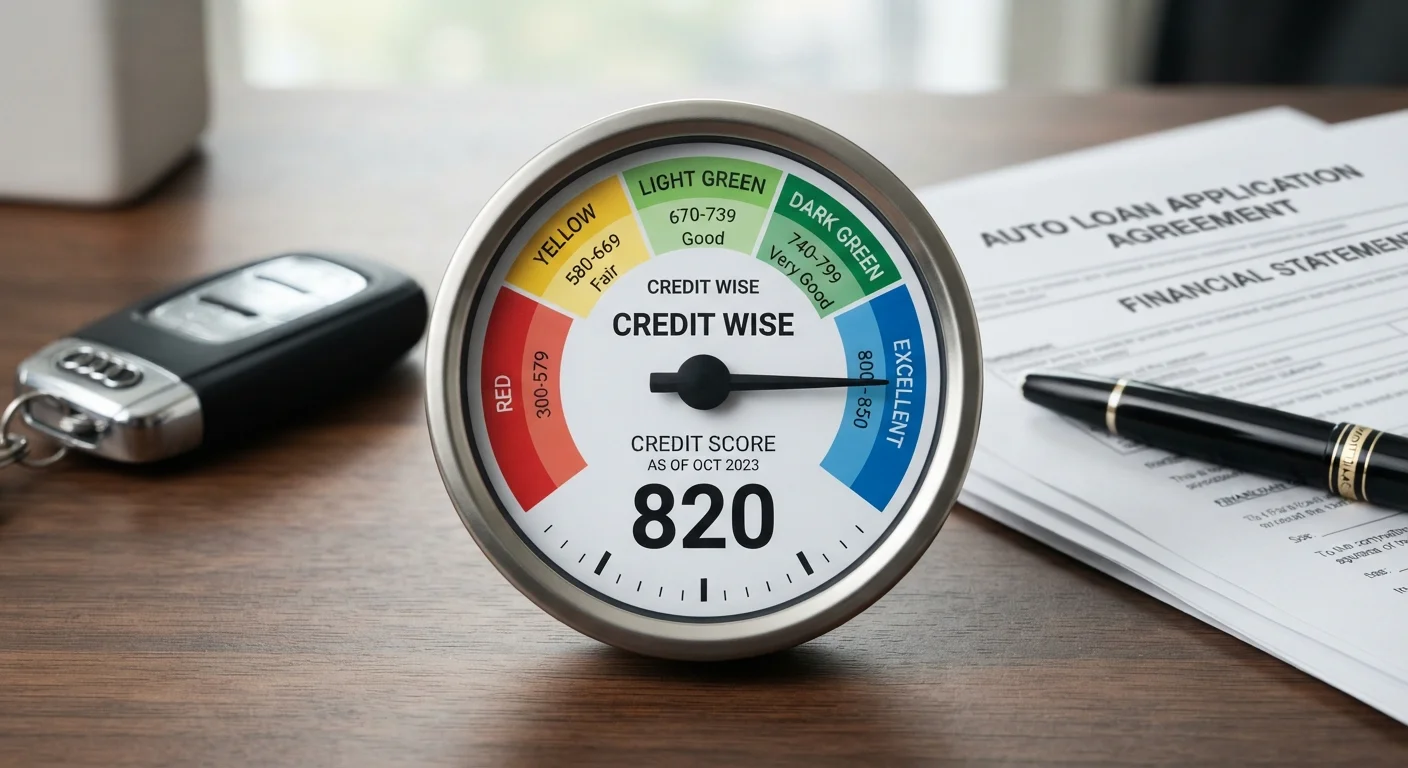
How Lenders Translate Your Score into a Rate
When a lender pulls your credit report, they aren't just checking whether to approve you — they're deciding what price to charge for the loan. That price is your interest rate, and it's largely determined by where your score falls within the lender's internal credit tiers.
Most lenders organize borrowers into bands — often labeled prime, near-prime, and subprime — each carrying a rate range. A borrower in the prime tier might be offered a rate several percentage points lower than someone in the subprime tier, even if the loan amount and term are identical. The lender's logic is straightforward: lower scores statistically correlate with a higher chance of default, and the higher rate compensates for that risk.
To understand how these tiers affect actual costs, see how credit score ranges translate to auto loan rates, which walks through typical tier structures and the dollar gaps between them.
5–7%
Typical rate gap between prime and subprime auto borrowers
Industry data consistently shows that borrowers in lower credit tiers pay significantly higher rates, often 5 to 7 percentage points above prime-tier offers for the same loan amount and term.
$3,000+
Potential extra interest on a subprime vs. prime loan
On a $25,000 60-month loan, a 6-percentage-point rate difference can result in more than $3,000 in additional interest paid over the loan's life.
The Real Dollar Impact of a Rate Difference
It's easy to dismiss a two- or three-percentage-point rate difference as minor, but on a multi-year loan the compounding effect is significant. Consider a $28,000 loan over 60 months: the difference between a 6% rate and a 10% rate is roughly $65 per month — and over the full term, that's more than $3,800 in additional interest paid.
That gap grows with larger loan amounts or longer terms. A lower rate's true dollar value becomes clearer when you work through specific examples, which illustrates how even a half-point difference compounds meaningfully across common loan scenarios.
For a broader view of how rate and term interact, financing a new car and how loan terms shape what you pay provides a useful framework before you sign anything.
Shop Multiple Lenders Before the Dealership
Arriving at a dealership with a pre-approval in hand puts you in a stronger position. You'll know your baseline rate, which makes it easier to evaluate whether dealer-arranged financing is genuinely competitive. Credit unions in particular often offer rates below what dealerships can match for well-qualified buyers.
Credit Score Is One Piece of the Lending Picture
Your credit score is influential, but lenders evaluate several factors together. Your debt-to-income (DTI) ratio — how much of your monthly income goes toward existing debt payments — plays a significant role in both approval and rate decisions. A high credit score paired with a stretched DTI can still result in a less favorable offer. How your debt-to-income ratio caps what you can borrow explains how lenders use this metric and how to calculate yours.
Lenders also examine the loan-to-value ratio — how much you're borrowing relative to what the car is worth. A large down payment reduces that ratio and can partially offset a lower credit score in the lender's risk assessment. See loan-to-value ratio in auto finance for a deeper explanation of how this factor is applied.
For a complete picture of the approval process, how lenders decide whether to approve your auto loan walks through all the variables lenders weigh simultaneously.
Scores Vary by Model and Lender
The score you see through a free monitoring service may differ from the score a lender actually pulls. Auto lenders frequently use industry-specific FICO Auto Score versions, which weight certain factors differently than general-purpose scores. Don't be surprised if the score a lender uses doesn't match what you expected — the tier it places you in is what matters most.
What You Can Do Before You Apply
The most effective step is to check your credit reports for errors before applying. Incorrect derogatory marks — a reported late payment that was actually on time, for instance — can suppress your score unfairly. Federal law allows consumers to dispute inaccurate items directly with the credit bureaus at no cost.
Beyond error correction, reducing your credit utilization ratio (the percentage of available revolving credit you're using) and making all existing payments on time are the two levers most likely to produce measurable score improvement within a few months. Avoid opening several new credit accounts in the period leading up to a loan application, as multiple hard inquiries in a short window can temporarily lower your score.
Finally, get pre-approved by more than one lender — including banks and credit unions — before entering a dealership. Pre-approval gives you a concrete rate offer to compare against dealer financing, and shopping multiple lenders within a short window (typically 14–45 days, depending on the scoring model) usually counts as a single inquiry for scoring purposes.
This article is for general informational purposes only and does not constitute personalized financial or lending advice. Loan terms, rate tiers, and approval criteria vary by lender and individual circumstances. Consult a qualified financial professional for guidance specific to your situation.