
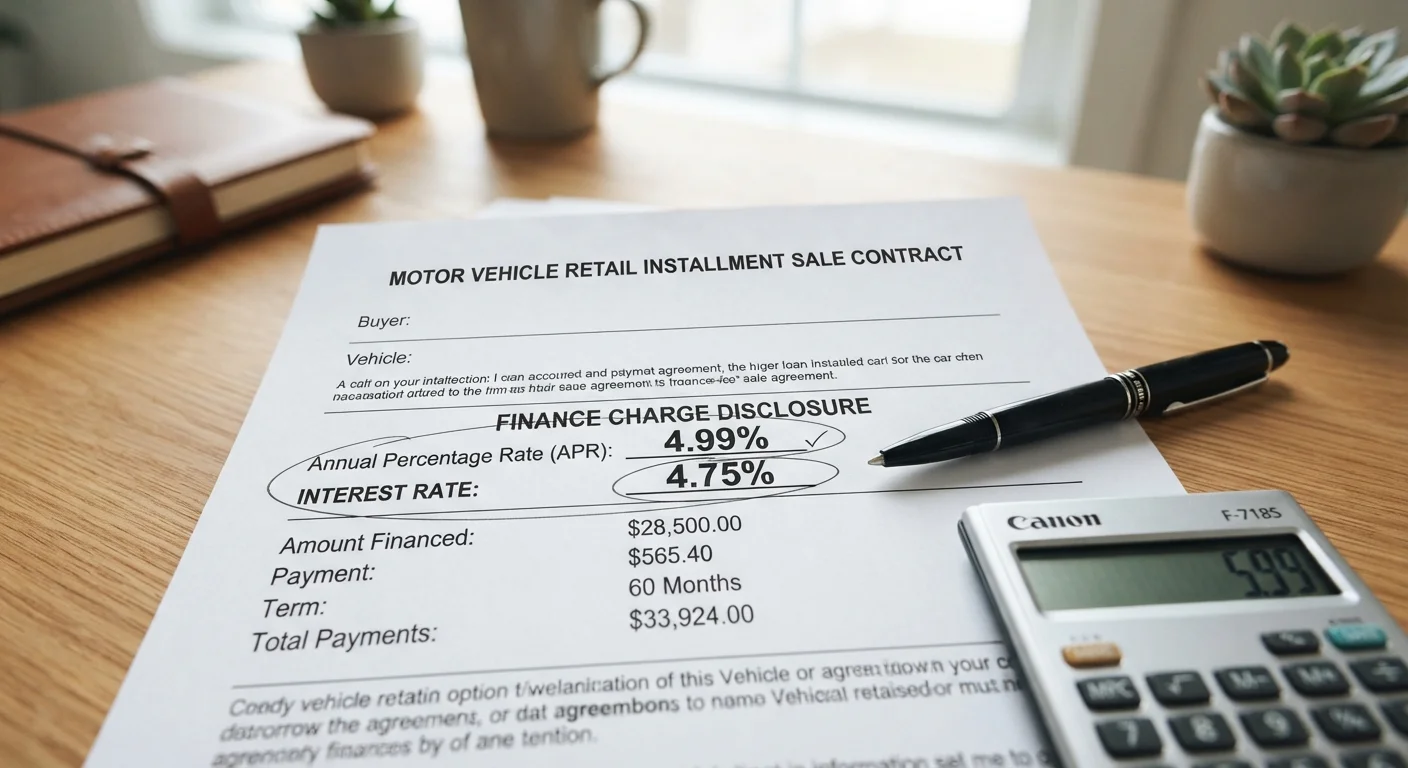
Two Numbers, Two Different Things
Every auto loan disclosure shows at least two rate figures: the interest rate (sometimes called the nominal rate) and the Annual Percentage Rate, or APR. Lenders are required by federal Truth in Lending Act (TILA) rules to disclose APR prominently, yet many buyers focus on whichever number looks smaller — often the interest rate.
The interest rate is the percentage the lender charges annually on the outstanding loan principal. If you borrow $25,000 at a 6% interest rate, that 6% determines how much interest accumulates each month on your balance. It says nothing about what you paid to obtain the loan.
APR takes the interest rate as its starting point and then layers in most lender-imposed fees — origination fees, certain dealer finance charges, and other mandatory costs — spreading them across the loan term and expressing the result as a single annualized figure. The result is a number that is always equal to or higher than the stated interest rate.
For a deeper look at how APR and interest rate each affect total borrowing cost, see our companion explainer on the topic.
What the Gap Between the Two Actually Tells You
The spread between your loan's interest rate and its APR is a direct signal of the fees built into the deal. A small spread — say, 6.0% interest rate versus 6.15% APR — suggests minimal fees. A larger spread — 6.0% versus 7.4% APR — indicates meaningful additional costs that deserve scrutiny.
| Criterion | Interest Rate | APR |
|---|---|---|
| What it measures | Annual cost on principal only | Annual cost including most fees |
| Includes lender fees | No | Yes (most mandatory fees) |
| Use for comparing lenders | Limited — ignores fee differences | Better — standardizes total cost |
| Use for monthly payment calc | Yes — drives the payment formula | Not directly used in payment calc |
| Affected by loan term length | Not directly | Yes — shorter terms raise APR impact of fees |
| Required federal disclosure | Yes (TILA) | Yes (TILA, prominently) |
| Relationship between the two | Always equal to or lower than APR | Always equal to or higher than rate |
Because APR distributes fees across the full loan term, the term length you choose affects how the spread appears. A $500 origination fee on a 72-month loan barely moves the APR needle; the same fee on a 24-month loan pushes APR noticeably higher. This means shorter-term borrowers should pay particular attention to the APR gap.
It is also worth noting that APR does not capture every possible cost. Add-on products — like guaranteed asset protection (GAP) coverage or extended service contracts rolled into the loan — may or may not appear in the APR depending on whether they are treated as required conditions of credit. Always request a complete itemization of all financed charges.
0.1%–2%+
Typical APR-to-rate spread on auto loans
The spread varies widely based on lender fee structures; dealer-arranged financing can carry larger spreads than direct lending.
72 months
Most common new-vehicle loan term in the US
Longer terms reduce the per-payment fee impact on APR, but increase total interest paid over the life of the loan.
Using Both Figures to Evaluate a Loan Offer
When reviewing competing loan offers, use APR as the primary comparison tool and the interest rate as a secondary diagnostic. If two lenders quote identical APRs but different interest rates, the lender with the lower interest rate is charging higher fees to close the gap — something worth understanding before you sign.
Here is a practical approach:
- Collect the APR, interest rate, loan term, and all disclosed fees from each offer in writing.
- Confirm whether any fees are waivable — some origination or documentation fees are negotiable.
- Re-calculate the total cost of the loan (monthly payment × number of payments + any upfront fees paid out of pocket) for each offer to get a true dollar comparison.
- Adjust for term differences — a lower APR on a longer term may still produce a higher total interest payment.
Your credit profile has a direct effect on both the interest rate and, indirectly, the APR you are offered. See how lenders use credit history in our article on what a credit score actually does to your loan rate.
For a full walkthrough of how rates are set and how to read your loan statement, the auto loan rates and payments end-to-end guide covers each stage in detail. And if a manufacturer is offering either a cash rebate or a low-APR financing deal, the comparison works differently — explore that in our article on cash rebate vs. low-APR financing.
This article provides general financial education and is not personalized financial or legal advice. Loan terms, fees, and APR calculations vary by lender. Consult a qualified financial professional before making borrowing decisions based on your individual circumstances.