
What Depreciation Actually Means for Your Wallet
Depreciation is the difference between what you pay for a vehicle and what it's worth when you sell or trade it. Unlike a fuel bill or an insurance premium, it never shows up as a line item — yet for most owners, it's the single largest cost of ownership.
Think of it this way: if you buy a new vehicle for $38,000 and sell it five years later for $20,000, you've absorbed $18,000 in depreciation — roughly $3,600 per year, or about $300 per month, before you've paid for a single tank of gas. That figure dwarfs what many owners budget for maintenance or even insurance.
Understanding depreciation is foundational to calculating what a car truly costs. Our guide on the real cost of owning a car beyond the purchase price breaks down how depreciation stacks up against fuel, servicing, and tires over a full ownership period.
~20%
Average new car value lost in year one
Industry data consistently shows new vehicles lose between 15–25% of value within the first twelve months of ownership.
~50%
Value lost after five years on average
Many mainstream vehicles retain roughly half their original purchase price by the five-year mark, though this varies significantly by model and segment.
$3,000–$5,000
Estimated annual depreciation cost per vehicle
AAA's annual Your Driving Costs study has estimated average depreciation for new vehicles in this range, representing the largest single ownership cost category.
How Depreciation Curves Work: Year by Year
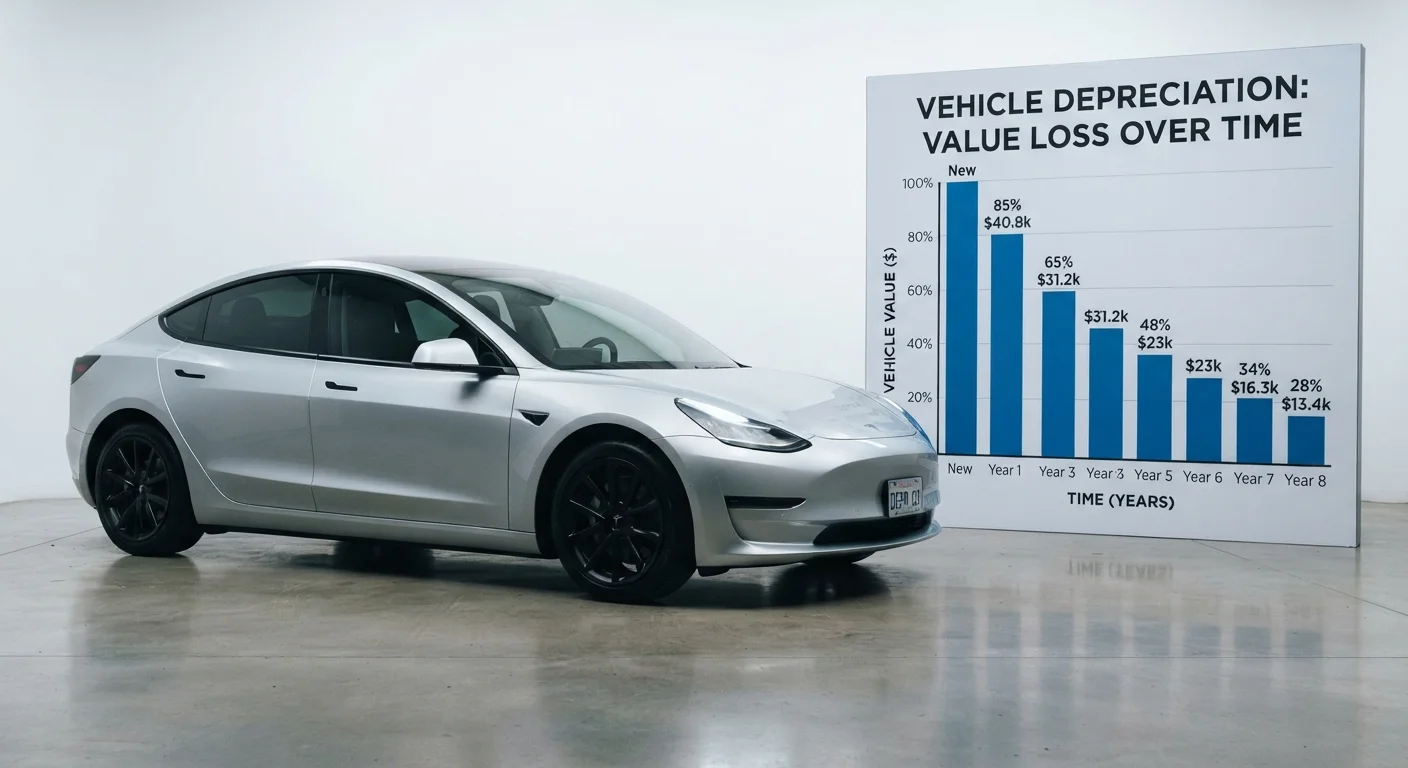
Depreciation doesn't move in a straight line. The loss is front-loaded — steepest in the earliest years, then gradually flattening as the vehicle ages.
- Year 1: Most new vehicles lose roughly 15–25% of their purchase price the moment they leave the lot and through the first year of ownership.
- Years 2–3: Value continues dropping by around 10–15% per year, though the rate begins to slow.
- Years 4–5: Annual depreciation typically falls to 8–12%, as the vehicle settles into a more stable used-car pricing band.
- Beyond year 5: Some vehicles reach a relative floor, losing value more slowly — though high-mileage wear and obsolescence can accelerate losses again later.
This front-loading is exactly why the two-to-three-year-old used vehicle market is often financially compelling — a previous owner absorbed the sharpest drop while you step in at a flatter point on the curve.
When comparing two vehicles at similar price points, look up their projected residual values at three and five years — not just the sticker. A $2,000 difference in purchase price can easily be reversed by a $4,000 difference in five-year resale value.
Residual value is a direct input into total cost of ownership, yet most buyers compare upfront price only. This reframe shifts the decision to what actually matters financially.
If you're financing, check whether you'd be underwater within the first 12–18 months — meaning the loan balance exceeds the vehicle's market value. Standard amortization schedules on longer-term loans can leave you exposed.
Being underwater on a loan limits your flexibility if you need to sell, trade, or if the vehicle is totaled — the lender collects, not you.
Factors That Speed Up or Slow Down Value Loss
Not all vehicles depreciate at the same rate. Several concrete factors determine where a specific car lands on the depreciation spectrum.
- Vehicle segment
- Luxury vehicles and EVs have historically depreciated faster than mainstream economy and compact SUVs, largely because their higher initial price amplifies dollar-denominated losses. Market dynamics for EVs are still evolving, so check current residual data for specific models.
- Mileage
- Every 10,000 miles above the segment average at resale typically reduces value noticeably. High annual mileage compresses the resale timeline.
- Condition and service history
- A clean Carfax report and documented maintenance records demonstrably support resale value. Accident history — even minor — can reduce offers by hundreds to several thousand dollars.
- Color and configuration
- Neutral colors (white, silver, gray, black) consistently attract broader resale demand. Rare trims or unusual color combinations can limit the buyer pool.
- Market demand
- Supply chain events, fuel prices, and shifting consumer preferences all move residual values. Pickup trucks and SUVs have historically held value better than sedans in the US market.
For a broader look at how these factors interact with insurance and registration costs, see the true cost of owning a car beyond the sticker price.
Luxury Vehicles: Amplified Dollar Losses
A luxury or near-luxury vehicle priced at $60,000 that loses 25% in year one sheds $15,000 in value — compared to $8,750 on a $35,000 mainstream vehicle losing the same percentage. If strong residual value is a financial priority, run the actual dollar figures rather than relying on percentage rates alone, since the absolute loss on premium vehicles can be substantially higher.
Depreciation in the Context of Total Ownership Cost
Depreciation rarely exists in isolation. It interacts with every other ownership cost category — and sometimes in ways that aren't obvious.
Higher-value vehicles depreciate more in raw dollar terms, and they also typically carry higher insurance premiums and registration fees tied to vehicle value. Conversely, a vehicle with strong residual value may cost more to insure comprehensively because replacement cost remains high.
The true cost of new car ownership beyond the sticker price includes not just depreciation but financing charges — and those two costs compound each other. When you finance a depreciating asset, you're paying interest on a value that is shrinking. Early in a loan, this can leave owners temporarily "underwater" — owing more than the vehicle is worth.
For buyers considering electric vehicles, depreciation dynamics carry additional nuance. Battery range anxiety, charging infrastructure, and software update cycles all influence resale demand. The EV charging and real ownership costs hub covers these considerations in depth.
“The cheapest car to own is often the one you already have. Every time you trade vehicles, you restart the depreciation clock at its steepest point.”
— Consumer financial education principle, Widely cited in automotive total cost of ownership analysis
Practical Strategies to Limit Depreciation's Impact
You can't eliminate depreciation, but you can make structurally better decisions that reduce its share of your annual ownership cost.
- Buy used at the right age: A vehicle that's two to four years old has already shed its sharpest value decline. You benefit from a lower purchase price, lower financing amount, and a flatter depreciation curve going forward.
- Hold longer: The longer you own a vehicle in good mechanical condition, the more you spread the fixed depreciation loss across more years — lowering cost per year. A vehicle held for ten years costs far less annually in depreciation than one traded every three.
- Prioritize models with historically strong residuals: Segment and body style matter. Research residual value data for the vehicle types you're comparing before committing. Mainstream SUVs and trucks have generally outperformed sedans in value retention in the US market, though this can shift.
- Maintain the vehicle and its records: Documented service history, clean interiors, and no deferred maintenance all support resale value at exit. This is one area where spending a modest amount on upkeep can return more at trade-in.
- Match mileage expectations to the vehicle: If you drive high annual mileage, buy accordingly — a vehicle priced for that expectation rather than one whose resale value will be disproportionately penalized.
Our overview of ownership cost factors worth calculating before you buy provides a structured framework to run these numbers before you commit to any purchase.
Use Residual Value Data Before You Negotiate
Before finalizing any vehicle purchase, look up projected residual values from industry sources for that specific model and trim. This data tells you what the market expects the vehicle to be worth at resale — and it's the number that actually determines your net cost of ownership. A vehicle with strong residuals isn't just easier to sell; it costs you less to own.
This article provides general financial and consumer information for educational purposes only. It is not personalized financial, tax, or legal advice. Actual depreciation rates and ownership costs vary by vehicle, market conditions, and individual circumstances. Consult a qualified financial adviser or automotive professional before making purchase decisions.