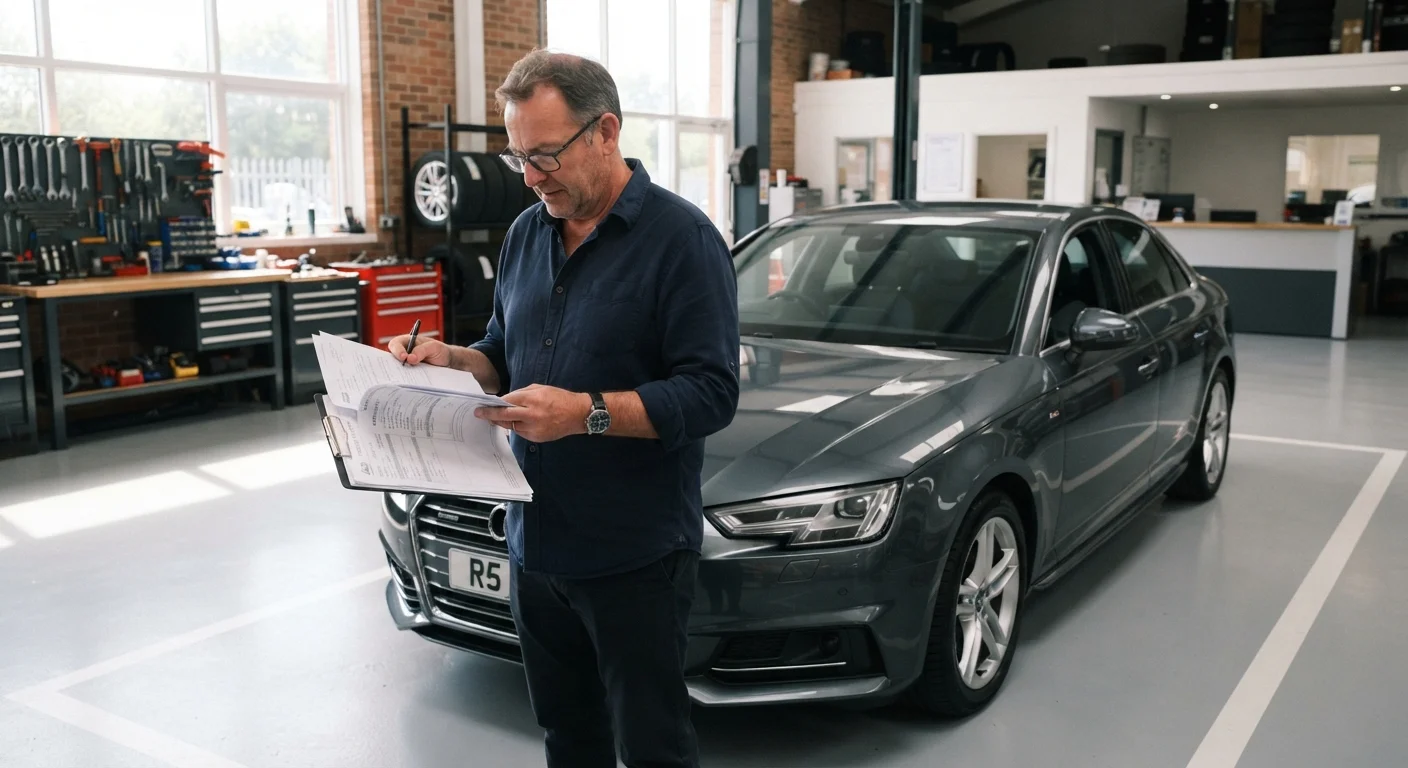
Complete service records can meaningfully increase a buyer's confidence and willingness to pay.
Minor cosmetic repairs often cost less than the discount buyers will demand if left unaddressed.
Timing your sale around mileage milestones and season can influence final offers.
Paperwork gaps — missing title, lien release, or maintenance logs — are common deal-killers.
A vehicle history report from the buyer's perspective helps you anticipate objections before they arise.
A practical checklist covering service records, cosmetic condition, documentation, and timing — everything that affects what a buyer will actually offer.
Why Preparation Directly Affects Your Offer Price
When a buyer evaluates a used car, they're running a mental cost-benefit calculation in real time. Every missing service record, every door ding, and every dashboard warning light gets subtracted from what they're willing to pay — often at a rate disproportionate to the actual repair cost. That asymmetry is exactly why pre-sale preparation pays off.
Depreciation curves are steepest in the first three years of ownership, but the floor you land on when you sell is shaped heavily by condition and documentation. Two identical vehicles from the same model year can attract very different offers depending on how well the seller has maintained and presented them. This checklist walks you through the practical steps to close that gap before you list.
If you've been thinking about resale value throughout your ownership period, you're already ahead — see how long-game ownership habits protect value for the broader picture. For sellers about to list, this checklist focuses on the final sprint.
Documentation & Paperwork
Locate the vehicle title and confirm it is in your name with no outstanding liens; obtain a lien release letter from your lender if you've recently paid off the loan.Must
Compile all service records — oil changes, tire rotations, major repairs — into a single folder, chronologically ordered.Must
Pull a vehicle history report (such as those available through CARFAX or AutoCheck) so you can review it from the buyer's perspective and prepare answers for anything flagged.Should
Gather the original window sticker (Monroney label) if retained, original owner's manual, and any warranty booklets or extended warranty documents.Nice to have
Note the odometer reading and confirm it aligns with mileage recorded in service documents — discrepancies raise red flags for buyers.Must
Mechanical Condition
Check that no warning lights are active on the dashboard; have any codes read by a mechanic and address genuine faults before listing.Must
Verify all fluids — engine oil, coolant, brake fluid, power steering fluid, and windshield washer fluid — are at correct levels and within service intervals.Must
Inspect tire tread depth and condition; replace tires that are at or near the wear indicators, as buyers frequently use tire condition to judge overall maintenance.Should
Test all lights — headlights, brake lights, turn signals, reverse lights, and interior lights — and replace any burnt-out bulbs.Should
Confirm brakes feel solid with no pulling, grinding, or unusual vibration; have a qualified mechanic inspect pad thickness if you're uncertain.Must
Perform or document a recent oil change so the buyer can see fresh oil on the dipstick and an updated service sticker.Should
Cosmetic Condition
Have the exterior professionally detailed or hand-washed and clay-barred to remove embedded contaminants that dull paint.Should
Address minor paint scratches and door dings through a touch-up pen, paintless dent repair (PDR), or body shop — weigh repair cost against the discount buyers typically demand.Should
Deep-clean the interior, including carpet shampooing, leather or fabric conditioning, and thorough vacuuming of seats and cargo areas.Must
Remove all personal items and odor sources; use an odor eliminator if smoking or pets have left any detectable smell, as odor is one of the hardest objections to overcome at negotiation.Must
Clean and dress rubber seals, door jambs, and trim pieces — these detail areas signal whether a car has been cared for.Nice to have
Pricing & Timing Strategy
Research current private-party and dealer trade-in values using multiple sources to set a realistic asking price anchored to actual market data, not optimism.Must
Consider mileage milestones — vehicles crossing 30k, 60k, 100k, or 150k miles often see sharper buyer resistance; selling just before a major milestone typically yields stronger offers.Should
Evaluate seasonal demand for your vehicle type: trucks and SUVs often attract stronger interest in spring and early summer; convertibles peak before summer.Nice to have
Decide in advance whether you're selling privately, trading in, or using a third-party buying service — each channel has different trade-offs between convenience and net proceeds.Must
Prepare a brief, factual written description of the vehicle's condition, features, and service history to include in your listing — accurate descriptions reduce wasted viewings and negotiation friction.Should
Tools and Resources You'll Need
Before working through the checklist, gather the following. Having everything in one place saves time and avoids last-minute scrambles when a serious buyer wants documentation quickly.
Required
Vehicle Title
Required to legally transfer ownership; must be free of liens at the time of sale.
Required
Service Records Folder
A complete, chronological maintenance history reassures buyers and supports your asking price.
Required
Vehicle History Report
Lets you review accident history, title status, and odometer records before a buyer raises them.
Optional
OBD-II Scanner
Reads any stored diagnostic trouble codes so you can address warning lights before listing.
Optional
Tire Tread Depth Gauge
Provides an objective measurement of remaining tire life to disclose accurately to buyers.
Required
Detailing Supplies or Professional Detailer
Interior and exterior detailing is one of the highest-ROI steps before listing a used vehicle.
Required
Market Valuation Sources
Cross-referencing multiple valuation tools gives you a defensible, realistic asking price range.
Keep in mind that buyers — especially informed ones — may run their own checks. Reviewing what buyers look for when inspecting a used car can help you anticipate questions and address issues before they become negotiating leverage against you.
Don't Over-Invest in Pre-Sale Repairs
It's tempting to fix everything before listing, but not every repair returns its cost in a higher sale price. Focus on items that buyers universally notice — warning lights, odors, obvious cosmetic damage — and get a realistic quote before committing to anything that costs more than a few hundred dollars. A qualified mechanic can help you distinguish deal-breakers from minor disclosures.
Disclosure Obligations Vary by State
Most US states require sellers to disclose known material defects. Misrepresenting a vehicle's condition — even through omission — can expose you to legal liability after the sale. If you're unsure what disclosure is required where you live, consult your state's DMV guidance or a legal professional before finalising any transaction.
This article provides general informational guidance on vehicle preparation and resale. It is not a guarantee of any specific resale value or outcome. Results will vary based on market conditions, vehicle history, and buyer preferences. For decisions involving significant financial transactions, consult a qualified professional as appropriate.
The content on this site is for informational purposes only and is not a substitute for professional advice. Always consult a qualified professional for guidance specific to your situation.