
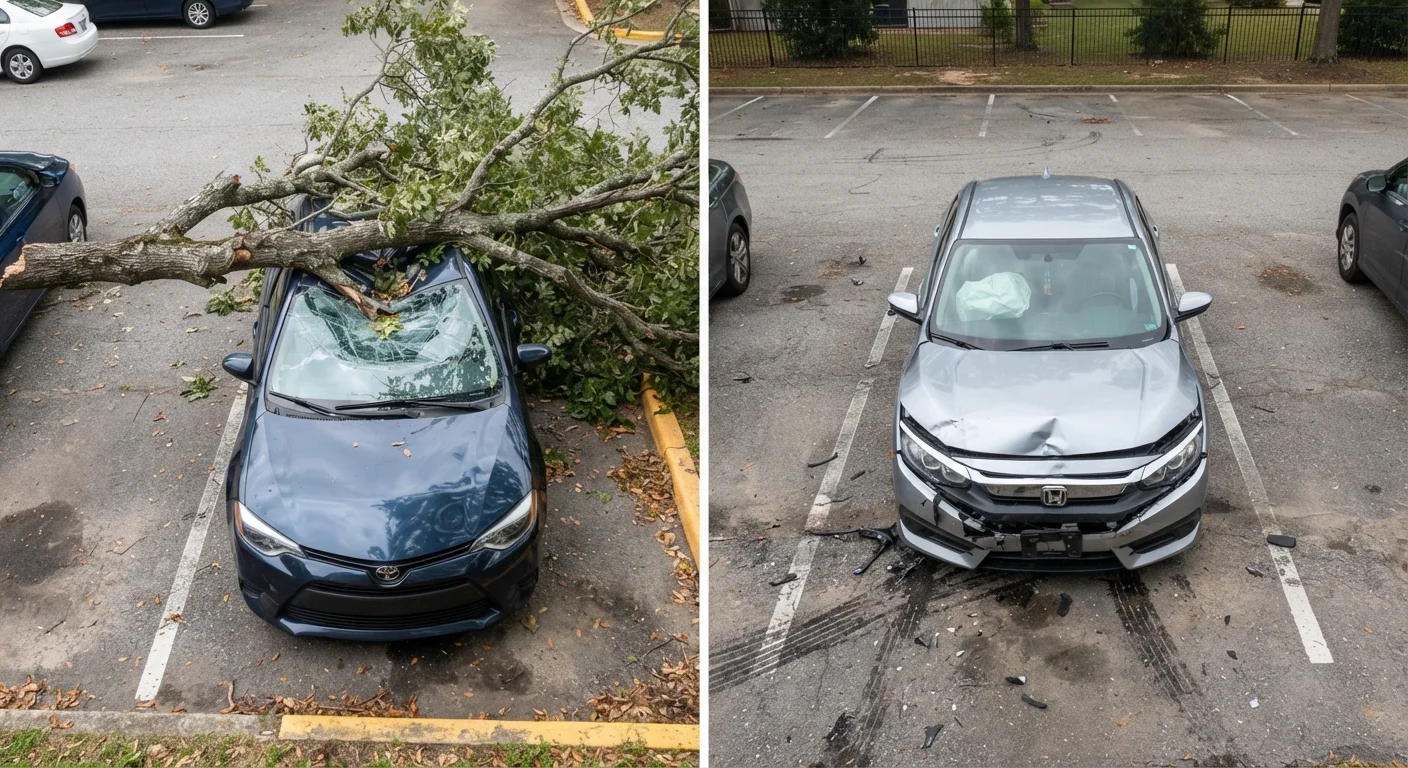
What Each Coverage Actually Does
The names sound almost interchangeable, but comprehensive and collision protect against completely separate categories of events.
Comprehensive coverage pays to repair or replace your vehicle when it's damaged by something other than a collision. That includes theft, vandalism, fire, flooding, hail, falling objects (think tree branches or debris), and animal strikes — a deer running into your door qualifies, for example. The common thread: these are events largely outside the driver's control.
Collision coverage responds when your vehicle makes physical contact with another car, a guardrail, a pole, or any other object while moving. It applies whether you're at fault or not, and it also covers single-vehicle incidents like rolling into a ditch or hitting a curb hard enough to cause damage.
One thing neither coverage does: pay for injuries to you or others, or damage to someone else's vehicle. That's the job of liability insurance and personal injury protection — separate components of your policy entirely. For a broader look at how these pieces fit together, see how liability-only compares to full coverage.
| Criterion | Comprehensive | Collision |
|---|---|---|
| What triggers a claim | Non-collision events (theft, weather, animals, fire) | Vehicle contact with another car or object |
| Driver fault required? | No — typically beyond driver control | No — covers at-fault and not-at-fault crashes |
| Typical premium cost | Generally lower | Generally higher |
| Deductible applies? | Yes | Yes |
| Required by lenders? | Yes, when financing or leasing | Yes, when financing or leasing |
| Covers other party's vehicle? | No | No |
| Premium influenced by | Location, theft rates, weather risk | Driving record, mileage, vehicle type |
How Deductibles and Premiums Differ Between the Two
Both coverages carry a deductible — the amount you pay out of pocket before your insurer covers the rest. Common deductible levels range from $250 to $1,500, and you typically set them independently for each coverage type.
Collision premiums are generally higher than comprehensive premiums because collision claims are more frequent. Fender-benders and parking lot scrapes happen far more often than hailstorms or vehicle thefts in most ZIP codes. Your collision rate also rises with your driving history; a prior at-fault claim typically pushes it higher at renewal.
Comprehensive premiums are more geography-dependent. If you're in a region with high rates of vehicle theft, frequent severe weather, or dense deer populations, your comprehensive rate will reflect that local risk profile.
~6%
of insured vehicles had a comprehensive claim annually
According to the Insurance Research Council, comprehensive claims are filed less frequently than collision claims on average across U.S. policyholders.
$3,900+
Average collision claim payout
The Insurance Information Institute has reported average collision claim severities in the range of several thousand dollars, reflecting rising parts and labor costs.
When evaluating whether each coverage is worth keeping, a useful benchmark is the actual cash value (ACV) of your vehicle — what it would fetch on the open market today, accounting for depreciation. If your car's ACV is, say, $5,000 and your collision deductible is $1,000, the maximum net payout you could receive is $4,000. Weigh that ceiling against what you're paying annually in premiums to gauge whether the math holds up.
When Lenders Require Both — and What Happens If You Drop Them
If you financed or leased your vehicle, the lender almost certainly requires you to carry both comprehensive and collision coverage for the life of the loan or lease. This protects their financial interest in the asset. Dropping either coverage while still owing money on the vehicle typically violates your loan agreement.
Check Your Loan Agreement Before Making Changes
Insurance requirements are typically spelled out in your financing or lease contract under the section on physical damage coverage. Before adjusting your deductibles or dropping a coverage type, review those terms or contact your lender directly. Making an unauthorized change can have contractual consequences beyond just force-placed insurance.
If your insurer notifies your lender that you've dropped coverage, the lender can purchase what's called force-placed insurance on your behalf and bill you for it. Force-placed policies are typically more expensive than what you'd choose yourself and cover only the lender's interest — not yours as the driver or vehicle owner.
Once you've paid off the vehicle, you have full discretion. At that point, it's worth running the numbers: add up your annual premiums for both coverages, factor in your deductibles, and compare that total to your car's current market value. Many owners of older, fully depreciated vehicles find that scaling back to liability-only saves meaningful money each year. If you financed with a small down payment and your vehicle depreciated quickly, also consider whether gap insurance belongs in the picture — it covers the gap between what you owe and what your insurer pays out after a total loss.
This article provides general insurance information for educational purposes only. Coverage terms, exclusions, deductibles, and premiums vary by provider, policy, and state. Read your actual policy documents carefully and consult a licensed insurance agent or adviser for guidance specific to your situation.