
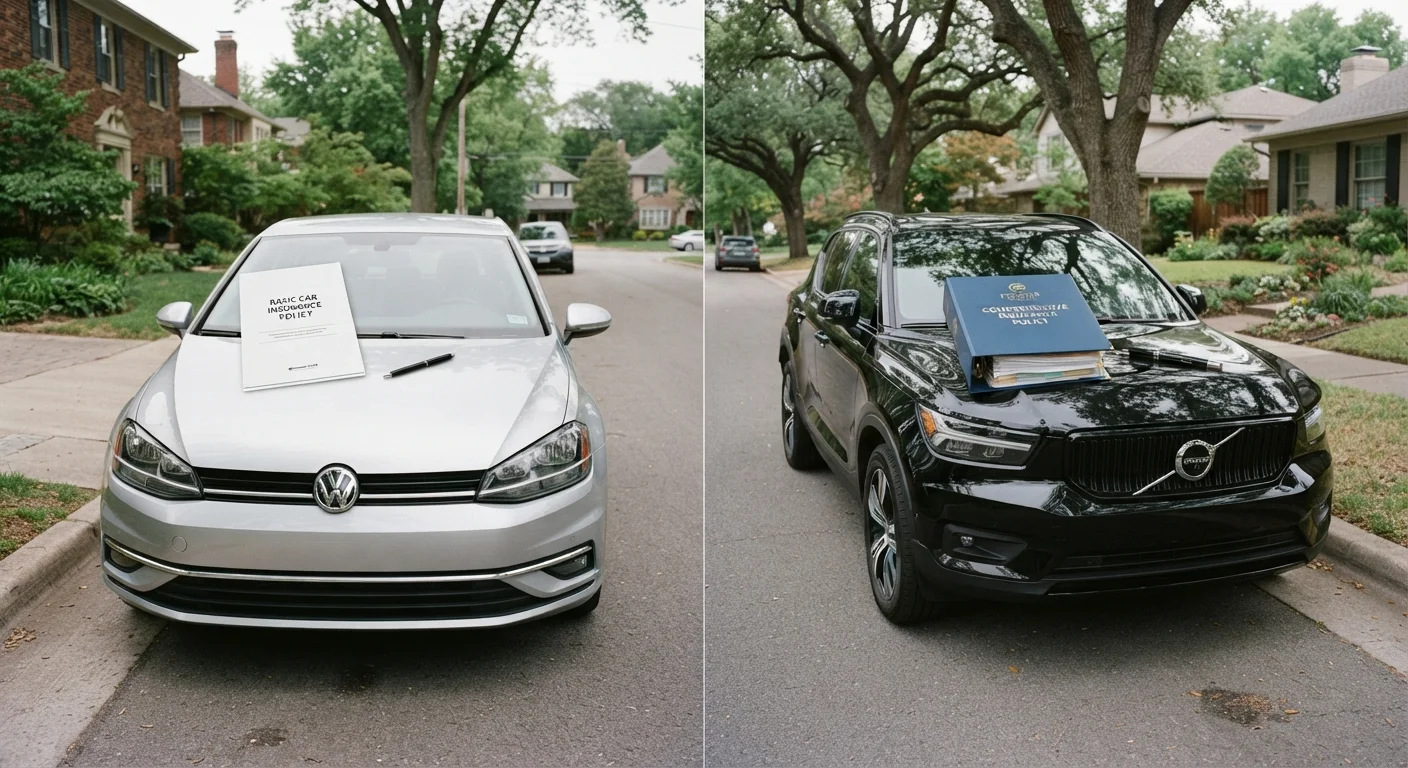
What Each Coverage Level Actually Includes
Liability-only insurance covers damage and injuries you cause to other people in an at-fault accident. It satisfies every state's minimum legal requirement, but it pays nothing toward repairing or replacing your own vehicle. Full coverage — a common shorthand, not an industry-defined term — typically bundles liability with both collision and comprehensive coverage. Collision pays for damage to your car from an impact regardless of fault; comprehensive covers non-collision events like theft, hail, flooding, or animal strikes. For a detailed breakdown of what each component actually protects, see how comprehensive and collision differ.
Understanding the distinction matters because the financial exposure gap between the two tiers is not symmetrical — it depends heavily on your specific vehicle's value.
The Case for Liability-Only Coverage
Significantly lower monthly or annual premium costs
Removing comprehensive and collision coverage can reduce total premium spend meaningfully, particularly for older vehicles where those coverages represent a disproportionate share of total cost.
Frees capital for a self-insurance reserve
Premium savings redirected to a dedicated savings account create a financial buffer that remains yours regardless of whether a loss event occurs.
Appropriate when vehicle ACV is very low
When a car's market value is modest, the maximum insurer payout after a deductible may be small enough that comprehensive and collision coverage offers little practical protection relative to its cost.
Simplifies coverage for infrequently driven vehicles
For vehicles used rarely and stored safely, the probability of a collision or theft event is lower, which can make a reduced coverage level more defensible.
The central argument for dropping to liability-only is premium savings applied to a vehicle whose value no longer justifies the cost of insuring it. If your car's actual cash value (ACV) — what an insurer would pay in a total-loss settlement — is low relative to your combined annual premium plus deductible, the math may favor self-insuring the vehicle itself. As a general rule of thumb sometimes cited by consumer finance sources, if your annual comprehensive and collision premium exceeds 10% of your vehicle's ACV, the coverage may be economically inefficient.
The savings can be redirected to an emergency fund, effectively self-insuring the vehicle while keeping that capital accessible for other needs.
The Case for Full Coverage
Leaves your vehicle fully exposed to loss
Any damage to your own car — whether from a collision, flood, or theft — is entirely your financial responsibility, regardless of the dollar amount.
Violates lender requirements on financed vehicles
Dropping below full coverage while carrying an auto loan breaches standard financing agreements and can trigger lender-placed insurance at a significantly higher cost.
No protection against non-collision events
Hail damage, animal strikes, flooding, and theft are covered by comprehensive — none of which apply to at-fault accidents, meaning liability-only leaves a broad category of common losses unprotected.
Total loss becomes a total out-of-pocket expense
If your vehicle is totaled through no fault of your own and the at-fault driver is uninsured or underinsured, recovery is limited without additional coverage layers in place.
The central risk of liability-only coverage is straightforward: if your car is totaled, stolen, or damaged in a hail storm, you absorb 100% of that loss. For many households, an unplanned $8,000–$15,000 vehicle replacement is not an absorbable expense — it becomes a financial emergency.
Financed or Leased? Coverage Is Not Optional
If you have an outstanding auto loan or are mid-lease, full coverage is almost certainly a contractual requirement — not a choice. Dropping to liability-only without lender approval typically constitutes a loan agreement violation. Should the lender discover the lapse, they may purchase force-placed insurance on your behalf and add the cost to your loan balance, often at rates far above what you'd pay on the open market. Always review your financing agreement before making any coverage change.
Full coverage is also non-negotiable if you're financing or leasing. Virtually all lenders and lessors require it as a loan condition, and lapsing coverage can trigger force-placed insurance — a lender-selected policy at significantly higher cost that protects only the lender's interest, not yours. If your coverage situation has changed recently alongside a new vehicle purchase, understand how your existing policy may or may not extend to that vehicle.
How to Evaluate the Decision for Your Situation
The most useful framework starts with three numbers: your vehicle's current market value, your deductible, and your annual comprehensive-plus-collision premium. If your car is worth $6,000, your deductible is $1,500, and you're paying $900 per year in those coverages, the insurer's maximum net payout in a total-loss scenario is $4,500 — and you're paying $900 annually for that protection. Whether that trade-off is worthwhile depends on your savings cushion and risk tolerance, not a universal rule.
Vehicle age and depreciation shift this calculus year by year. A structured framework for evaluating coverage as your car depreciates can make that annual reassessment more systematic.
~13%
Estimated share of U.S. drivers uninsured
The Insurance Research Council has estimated that roughly one in eight drivers on U.S. roads carries no insurance, increasing the risk that a not-at-fault accident still leaves you without a recovery path if you carry only liability.
10%
Premium-to-ACV threshold used as a rough rule
Consumer finance sources commonly suggest reconsidering comprehensive and collision when combined annual premiums exceed roughly 10% of the vehicle's actual cash value, though individual circumstances vary.
Coverage decisions shouldn't be set-and-forget. An annual insurance review tied to your renewal date is the most practical way to catch the moment your vehicle's value tips the balance.
This article is for general informational purposes only and does not constitute personalized insurance, financial, or legal advice. Coverage terms, premiums, and eligibility vary by provider, state, and individual circumstances. Consult a licensed insurance agent or adviser for guidance specific to your situation.