
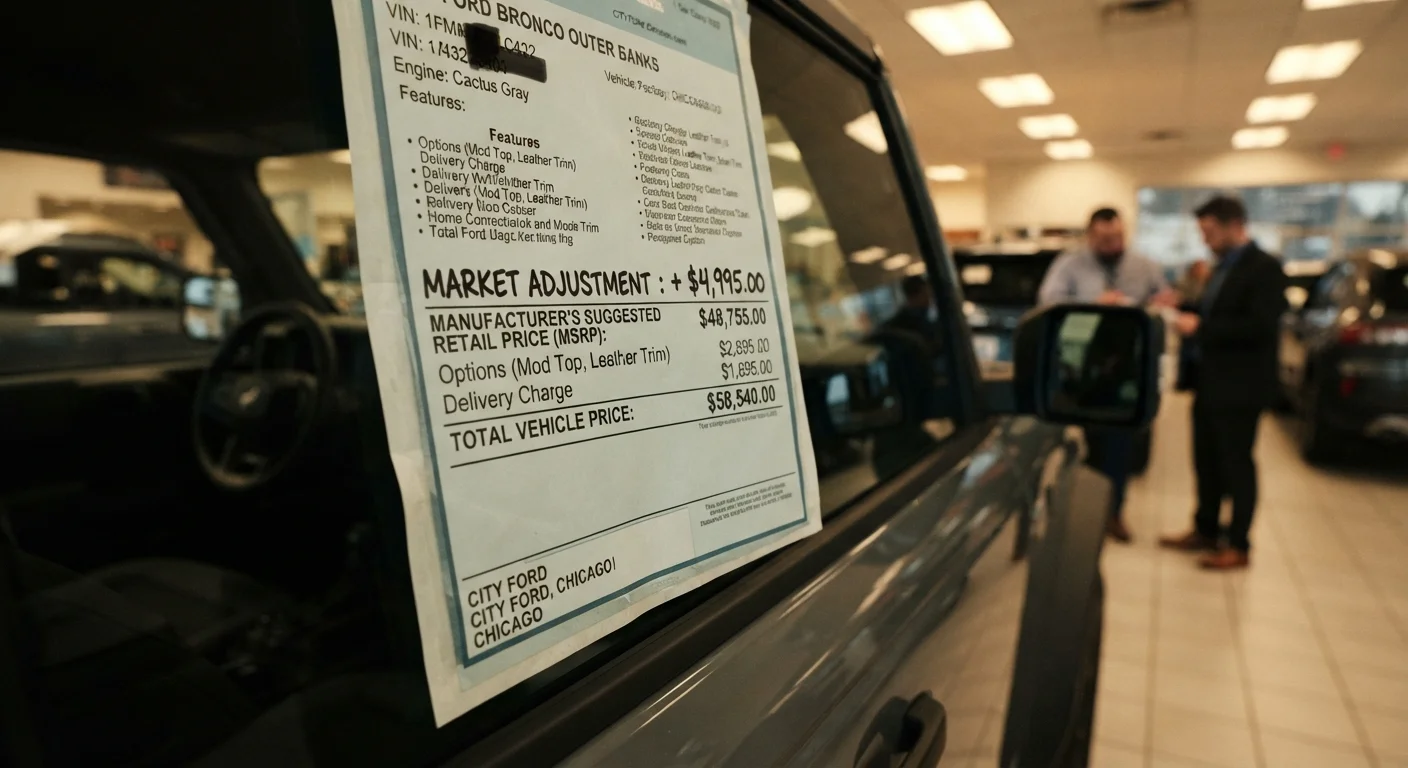
How ADMs End Up on the Window Sticker
Every new vehicle sold in the U.S. carries a factory window sticker — formally the Monroney label — that lists the MSRP set by the manufacturer. That price is a starting suggestion, not a hard cap. When consumer demand outpaces available supply, many dealers attach a second sticker, often called an addendum, that adds a market adjustment line above the MSRP total.
The addendum is the dealer's own document. It may also include dealer-installed accessories or protection packages, but the ADM line is a pure price increase with no corresponding product. Federal law requires the Monroney label to remain on display, but it does not limit what a dealer can charge above that figure. The ADM's dollar amount is set internally — sometimes by a pricing algorithm tied to regional sales data, sometimes by management judgment.
For a fuller glossary of dealership pricing terms — including holdback and doc fees — see our negotiator's pricing glossary.
$1,000–$10,000+
Typical ADM range on high-demand vehicles
Market adjustment fees have ranged from a few hundred dollars to well above MSRP on constrained models, depending on regional demand and inventory levels at the time of sale.
~6–8 weeks
Typical window before ADMs begin to compress
Industry observers have noted that on many models, dealer markups tend to soften within six to eight weeks of initial inventory arriving, as the pool of buyers willing to pay a premium shrinks.
150–200 miles
Recommended search radius to benchmark ADMs
Expanding a vehicle search to dealers within 150–200 miles is a commonly cited strategy for determining whether a local ADM reflects genuine scarcity or just one dealer's pricing choice.
What Actually Drives Market Adjustments
Three conditions reliably produce ADMs: supply disruptions, launch windows for high-demand models, and regional demand imbalances.
- Supply disruptions: Factory shutdowns, component shortages, or shipping delays reduce how many units a dealer receives each month. Fewer vehicles competing for the same buyer pool shifts pricing power toward the seller.
- New model launches: When a redesigned or newly released model generates a waiting list, some dealers see the gap between MSRP and what buyers will pay as margin they would otherwise leave behind.
- Regional demand: A truck or SUV popular in one metro area may sit without an adjustment in a different market. ADMs are local decisions, which is why cross-shopping across a wider geography can surface better prices.
Understanding these drivers matters because they also tell you when adjustments are likely to shrink. As production normalizes or a model's initial excitement fades, ADMs tend to compress — sometimes disappearing entirely within months of a launch.
Evaluating Whether an ADM Is Worth Accepting
The question isn't whether a market adjustment fee is fair in the abstract — it's whether the deal still makes financial sense for you, given your alternatives. A structured evaluation helps.
- Check regional inventory: Search dealer inventory within 150–200 miles. If multiple dealers have the same model at or near MSRP, the ADM at one store is negotiating room, not a market floor.
- Price the total transaction: ADMs compound with other fees. A $3,000 ADM on a vehicle with a high doc fee, financed at a dealer-marked-up interest rate, can add significantly to total cost. Always evaluate out-the-door price, not sticker. See which fees are negotiable for a breakdown.
- Ask how long the vehicle has been in stock: A unit that arrived last week during a hot launch window is less likely to see its ADM budge than one that has been on the lot for 45 days.
- Separate ADM from add-ons: Dealers sometimes bundle accessories into the ADM line or present them separately on the same addendum. Distinguishing genuine add-ons from pure markup is an important step before negotiating.
Get the Quote in Writing Before You Visit
Request an out-the-door price quote by email from at least two dealers before visiting in person. This forces disclosure of any ADM upfront and gives you a documented baseline to reference during any in-person negotiation. Dealers who won't quote in writing are often signaling that their pricing won't survive comparison.
Negotiating an ADM: What Actually Works
ADMs feel immovable because dealers present them as market data, not negotiating positions. In practice, they are both. The leverage buyers have is largely informational — and transportable.
Start by getting written quotes from at least two other dealers on the same trim and configuration. A printout or email showing a lower price at a competing store is more persuasive than any verbal argument about fairness. Dealers track each other's pricing and know when a peer nearby is moving units at MSRP.
If the ADM won't move entirely, consider asking for it to be offset: dealer-installed accessories removed from the addendum, a discounted finance rate if you're financing through the dealer, or a longer included maintenance period. These concessions don't appear on the MSRP line but reduce what you're actually paying.
For a broader framework on dealership negotiation tactics, including how to sequence offers and when to walk, our negotiation hub covers the full process. And if you're reviewing an offer that includes manufacturer discounts, check what dealer incentives don't reveal about total cost before signing.