
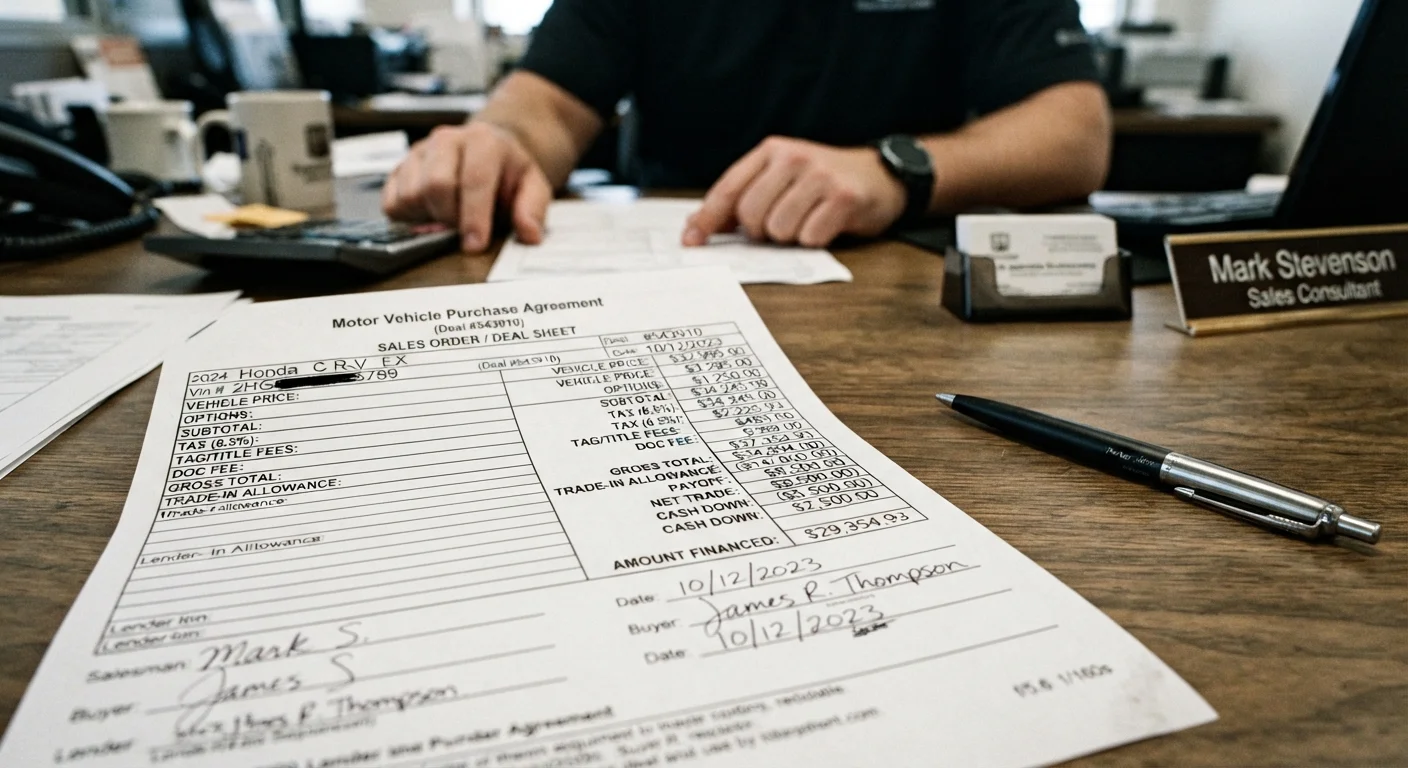
Why the Deal Sheet Deserves Your Full Attention
The buyer's order — sometimes called a worksheet or deal sheet — is the document that translates a verbal negotiation into binding numbers. It typically arrives as a dense, multi-line page full of codes, fees, and figures that many buyers scan rather than read. That habit is costly.
Each line on the sheet represents either money leaving your pocket or a product you may or may not need. The deal sheet is also the foundation for the formal retail installment contract you sign in the finance office, so errors or additions made here carry forward. For context on how dealership pricing structures work before you even reach this document, dealership negotiation decoded walks through what happens on the other side of the desk.
Request a Worksheet Before the Finance Office
Ask the sales manager for a buyer's order or deal worksheet before you move to the finance and insurance (F&I) office. Reviewing figures at the sales desk — where pressure is lower — gives you time to identify line items worth questioning. You are entitled to see every number before signing anything.
The sections below walk through each major block of a deal sheet and what to look for — starting with the tools you should bring.
What you will need
What the Numbers Mean, and How to Verify Them
A standard deal sheet flows in a logical sequence: vehicle price → fees → taxes → trade-in credit → F&I products → financing terms → total. Understanding that sequence makes the document far less intimidating.
Buyer's Order / Deal Worksheet
The primary document listing vehicle price, fees, taxes, and financing terms — the core of what you are reviewing.
Pre-Approved Loan Offer
A financing offer from your own bank or credit union to benchmark the dealer's interest rate against.
Calculator
Verify that monthly payment figures match the quoted principal, rate, and term independently.
Rebate and Incentive Documentation
Manufacturer rebate offers or dealer incentive printouts to confirm they are applied correctly on the sheet.
Follow the steps below to move through each section methodically. If you want to go deeper on how your payment divides between principal and interest over time, reading an amortization schedule explains the mechanics clearly.
Locate the Vehicle Price Line and Verify It
Find the line labeled selling price, capitalized cost, or agreed price. This should match the number you negotiated — not the MSRP unless you accepted sticker price. Confirm any manufacturer rebates are subtracted here or shown as a separate credit line, reducing the amount financed.
Identify and Scrutinize All Fees
Below the vehicle price you will typically see a block of fees. Common legitimate fees include documentation fee (doc fee), destination and delivery, and title and registration charges. Watch for vague entries like "dealer prep," "market adjustment," or "administrative fee" — these are dealer-generated and often negotiable. Ask what each line covers; a clear answer should be immediate.
Confirm Taxes Are Calculated on the Correct Base
Sales tax is calculated on the taxable selling price, which in most states means after manufacturer rebates are applied but before dealer fees. Verify the tax base on the sheet matches this structure. Errors — intentional or accidental — in the tax base can quietly add money to your total.
Review the F&I Add-On Section Line by Line
The finance and insurance (F&I) section lists optional products: extended service contracts, gap coverage, tire-and-wheel protection, paint sealant, and similar items. Each has its own cost, often rolled into the financed amount so the monthly impact looks small. Assess each product independently on its own merits — not as part of a bundled monthly payment. Decline anything you did not specifically request.
Check the Financing Terms Against Your Pre-Approval
Locate the annual percentage rate (APR), loan term (in months), and amount financed. The APR on the dealer's offer should be competitive with your pre-approved rate. Dealers are permitted to mark up the interest rate above what a lender offers — often called a "dealer reserve" — so your pre-approval is leverage. For a deeper explanation of how loan mechanics work, see Auto Loans Explained.
Confirm the Out-of-Door Total
The out-of-door price (sometimes called the "drive-off" or "total amount due") is the final sum of vehicle price, fees, taxes, and any financed add-ons. This is the number that matters most. Request it in writing before signing anything. Confirm it aligns with your own arithmetic across all prior lines. Then review what to verify before you sign to complete your final check.
Add-Ons Can Inflate Costs Silently
Items like paint protection, gap insurance, extended warranties, and tire-and-wheel coverage are often pre-printed on deal sheets as if standard. Each is optional unless your financing requires it. Ask for a revised sheet with any unwanted items removed before continuing.
Never Evaluate a Deal by Monthly Payment Alone
Dealers can manipulate monthly payments by stretching loan terms or layering in extras — making an expensive deal look affordable. Always anchor your evaluation to the total vehicle price and the total amount financed. A lower monthly payment paired with a longer term can cost thousands more overall.
When you have verified every line, compare the deal sheet figures against any vehicle valuation data you gathered during your research. Reading a valuation report can help you contextualize whether the selling price reflects actual market value. For broader negotiation strategy, the dealership negotiation hub covers the full picture.
This article is for general informational purposes only and does not constitute financial, legal, or tax advice. Fees, tax rules, and regulations vary by state and by dealership. Consult a qualified professional for guidance specific to your situation.