
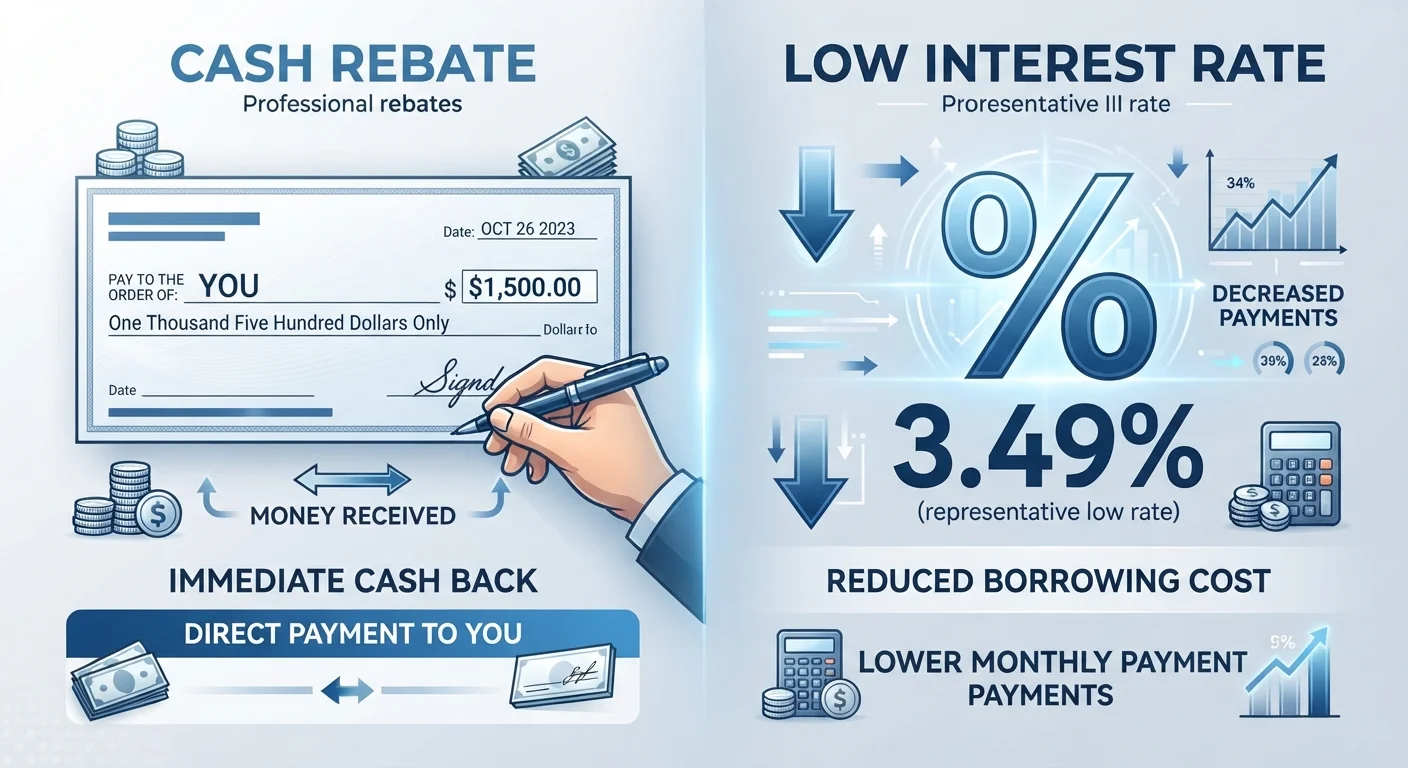
Why You Typically Can't Have Both
Manufacturer incentives are structured as either/or choices. The automaker — through its captive financing arm — sets aside a pool of subsidy money per vehicle. That subsidy can fund a below-market interest rate or a cash rebate, but financing the rate reduction and handing you a check at the same time would double the cost. Dealers are contractually bound by these program rules, so the choice lands entirely with you.
Understanding this constraint is foundational. Many buyers walk in hoping to stack deals and are surprised when told they must choose. For a deeper look at how these programs are structured, see how manufacturer incentives are built.
Regional and Model-Level Variation
Incentive programs differ by ZIP code, vehicle trim, and even dealer allocation. The rebate available in one metro market may not match what's offered 50 miles away. Always verify the current program directly on the manufacturer's website or through an official dealer quote before doing your calculations.
How to Run the Numbers
The only reliable comparison is total interest paid under each scenario — not monthly payments. Here's the framework:
- Rebate path: Subtract the rebate from the negotiated price. Finance the reduced amount at your best outside rate (check your bank or credit union first). Calculate total interest over your chosen term.
- Low-APR path: Finance the full negotiated price at the promotional rate for the same term. Calculate total interest.
- Compare the two totals. The option with the lower combined cost (price paid + interest paid) wins.
Example: On a $35,000 vehicle with a $2,500 rebate versus 1.9% APR financing over 60 months — if your outside rate is 6.5%, the rebate path would cost roughly $5,800 in interest on $32,500 financed. The 1.9% APR path costs roughly $1,730 in interest on $35,000. The low-APR option saves about $1,570 in this scenario, even though the loan starts $2,500 higher. Flip the outside rate to 4.5% and the rebate path starts closing the gap fast.
For a granular look at how rate differences translate to real dollars, see what a lower rate is actually worth. And to understand how term length amplifies or dampens these effects, how loan terms shape what you really pay covers the mechanics clearly.
| Criterion | Cash Rebate | Low-APR Financing |
|---|---|---|
| Immediate price reduction | Yes — lowers amount financed | No — full price is financed |
| Interest cost | Depends on your outside rate | Fixed at subsidised rate |
| Credit score requirement | None — available to all buyers | Usually 720+ for advertised rate |
| Best with short loan term | Yes — interest savings are minimal | Less beneficial — less time to save |
| Best with long loan term | Only if outside rate is competitive | Yes — maximises interest savings |
| Flexibility of lender | Use any lender you choose | Must use captive/manufacturer lender |
| Stackable with other discounts | Often yes (e.g. loyalty, military) | Fewer stacking options typically |
Credit Score: The Hidden Qualifier
Promotional APR offers — especially the eye-catching 0% deals — are typically reserved for buyers whose credit profiles meet the lender's top tier, often a FICO score of 720 or higher. Captive lenders (the financing arms owned by automakers) use tiered pricing, and buyers in lower tiers may be offered a rate several percentage points above the advertised figure.
If you're quoted a rate higher than advertised, the rebate is almost certainly the better path. Before you visit a dealership, pull your credit report and get a pre-approval from your bank or credit union — this gives you both a rate benchmark and negotiating leverage. See why APR and interest rate aren't the same number to make sure you're comparing the right figures.
720+
Typical minimum credit score for promotional APR
Captive lenders generally reserve their lowest advertised rates for top-tier borrowers; buyers below this threshold are often quoted higher rates.
60 months
Most common new-car loan term in the U.S.
Federal Reserve consumer credit data consistently shows 60-month terms as the most prevalent, making term-length assumptions central to any rebate-vs-rate calculation.
$1,000–$5,000
Typical cash rebate range on new vehicles
Rebate amounts vary widely by manufacturer, model segment, and market conditions; high-inventory models often carry the largest rebates.
It's also worth checking whether your outside lender's rate could be improved after the fact. refinancing an existing auto loan explains when that move genuinely helps versus when it costs more than it saves.
Timing and Negotiation Context
Incentive programs reset monthly and vary by region, model, and trim level. A $3,000 rebate in one month may drop to $1,500 the next — or the manufacturer may switch to a low-APR promotion entirely. Checking current programs directly on the manufacturer's consumer website gives you the authoritative figure before any dealer conversation.
One practical note: negotiate the vehicle price before declaring which incentive you'll take. The rebate or APR choice is a financing decision made after price is settled. Dealers sometimes blur these steps, so keeping them separate preserves your leverage. For a broader view of financing channels and how dealer-arranged loans compare to outside options, dealer financing vs. bank or credit union loans walks through the trade-offs clearly. And for a structured approach to the full financing decision, the Financing Strategies hub covers down payments, trade-ins, and loan timing in one place.
This article provides general financial education and is not personalised financial or lending advice. Rates, incentive amounts, and credit requirements vary by lender, region, and time. Consult a qualified financial professional regarding decisions specific to your circumstances.