
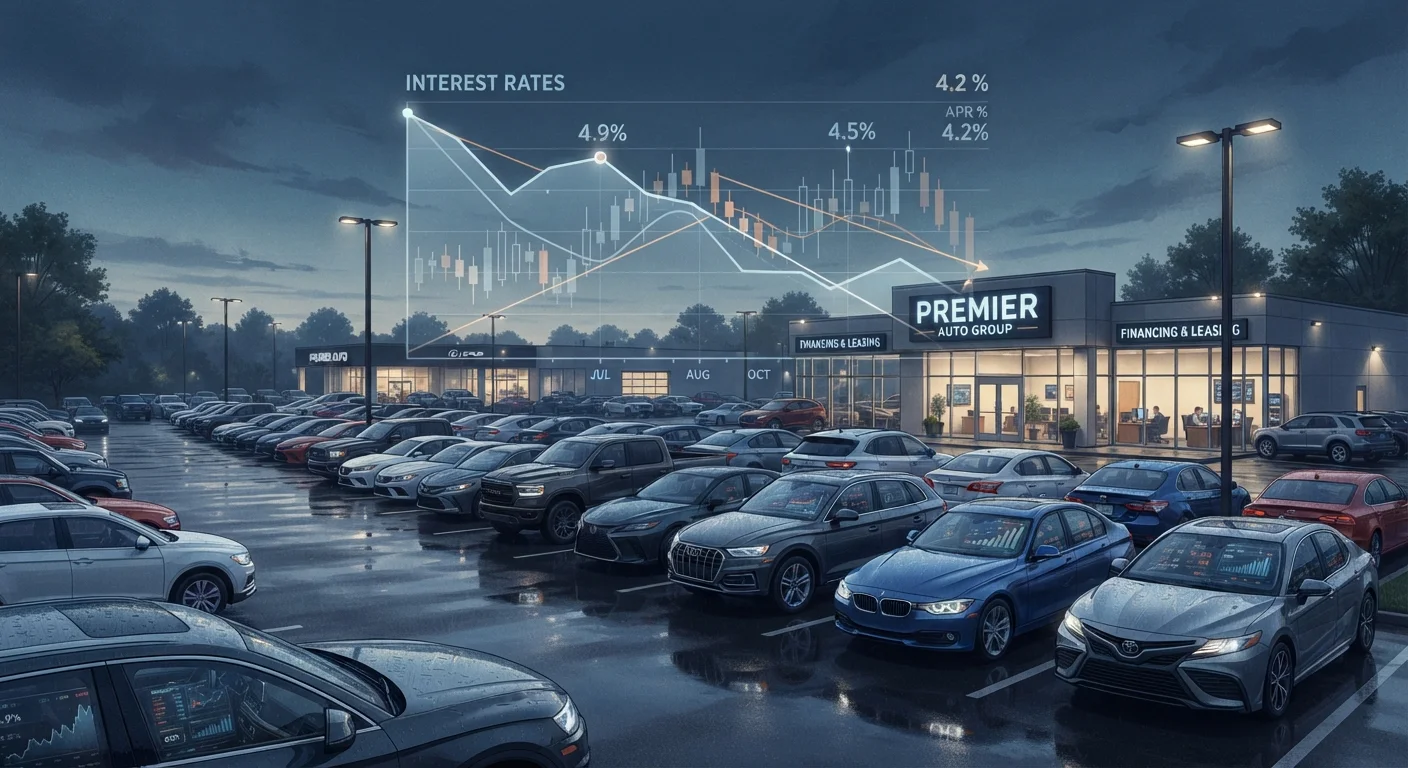
How Rate Cycles Work and Why They Matter for Car Buyers
Auto loan APRs do not move in isolation. They follow a broader pattern tied to monetary policy, inflation expectations, and lender competition. When the Federal Reserve raises its benchmark rate to cool inflation, lenders' cost of capital rises — and that cost passes through to borrowers as higher loan APRs. The reverse occurs when the Fed eases policy to stimulate the economy.
For a car buyer, this creates real dollar consequences. The difference between a 5% and a 7% APR on a $30,000, 60-month loan is roughly $1,600 in additional interest paid over the life of that loan. Understanding where rates stand — and where they may be heading based on publicly available economic signals — gives buyers context for structuring their financing approach.
See the Rates & Payments hub for a deeper look at how APR and monthly payments are calculated and compared across different loan structures.
~$1,600
Extra interest on a $30,000 loan at 7% vs. 5% over 60 months
Calculated using standard loan amortization on a fixed-rate, 60-month auto loan with no down payment applied.
72+ months
Average new car loan term length in recent years
Extended loan terms have become increasingly common in U.S. auto financing, amplifying the total interest cost of higher APRs.
1–3%
Typical APR spread between credit tiers
Lenders commonly apply meaningfully different APRs based on borrower credit tier, making credit profile a major determinant of actual loan cost.
The Hidden Trade-Off: Rates vs. Vehicle Prices
A common mistake is treating rate timing as the only variable worth optimizing. In practice, vehicle prices and interest rates don't always move in the same direction. During periods of rising rates, demand for new vehicles sometimes softens, which can push transaction prices lower. Conversely, a rate-cutting cycle may coincide with rising vehicle prices as demand picks up.
This means the "ideal" financing window is not simply when rates are lowest — it's when the combined cost of the vehicle price and financing terms is most favorable. Market conditions affect new and used prices differently, and understanding that interaction prevents buyers from over-indexing on one factor.
Calculate Total Cost, Not Just Monthly Payment
Before signing any financing agreement, multiply your monthly payment by the number of payments and add any fees to find the total amount you'll pay. Compare this figure across different rate and term combinations. A lower monthly payment can easily mask a significantly higher total cost if it comes with a longer loan term.
Practical Strategies for Any Rate Environment
Rather than waiting passively for a rate cycle to turn, buyers can use several structural levers to reduce financing costs regardless of where rates stand.
- Increase your down payment. Reducing the loan principal directly limits how much interest a higher rate can accumulate. A 20% down payment on a $30,000 vehicle cuts the financed amount to $24,000 — a meaningful difference over a 60-month term.
- Shorten the loan term. Longer terms lower monthly payments but substantially increase total interest paid. A 48-month loan at 7% costs less in total interest than a 72-month loan at the same rate, even though the monthly payment is higher. Loan terms shape what you really pay in ways that aren't always obvious at signing.
- Strengthen your credit profile before applying. Your credit score directly affects your loan rate — sometimes more than the prevailing rate environment. Paying down revolving balances and correcting credit report errors before applying can move you into a more favorable rate tier.
- Consider refinancing as a follow-up strategy. If you purchase during a high-rate environment, plan for a possible refinance once rates ease. Most auto loans can be refinanced without penalty, and even a 1–1.5% reduction in APR can generate meaningful savings mid-loan.
For a comprehensive view of every financing lever available to buyers, the Auto Financing Strategies buyer's framework walks through down payments, loan timing, and lender comparison in full detail.
Fixed vs. Variable Rates: A Rate-Cycle Consideration
Most auto loans in the U.S. carry fixed interest rates, meaning your APR is locked at origination and doesn't change over the loan term. This provides predictability but also means you don't benefit automatically if rates fall after you close. Variable-rate auto loans exist but are far less common in consumer auto financing.
Understanding the distinction matters when evaluating loan offers. Fixed vs. variable rate auto loans explains how each structure behaves and what to weigh before committing. In a declining rate environment, a fixed rate locks in today's cost — which may be worth it for budget certainty even if rates drop modestly later.
Refinancing Requires a New Application
Refinancing an auto loan means applying for a new loan with a different lender (or your current lender) to pay off the existing balance. Your credit will be checked again, and approval depends on your credit profile at that time, the vehicle's remaining value, and lender policies. It's worth planning for this possibility but not assuming it will be available on favorable terms when needed.
This article is for general informational and educational purposes only and does not constitute personalized financial or lending advice. Loan rates, terms, and eligibility depend on individual circumstances and lender policies. Consult a qualified financial professional before making borrowing decisions.